


You look down at your newborn, and something feels off. The head looks uneven. One side is flatter. The back does not look quite right. Your stomach drops a little.
Before you spiral, here is something that might help. Nearly half of all babies born in the U.S. have some form of uneven head shape. Most cases are harmless. Many sort themselves out. But some do need a closer look.
Knowing the difference is exactly what this guide is for.
We cover what a normal baby head shape looks like, what causes things to shift, which warning signs actually matter, and when babies’ head shapes are something to genuinely worry about.
What Does a Normal Baby’s Head Shape Look Like?
A healthy baby’s head looks oval, like an egg, when seen from above. It is roughly one-third longer than it is wide. Both sides should mirror each other. The back of the head is curved, not flat.
Both ears sit at the same level and at the same distance from the front and back of the head. The forehead looks even from left to right.
Two soft spots, called fontanelles, sit at the top and near the back of the head. These are completely normal and close over time as the skull matures.
Types of Abnormal Baby Head Shapes
Not every uneven head looks the same. The shape itself can tell you a lot about what is going on and what step to consider next.
| Head Shape Type | What It Looks Like | Common Cause |
|---|---|---|
| Plagiocephaly | Flat on one side of the back. Ear shifted forward. The head looks like a parallelogram in the diagram above. | Lying in one position too long |
| Brachycephaly | Flat across the entire back. The head appears wider than normal from the front. | Back sleeping without position changes |
| Scaphocephaly | Long and narrow from front to back. Head looks stretched. | Premature birth or early suture closure |
| Craniosynostosis | Hard ridge along a suture line. Shape gets worse over time, not better. | Skull bones fuse too early |
When to Worry About Your Baby’s Head Shape?

Some head shapes need time. Others need action. Here is a simple way to tell which situation you are in.
Signs you can wait and watch:
- The head is still changing in the first two weeks after birth: This is normal molding from the birth process and usually settles on its own.
- Mild flatness softens with position changes: If moving the baby around brings visible improvement, that is a positive sign.
- Both soft spots are still open and soft: Open fontanelles mean the skull is growing as it should be.
- Baby is feeding, sleeping, and gaining weight normally: These are signs that overall development is on track.
- Flat spot improves as the baby gets more active: Sitting and crawling naturally take pressure off the skull.
Signs to call the doctor:
- The head is still very uneven two or more weeks after birth: This is worth raising with your pediatrician sooner rather than later.
- A hard ridge along a suture line on the skull can be a sign of early bone fusion and requires professional review.
- Baby always turns the head to only one side: This may point to tight neck muscles, a condition called torticollis.
- A soft spot closes earlier than expected: Early closure can signal craniosynostosis and should not be ignored.
- Eyes, ears, or facial features look noticeably uneven: This level of asymmetry needs to be checked by a doctor.
- Head shape is not improving by four to five months of age: This is the window when treatment works best, so do not wait past this point.
What Causes an Uneven Baby Head Shape?

There is rarely a single reason for an uneven baby’s head shape. Most of the time, it comes down to one or more of the following factors.
- Back sleeping: Babies sleep on their backs to reduce the risk of SIDS, but this puts steady pressure on the back of the skull for many hours each day.
- Torticollis: Tight neck muscles on one side force the baby to keep the head turned one way, pressing the same spot against the surface repeatedly.
- Womb pressure: Twins or babies in a tight womb position face pressure on the skull even before birth.
- Premature birth: Preemie skulls are softer than full-term skulls, and NICU care often means long stretches in one fixed position.
- Forceps or vacuum delivery: These tools apply pressure during birth and can leave temporary shape changes that may linger for a few weeks.
- Too much time in baby gear: Car seats, bouncers, swings, and strollers hold the head in one spot and add steady pressure over time.
How to Check Your Baby’s Head Shape at Home
You do not need a clinic visit to get a basic sense of what is going on. A few simple steps at home can give you a useful starting point before you speak with your doctor.
Step 1: Get the right view: Lay your baby in your lap and look straight down at the top of the head. Wet the hair slightly first. Flat spots and shape differences show up much more clearly on a wet head than a dry one. A lot of parents miss mild issues simply because of dry hair.
Step 2: Check for symmetry: The head should look oval from above. Trace an imaginary line down the middle. Both halves should match. If one side looks pushed forward or noticeably flatter than the other, note which side and how visible the difference is.
Step 3: Look at the ears: Both ears should sit at the same height. They should also be at the same distance from the front and back of the head. An ear that sits further forward than the other is one of the clearest signs of plagiocephaly and is worth mentioning to your pediatrician.
Step 4: Check the forehead: Look at the forehead from the front. Both sides should be level. If one side pushes out more than the other, that often goes along with a flat spot on the opposite side of the back of the head.
Step 5: Feel along the suture lines: Gently run a finger along the natural ridges of the skull. The surface should feel smooth. A hard, raised ridge running along a seam line is not normal and should be flagged to your doctor as soon as possible.
How to Fix Baby Head Shape: Home Methods That Work
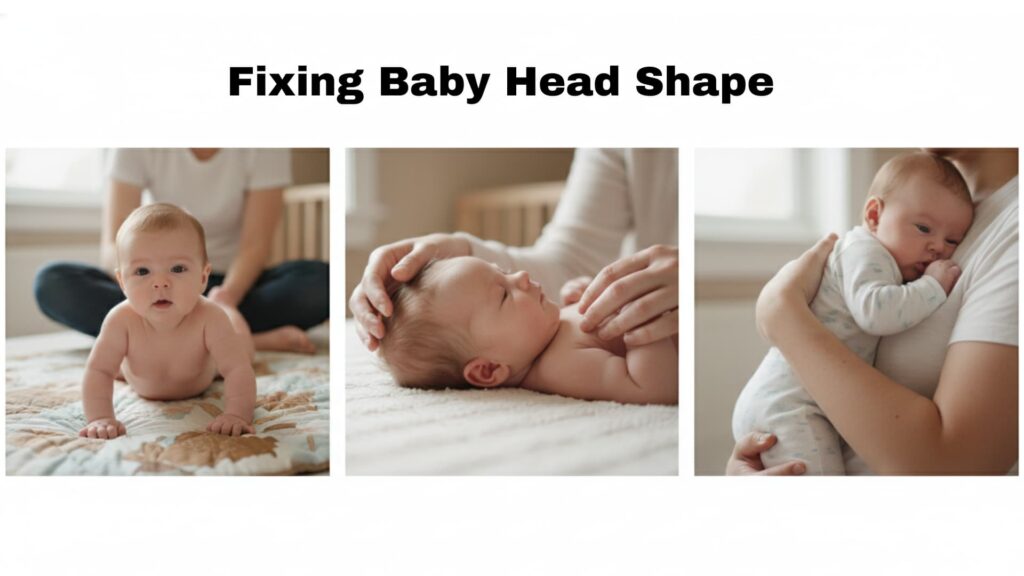
The good news is that most flat head cases in babies respond well to simple changes at home. The earlier you start, the better the results tend to be.
1. Repositioning
When your baby is awake, gently turn the head toward the non-flat side. Alternate which end of the crib the head points toward on different nights.
Hold your baby more often during the day. Time in your arms completely removes pressure from the skull, and it costs nothing.
2. Tummy Time
The American Academy of Pediatrics recommends tummy time two to three times a day. Start with three to five minutes per session and build up as your baby gets stronger.
Always do it when your baby is awake, and an adult is present. Use a toy or your own face to encourage the baby to lift and turn the head. For babies under four months, tummy time paired with repositioning can often correct mild flat spots on its own.
3. Reducing Time in Baby Devices
Car seats, swings, bouncers, and strollers are useful tools, but they keep the head in one fixed spot for extended periods. When your baby is awake and safe, limit time in these items.
Check the head position while your baby is in them and adjust as needed. Every minute spent offa flat surface gives the skull more room to grow evenly.
When Does a Baby’s Head Shape Become Permanent?
A baby’s skull is at its softest and most changeable in the first six months. It starts to firm up between six and nine months. By 18 to 24 months, the shape is mostly set.
Skull plates fully close over the soft spots at around 26 months. Mild flat spots often become barely visible by age one to two, especially as hair grows in and the child becomes more active.
More severe cases may keep some lasting flattening. This is exactly why acting before six months gives the best chance at full correction.
When Do Doctors Recommend a Helmet?
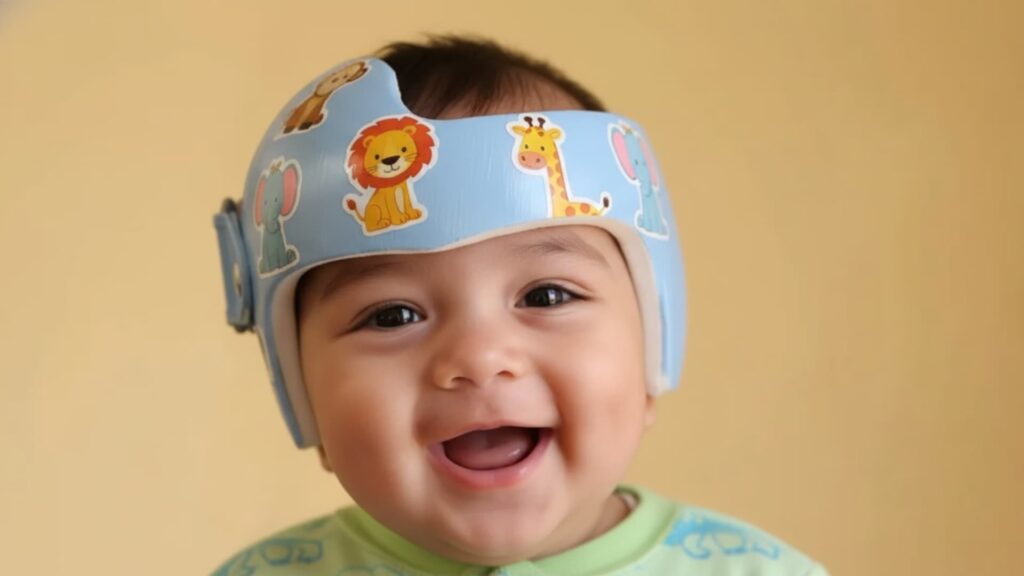
Repositioning and tummy time handle most mild cases well. But when a flat spot is moderate to severe, or not improving after several weeks of effort, a cranial helmet may be the right next step.
| Factor | Details |
|---|---|
| Who needs it | Babies with moderate to severe flat spots that do not respond to repositioning |
| Best age to start | 3 to 6 months |
| How it works | A custom-fitted device that takes pressure off flat areas and guides skull growth toward them |
| Hours worn daily | Up to 23 hours a day |
| Average treatment time | 3 to 6 months |
| Upper age limit | Up to 18 months, though results take longer after 12 months |
| Is it painful | No. The baby should not feel any pain or discomfort from wearing it |
What Happens If Flat Head Goes Untreated?
For mild cases of positional flat head, the outlook is generally good even without formal treatment.
As the baby becomes more mobile, sits up, and crawls, pressure reduces naturally, and the head often rounds out on its own. Most mild cases are barely noticeable by age one to two.
Severe cases that go untreated may result in some lasting flattening. This does not affect brain function or development for positional flat head. Craniosynostosis is different.
If that condition goes untreated, the brain may not have enough space to grow, and developmental delays can follow. Early diagnosis and care for craniosynostosis significantly improve outcomes.
Conclusion
Most of the time, an uneven baby head shape is just part of being a newborn. The skull is soft. The brain is growing fast. And the body is doing exactly what it is supposed to do.
But knowing when to observe and when to act makes all the difference. Simple steps like repositioning and tummy time can make a big difference in the early months. And if something feels off, trust that feeling. Bring it up at your next well-child visit.
The question of when to worry about a baby’s head shape is a question every new parent asks at some point. Now you have real answers to work with. The earlier you raise a concern, the more options you and your doctor have.
Still have a question about your baby’s head shape? Drop it in the comments below. We read every single one.