

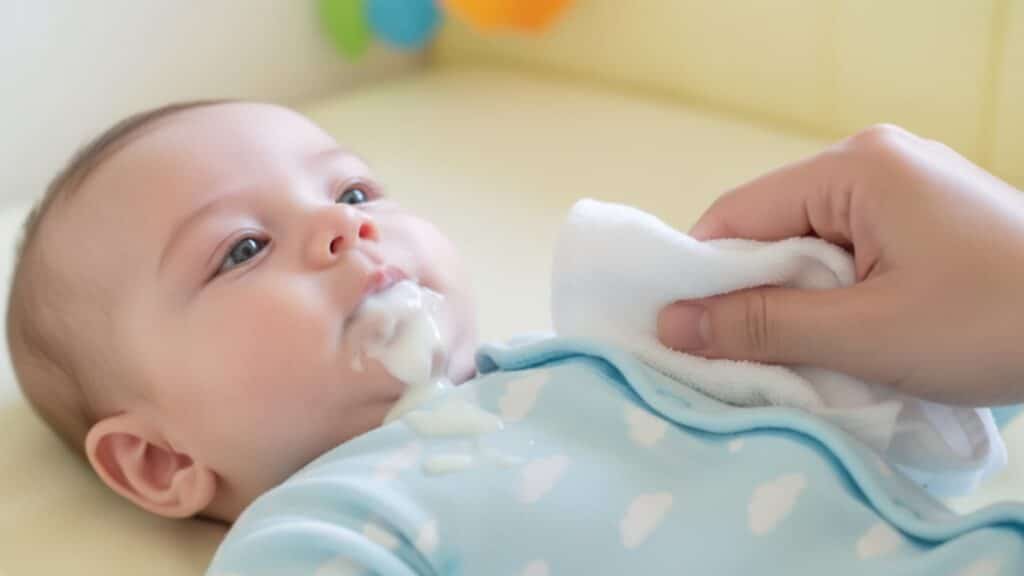
You just fed your baby. You burped them. You waited the full 30 minutes. And still, spit up. Everywhere.
Every new parent has lived this moment. The burp cloths pile up. The washing machine runs on a loop. And at some point, you stop being surprised and start wondering when it actually stops.
Here is the good news. In most cases, it is completely normal. Babies are built this way. Their tiny stomachs fill fast, and the muscle that keeps food down is still learning to do its job.
This guide walks you through when babies stop spitting up, what causes it, warning signs to watch for, and simple steps to help your baby feel better.
Why Do Babies Spit Up?
There is a small but important muscle between your baby’s esophagus and stomach called the lower esophageal sphincter. In adults, this muscle stays tight and keeps food down.
In newborns, it is still developing and tends to relax too easily. When a baby’s stomach fills up, milk flows right back up.
A newborn’s stomach is also tiny, roughly the size of their own fist, so it fills quickly and overflows easily. As this muscle matures over the coming months, spit-up slows down and eventually stops on its own.
When Do Babies Stop Spitting Up? Month-by-Month
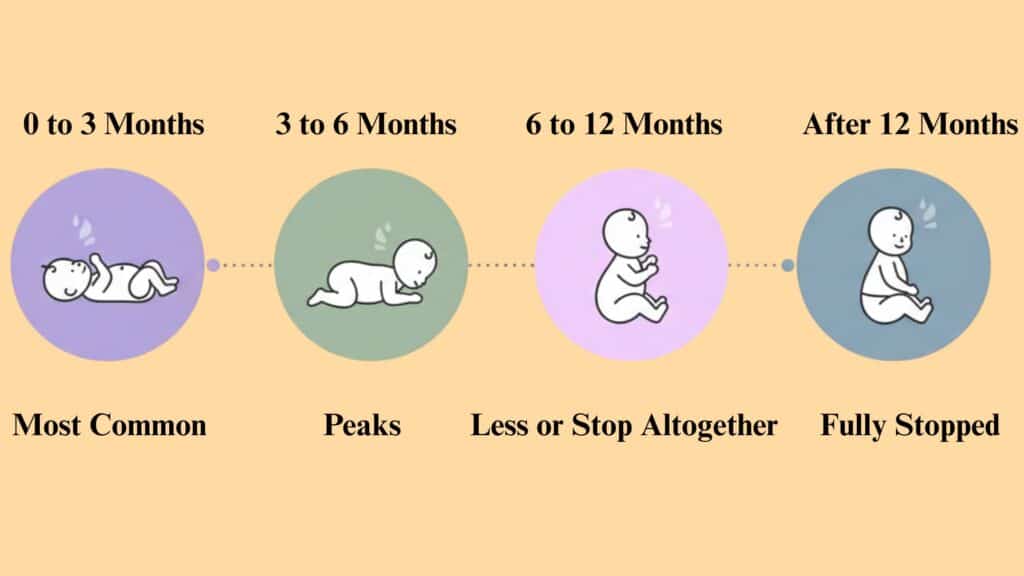
The burp cloths do not last forever. Most babies follow a clear pattern as they grow, and knowing what to expect at each stage makes the wait a little easier.
0 to 3 Months
Spitting up is most common during this stage. About half of all newborns spit up regularly in the first three months. The sphincter muscle is at its weakest, and their stomachs are still very small.
Some babies even pass amniotic fluid they swallowed before birth in the very first days. This is normal and clears up quickly on its own.
3 to 6 Months
Spitting up usually peaks around the 4-month mark. After that, things start to improve. The esophageal muscles begin to coordinate better, and many babies start spitting up less often.
Babies also start gaining more head and neck control, which helps keep milk down.
6 to 12 Months
By 6 months, most babies spit up much less or stop altogether. Starting solid foods helps keep things in the stomach. Spending more time sitting upright also makes a real difference.
Most babies stop spitting up entirely during this window.
After 12 Months
Most babies have fully stopped by their first birthday. If your baby is still spitting up past 12 months, especially with signs like weight loss, pain, or refusing to feed, that is worth a conversation with your pediatrician.
What Is a “Happy Spitter”? How to Know If Your Baby Is One
Some babies spit up after every single feeding. And yet they coo, kick their legs, and seem completely unbothered by it. Pediatricians have a name for these babies: happy spitters.
A happy spitter is a baby who spits up often but is growing well, feeding normally, and showing no signs of pain or discomfort. The spit up is messy. But it is not hurting them.
Your baby is likely a happy spitter if they:
- Gain at least 6 ounces per week in the early months
- Have at least 6 wet diapers every day
- Feed well without crying or arching their back
- Seems calm and settled after feeding
- Spit up that looks like milk, not bile or blood
If this sounds like your baby, no medical treatment is needed. Just a good stock of burp cloths and a little patience.
Baby Spit Up vs. Vomiting: How to Tell the Difference
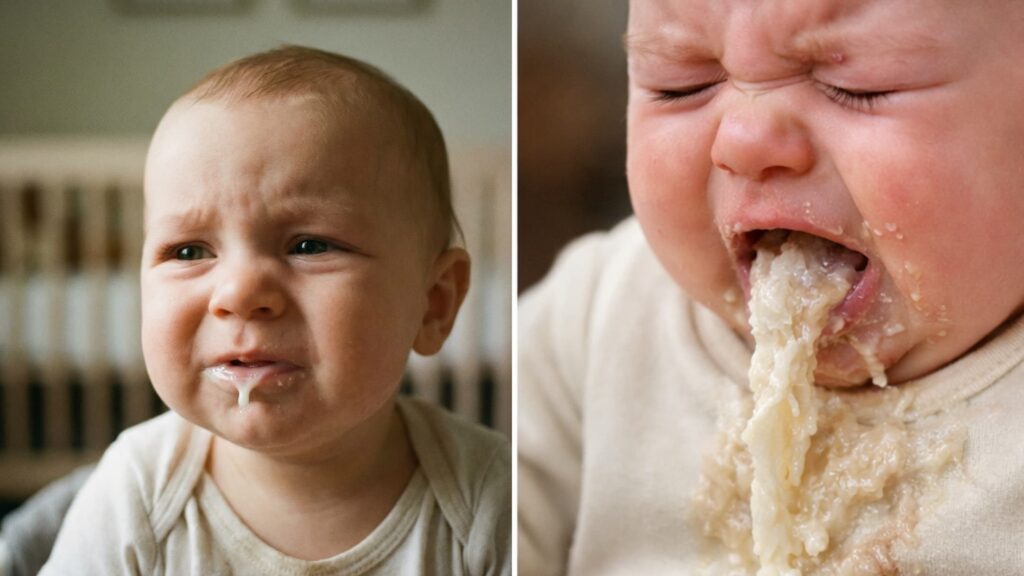
It can be hard to tell the two apart in the moment. But once you know what to look for, the difference becomes much clearer.
| Difference | Spit Up | Vomiting |
|---|---|---|
| How it comes out | Gentle, easy flow | Forceful, shoots out |
| Amount | Small, 1 to 2 tablespoons | Larger amounts |
| When it happens | Often during or after a burp | Can happen at any time |
| Baby’s reaction | Baby seems unbothered | The baby may cry or look upset |
| Smell | Mild, slightly sour | Often stronger, unpleasant |
| Color | White or off-white milk | May be yellow, green, or have blood |
How Much Spit Up Is Too Much?
One to two tablespoons per spit-up is considered normal; less than one ounce is not. It almost always looks like more because it spreads so far on a cloth or your clothes.
Spitting up after every feeding is common in healthy babies, as long as they are gaining weight and seem comfortable.
If your baby is regularly bringing up large amounts, spitting up with force, or seems in pain, speak with your pediatrician.
What Causes a Baby to Spit Up a Lot?
Most of the time, spit up has a clear cause. Here are the most common reasons babies spit up more than usual.
- Immature digestive system: The lower esophageal sphincter has not fully developed, so food can flow back easily.
- Overfeeding: Too much milk at once overfills a tiny stomach, and the extra comes right back out.
- Aerophagia (swallowing too much air): Air bubbles rise in the stomach and bring milk up with them when the baby burps.
- Overstimulation: Bouncing or active play right after a feeding can put pressure on a full stomach, pushing milk back up.
- Forceful let-down during breastfeeding: When milk flows too quickly, babies gulp and swallow extra air, which can lead to increased spit-up.
- Formula type or breastfeeding diet: Some babies react to certain formulas or proteins in the mother’s diet with more spit-up.
- Teething, colds, or constipation: These can temporarily increase spit-up by increasing saliva, causing mouth breathing, or increasing abdominal pressure.
- Infant reflux (GER): The normal type of reflux that almost all babies have to some degree. It goes away on its own.
| When Should You Call the Pediatrician?
Call your pediatrician if your baby spits up with force, is not gaining weight, seems to be in pain during or after feedings, has green or yellow spit up, blood in their spit up or stool, or has fewer wet diapers than normal. These are signs that something may need attention beyond normal spit-up. When in doubt, always call. No concern is too small. |
Medical Conditions Linked to Excessive Spitting Up
Most spit-up is harmless and passes with time. But sometimes, frequent or forceful spit up is the body’s way of signaling something that needs a closer look. Here are three conditions that can cause spit-up to go beyond the normal range.
GERD in Babies
GERD stands for gastroesophageal reflux disease. It is different from normal GER, which almost all babies have. With GERD, reflux causes real discomfort and starts to affect feeding and growth.
- When it peaks: Around 4 to 6 months of age
- When it usually clears: Between 12 and 18 months in most babies
- Signs to watch for: Crying during feedings, arching the back, refusing to eat, poor weight gain, and frequent choking or gagging
- How it is managed: Feeding adjustments and positioning changes are tried first. In more serious cases, a pediatrician may prescribe medication.
- Worth knowing: Long-term use of acid-blocking medication in babies carries risks, including a higher chance of pneumonia and intestinal infections. Never start or continue medication without your pediatrician’s guidance.
Pyloric Stenosis
Pyloric stenosis happens when the valve between the stomach and the small intestine becomes too thick and narrow. Food cannot move forward the way it should, so it gets pushed back out with force.
- How it looks: Projectile vomiting after every feeding — milk shoots out rather than flowing gently
- Who it affects: More common in boys, and it usually shows up in the first few weeks of life
- What to do: This needs urgent medical attention. It does not go away on its own. Surgery is typically required to correct it.
If your baby’s spit-up suddenly becomes forceful and happens after every single feeding, call your doctor right away.
Cow Milk Protein Intolerance (CMPI)
Some babies cannot handle the proteins found in standard cow’s milk or soy-based formula. This is called Cow Milk Protein Intolerance, or CMPI. It affects around 5% of babies and is more common than most parents realize.
- Signs to watch for: Excessive spit up, loose or watery stools, belly discomfort, and ongoing irritability
- For formula-fed babies: A pediatrician may suggest switching to a hypoallergenic formula for one to two weeks to see if things improve
- For breastfed babies: The mother may need to remove dairy and soy from her own diet, since those proteins can pass through breast milk
- Important: Always speak with your pediatrician before switching formulas or making diet changes. Do not make this call on your own.
Does Spitting Up Affect a Baby’s Weight and Growth?
In most cases, it does not. Spit-up looks like a lot, but it is usually just 1 to 2 tablespoons. Most of the milk stays down and gets digested.
If your baby is gaining weight steadily, feeding well, and producing enough wet diapers, spit-up is not hurting their growth.
Concerns come up only when spit-up is so frequent or large in volume that the baby cannot keep enough milk down to grow. Your pediatrician tracks weight at every visit.
If growth is on track, you do not need to worry.
Final Thoughts
Most babies stop spitting up between 6 and 12 months. Spit-up peaks around 4 months, then improves as their muscles grow stronger, solid foods begin, and they spend more time upright.
It is rarely a sign of something serious.
If your baby is growing, feeding well, and seems comfortable after meals, you have a happy spitter on your hands. The burp cloths are not a permanent fixture in your life, even if it feels that way right now.
That said, you know your baby better than anyone. If something feels off, do not wait. Call your pediatrician. No question is too small when it comes to your child.
Have a tip that helped your baby spit up less? Share it in the comments below. Other parents will thank you for it.