

Welcome to our blog about objects beginning with L. This alphabetical journey showcases diverse items, each with significance and utility.
From everyday essentials to specialized tools, our blog will cover a fantastic collection that enhances our understanding of language and culture.
Whether you’re here to expand your vocabulary, discover new objects, or simply satisfy your curiosity, this list promises a fascinating glimpse into a world of varied “L” items.
Get ready to broaden your horizons and appreciate the vast array of objects that start with this versatile letter.
Let’s start this educational journey together and explore the diverse world of “L”!
List of Objects that Start with L
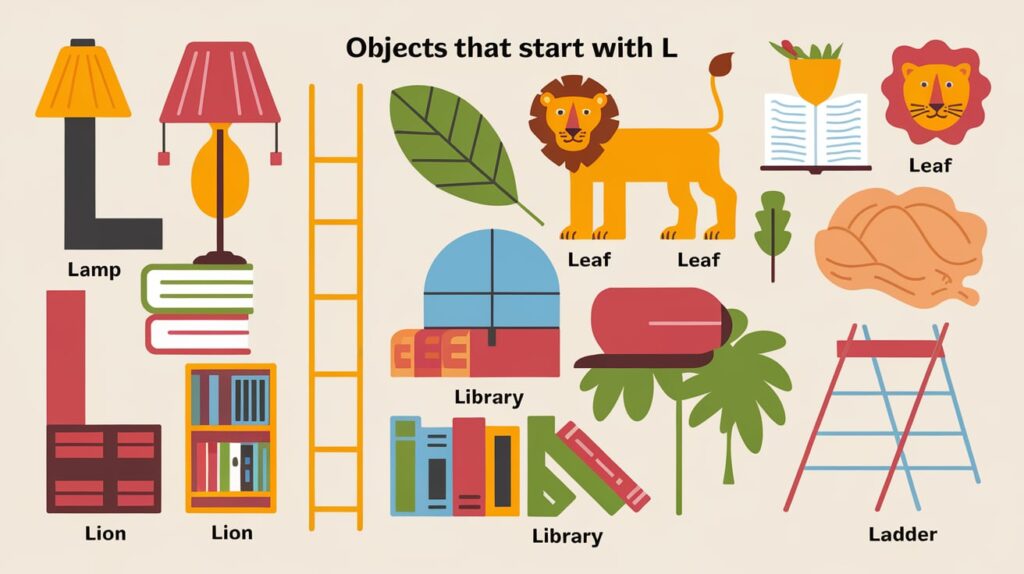
- Ladle: A large, long-handled spoon used primarily for serving soups, stews, or sauces from a pot to a bowl.
- Lamp: A device that produces light through electricity or a flame, commonly used for illumination in homes and streets.
- Lanyard: A cord or strap which is worn around the neck, shoulder, or wrist to carry items like keys or identification cards.
- Laptop: A portable personal computer with a screen and alphanumeric keyboard, suitable for mobile use and compact enough to rest on the user’s lap.
- Latch: A type of mechanical fastener that is used to join two objects or surfaces together, allowing for the regular separation of the objects or surfaces.
- Lathe: A machine tool that rotates a workpiece about an axis of rotation to perform various operations such as cutting, sanding, knurling, drilling, or deformation.
- Launcher: A device or structure for launching projectiles or other objects, typically used in contexts ranging from toys to military weaponry.
- Laundry: A room or area designated for washing, drying, and ironing clothes, typically equipped with specific appliances for these tasks.
- Lavender: A small aromatic evergreen shrub noted for its purple flowers, widely used in perfume and aromatherapy.
- Lawnmower: A machine utilizing one or more revolving blades (or a blade reel) to cut a grass surface to an even height.
- Lead: A heavy, soft, malleable metal with a bluish-white color when freshly cut but tarnishes to a dull grayish color when exposed to air.
- Leaflet: A small piece of paper containing information or advertising, typically one that is distributed free.
- Leak: An unintended hole, crack, or the like through which liquid, gas, light, or other substances can pass.
- Leggings: Tight-fitting stretch pants, typically worn by women or girls to provide warmth, fashion, or athletic comfort.
- Lemon: A bright yellow, acidic fruit of a small thorny tree, used primarily for its juice in cooking and in beverages.
- Lens: A piece of glass or other transparent material with curved sides for concentrating or dispersing light rays, used singly or as part of an array in eyeglasses or optical devices.
- Letter: A written, typed, or printed communication, especially one sent in an envelope by mail or messenger.
- Level: A tool used in construction and carpentry that indicates whether a surface is horizontal (level) or vertical (plumb).
- Lever: A rigid bar resting on a pivot, used to help move a heavy or firmly fixed load with one end when pressure is applied to the other.
- License: A document, tag, or plate that grants permission to own, do, or use something, typically a vehicle or firearm.
- Lighthouse: A tall building equipped with a powerful light and other navigational systems located at an important or dangerous place regarding maritime travel.
- Lightning rod: A metal rod or conductor mounted on top of a building and connected to the ground through a wire, used to protect the building from lightning damage.
- Lime: A greenish-yellow citrus fruit with acidic, juicy pulp, used in beverages and foods for its tangy flavor.
- Limousine: A large, luxurious automobile, usually driven by a chauffeur, often with a partition between the driver’s compartment and the passengers’ area.
- Line: A long, narrow mark or band, typically one painted or drawn on a surface to indicate a boundary or route.
- Linen: A fabric woven from fibers of the flax plant, renowned for its strength, coolness, and luster, often used for tablecloths and garments.
- Lingerie: Women’s lightweight, luxurious, and decorative undergarments or sleepwear, typically made of materials like silk or lace.
- Link: A single ring or loop in a chain or a hyperlinked connection between web pages.
- Lint: Fuzzy or fibrous material shed from cloth or yarn, especially one that accumulates on clothing or in pockets.
- Lipstick: A cosmetic product containing pigments and waxes applied to the lips to add color and texture.
- Liqueur: A sweet alcoholic drink made from distilled spirits and various flavorings, including fruits, herbs, or spices.
- Liquid: A substance that is freely flowing but constant in volume, having a consistency like that of water or oil.
- Litter: Small trash items dispersed in a disorderly way in public places, often consisting of items like paper, cans, and bottles.
- Locket: A small ornamental case, typically worn on a necklace, containing a photograph or memento.
- Lollipop: A sweet candy consisting of hardened, flavored sucrose with corn syrup mounted on a stick.
- Lotion: A low- to medium-viscosity topical preparation intended for application to unbroken skin.
- Lounger: A comfortable, reclining chair, often outdoor furniture, used for relaxing or sunbathing.
- Luggage: Containers such as suitcases or bags holding a traveler’s personal belongings during transit.
- Lumber: Wood that has been processed into beams and planks, a stage in the process of wood production.
- Lunchbox: A container used to store, transport, and protect food for personal meals typically taken to work or school.
- Lychee: A tropical fruit with rough, leathery skin and sweet, gelatinous flesh around a large seed, often eaten fresh or used in beverages.
- Lyre: An ancient stringed musical instrument resembling a small harp, used primarily in classical and folk music.
- Lab coat: A white coat made of cotton or a cotton-polyester blend worn by scientists or doctors in laboratories to protect their clothing and maintain hygiene.
- Label: A small piece of paper, fabric, or other material attached to an object and giving information about it, such as its origin, owner, contents, or use.
- Lace: A delicate fabric made of yarn or thread in an open weblike pattern, made by machine or by hand, often used in clothing and decorative arts.
- Ladder: An equipment consisting of a series of bars or steps between two upright lengths of wood, metal, or rope used for climbing up or down.
- Laminator: A machine that applies a protective layer of plastic film to documents or other materials, enhancing their durability and appearance.
- Lampshade: A cover fixed around a light bulb on a lamp to diffuse and direct the light emitted.
- Lance: A long weapon for thrusting, having a wooden shaft and a pointed steel head, formerly used by a horse-mounted soldier.
- Landmine: An explosive device planted in the ground, used primarily to disable enemy personnel or vehicles.
- Lantern: A portable lighting device or mounted fixture used to illuminate broad areas, usually consisting of a protective enclosure for a light source.
- Laptop bag: A bag designed to carry and protect a laptop computer along with chargers, peripherals, and sometimes documents.
- Lariat: A long, light rope used, especially in North America, as a lasso for catching cattle or as tethering gear.
- Laser: A device that emits light through a process of optical amplification based on the stimulated emission of electromagnetic radiation.
- Latchkey: A key to an outer door of a house, typically worn on a chain around a child’s neck, allowing them to let themselves in after school.
- Latex: A milky fluid from certain plants that coagulates on exposure to air; used commercially for making rubber.
- Laugh: An object that brings joy and amusement, often considered a good company or entertainment piece.
- Lava lamp: A decorative lamp invented in the 1960s featuring a mesmerizing display of colored wax in liquid that moves in slow, blob-like patterns.
- Lawbook: A book containing or dealing with laws, legal cases, or the legal profession.
- Lawn chair: A folding chair made of cloth and a lightweight metal frame, commonly used outdoors.
- Layer: A thickness or coat of a substance spread over a surface or body, typically applied for protection or decoration.
- Lazy Susan: A revolving tray placed on a table or countertop to aid in distributing food.
- Lead pipe: A heavy, malleable grey metal pipe used historically in plumbing.
- Leaf: An organ of a vascular plant and is the principal lateral appendage of the stem, typically green and flat, and functions in photosynthesis.
- Leak detector: A device used to detect the escape of liquid or gas, commonly used in industrial installations, where they are essential for safety or operational efficiency.
- Leapfrog: A children’s game in which players vault over each other’s stooped backs.
- Leather: A durable and flexible material created by tanning animal rawhide and skins, commonly used in clothing, footwear, and upholstery.
- Lectern: A tall stand with a slanted top to hold a book or notes, typically used by a lecturer.
- Ledger: A book or other collection of financial accounts of a particular type.
- Leg warmer: A covering for the lower legs to keep them warm, typically worn by dancers or exercisers who practice in cold environments.
- Lemonade: A drink made from lemon juice and water and sweetened to taste, often enjoyed as a refreshing summertime beverage.
- Lens cap: A cover for a camera lens to protect it from scratches or the elements when not in use.
- Leotard: A tight-fitting garment, often worn by dancers, gymnasts, and acrobats, that covers the body from the shoulders to the thighs.
- Letter opener: A device used for opening sealed envelopes, usually a small, dull blade.
- Leveler: A tool used in surveying and construction to obtain a horizontal plane. It can be a simple visual or complex electronic device.
- Library: A collection of books, periodicals, and sometimes films and recorded music for people to read, borrow, or refer to for study.
- Lid: A removable or hinged cover for the top of a container, used to close or seal it.
- Lifeboat: A small, sturdy boat specially designed for saving lives at sea by being used to rescue people in distress or in danger of drowning.
- Lifeline: A piece of safety equipment consisting of a line tossed to rescue someone in difficulty in the water.
- Lift: A platform or compartment housed in a shaft for raising and lowering people or things to different floors or levels.
- Lightbulb: A device that emits light when electrically heated, typically consisting of a filament wire that is heated until it glows.
- Lighter: A small device that produces a flame for lighting cigarettes, candles, or other combustible materials.
- Lighthouse: A tower with a powerful light at the top, positioned at a crucial or dangerous place regarding maritime navigation, used to guide ships.
- Lightning conductor: A metal rod mounted on a building and connected to the ground to protect the building from damage by attracting lightning.
- Lignite: A soft brownish coal showing traces of plant structure, intermediate between bituminous coal and peat.
- Lilac: A flowering woody plant with clusters of purple or white fragrant flowers, often grown as an ornamental shrub.
- Lily: A type of flowering plant with large prominent flowers, known for their variety of colors and species.
- Limeade: A beverage similar to lemonade but made from lime juice and sweetened water.
- Limiter: A device that automatically prevents a signal from exceeding a specified point, commonly used in audio applications.
- Linchpin: A pin passed through the end of an axle to keep a wheel in position.
- Lineament: Any of the features that make up the earth’s surface, including geological or geomorphological features like ridges and valleys.
- Linear accelerator: A type of particle accelerator that increases the energy of charged particles along a straight line using oscillating electric fields.
- Liner: A covering or layer that protects or insulates a surface, object, or container, often removable.
- Linesman: A person who installs or repairs electrical power or telephone lines.
- Linkage: A mechanical system consisting of rods linked together, designed to transfer motion and forces in a controlled manner.
- Lip gloss: A cosmetic used primarily to give lips a glossy luster and sometimes to add a subtle color.
- Lip liner: A cosmetic product applied around the lips to define their edges before applying lipstick or gloss.
- Liqueur glass: A small, often decorative glass used for serving aromatic alcoholic beverages, typically after dinner.
- Liquid crystal: A substance that flows like a liquid but has some properties typical of crystalline solids used in displays.
- Liquidizer: An electrical kitchen appliance intended for blending or pureeing foods to a liquid state.
- Liquor: An alcoholic drink, especially distilled spirits like whiskey, vodka, or rum.
- List: A number of connected items or names written consecutively, typically one below the other.
- Litter bin: A container in public spaces used for the disposal of rubbish.
- Liturgy: A form or formulary according to which public religious worship, especially Christian worship, is conducted.
- Livestock: Farm animals regarded as an asset, including cows, sheep, and pigs, raised for meat, milk, or wool.
- Lizard: A reptile with a long body and tail, moving with a sinuous motion, and able to shed its tail when captured.
- Loaf: A quantity of bread that is shaped and baked in one piece and can be sliced for eating.
- Loafer: A type of shoe that slips on, with no laces or fastenings, and typically low, lace-less shoes.
- Lobby: A hall or other open area in a building used by the public, especially a hotel or theater, near the entrance.
- Lobster: A large marine crustacean with a cylindrical body, stalked eyes, and the first of its five pairs of limbs enlarged as pincers.
- Locket: A small ornamental case on a necklace, which opens to reveal a space used for storing a photograph or other keepsake.
- Locomotive: A powered rail vehicle used for pulling trains.
- Lode: A vein of metal ore in the earth’s crust.
- Log: A part of a felled tree.
- Logbook: A book for recording events, transactions, or observations on a regular basis; used especially in shipping and aviation.
- Logic board: The main printed circuit board in a complex electronic system, like a computer, containing the central processing unit and other key components.
- Logo: A symbol or other small design adopted by an organization to identify its products, uniform, vehicles, etc.
- Loincloth: A single piece of cloth worn around the waist, typically used in warm climates as a basic form of dress.
- Lollipop mold: A mold used to shape lollipops or candy on a stick into various designs.
- Longboat: A large boat from the past, typically used for carrying people and goods, often rowed by multiple oarsmen.
- Longbow: A large bow used for shooting arrows, historically used for both hunting and as a weapon in medieval warfare.
- Lookout: A high place or structure where someone can keep watch for potential danger, emergency, or observation.
- Loop: A shape produced by a curve that bends around and crosses itself or a length of thread, rope, or similar material doubled or laid in a circle.
- Lopper: A gardening tool with long handles and a sharp blade used for pruning overgrown branches.
- Lotion bottle: A container specifically designed to hold and dispense lotions, typically made from plastic with a pump or squeeze mechanism.
- Lottery ticket: A small paper ticket that allows the holder a chance of winning a prize in a drawing.
- Lounge chair: A comfortable chair designed for relaxing, often reclining and upholstered, used in living rooms or lounges.
- Loupe: A small magnifying glass used by jewelers, watchmakers, and other fine detail inspectors.
- Love seat: A small sofa designed to seat two people, typically in a snug fit.
- Low-loader: A flatbed trailer with a low floor used especially for transporting heavy or tall goods.
- Lox: A fillet of brined salmon, often served as part of the American bagel and cream cheese dish.
- Lubricant: A substance, such as oil or grease, used to reduce friction between surfaces in mutual contact, which ultimately reduces the heat generated when the surfaces move.
- Lucerne: Another term for alfalfa, a plant used for fodder and for its nutritional properties, often in livestock feed.
- Luge: A small one- or two-person sled on which one sleds supine (face up) and feet-first.
- Lullaby: A quiet, gentle song sung to send a child to sleep.
- Lumberjack shirt: A heavy shirt, typically made from flannel and featuring a checked pattern, often worn by workers in the logging industry.
- Luminary: A celestial body, like the sun or moon, or a person who inspires or influences others, especially one prominent in a particular sphere.
- Lump: A compact mass of a substance, typically one without a definite or regular shape.
- Lunch meat: Pre-cooked or cured meat, often sliced and served on sandwiches or used to prepare quick meals.
- Lure: An object used in fishing to attract fish, typically resembling small prey with hooks incorporated.
- Lute: A plucked string instrument with a body like a half pear, popular in Renaissance and Baroque music.
- Luxmeter: A device that measures the intensity of light, used in photography, video, and in conserving energy in public and private environments.
- Lyric sheet: A piece of paper that lists the words to a song, typically used by singers during performances or recordings.
- Lab bench: A sturdy table used in laboratories for scientific experiments, equipped with various utilities to facilitate a wide range of scientific research.
- Label maker: A device that prints self-adhesive labels, which can be used for organizing files, labeling products, or tagging equipment for easy identification.
- Lacquer: A clear or colored varnish that dries by solvent evaporation and often a curing process that produces a hard, durable finish used in wood and metal coatings.
- Lactometer: An instrument used to measure the density (specific gravity) of milk, which helps in assessing its quality and purity.
- Ladder rack: A frame or series of bars mounted on top of a vehicle to carry large items such as ladders or building materials securely.
- Ladle holder: A kitchen accessory designed to hold a ladle, helping to keep cooking surfaces clean and preventing spills.
- Ladybug: A small, round beetle with a distinctive pattern of spots on its wing covers, beneficial for gardens as it consumes aphids and other harmful insects.
- Lag bolt: A heavy-duty fastener used in woodworking and construction, featuring a hexagonal head and a coarse thread designed to grip into wood or other materials.
- Lake: A large body of water surrounded by land, often freshwater, used for water sports, fishing, and recreational activities.
- Laminar flow hood: A carefully enclosed bench designed to prevent contamination of semiconductor wafers, biological samples, or any particle-sensitive materials.
- Lamp post: A tall pole with a light at the top, usually found on streets or paths to illuminate areas during the night.
- Lampblack: A form of carbon black obtained from the soot of burned oil or tar, widely used as a pigment and in lubrication greases.
- Lampion: A small lantern made of paper, often used in decorative lighting for festivals and celebrations.
- Lapping compound: An abrasive paste used in the process of lapping to smooth surfaces by grinding them down with a very fine abrasive powder.
- Larch: A type of coniferous tree known for its tough, water-resistant wood, commonly used in construction and carpentry.
- Lard: A semi-solid white fat product obtained by rendering the fatty tissue of the pig, used in cooking and baking for its flavor and moisture content.
- Large hadron collider: A massive particle accelerator used by physicists to study the smallest known particles – the fundamental building blocks of all things.
- Lark: A small, ground-dwelling songbird known for its melodious songs, often performed during flight.
- Laser pointer: A small handheld device that emits a laser beam used to highlight points of interest by projecting a small bright spot of colored light onto them.
- Latch hook: A tool used in crafting to create knotted rugs or wall hangings by pulling yarn through a canvas.
- Lattice: An interlaced structure or pattern formed of strips of wood or metal, used as a screen or fence and sometimes as a decorative element.
- Launch pad: A complex structure that houses a vehicle (such as a rocket) used for launching spacecraft or missiles.
- Launderette: A public place equipped with laundry machines, where clothes can be washed and dried by customers for a fee.
- Laurel: An evergreen shrub or tree known for its glossy green leaves and aromatic properties, often used as a symbol of victory and achievement.
- Lavatory: A room equipped with toilet facilities.
- Lawn ornament: A decoration placed in gardens or lawns, typically made of metal, stone, or resin to enhance the aesthetic appeal of the outdoor space.
- Lead glass: A variety of glass in which lead replaces the calcium content of a typical potash glass, known for its high refractive index and clarity.
- Leaf blower: A gardening tool that propels air out of a nozzle to move debris such as leaves and grass cuttings.
- Leak sealant: A substance used to block leaks and seal surfaces to prevent the escape of liquids and gases.
- Lean-to: A simple structure with only one sloping roof, usually attached to a more substantial building.
- Leap: A jump, especially one that spans a long distance or is made from a standing start.
- Lease: A contract by which one party conveys land, property, services, etc., to another for a specified time, usually in return for periodic payments.
- Lectin: A protein that binds specifically to certain sugars and so can interfere with cells and their interactions with each other.
- Leg press: A weight training exercise in which the individual pushes a weight or resistance away from them using their legs.
- Legal pad: A type of writing pad that typically has yellow paper, used often by attorneys and in business environments for notes and drafting.
- Legume: Any plant of the pea family characterized by pods containing a number of seeds, including forms such as beans, peas, and lentils.
- Leitmotif: A recurrent theme throughout a musical or literary composition associated with a particular person, idea, or situation.
- Lemon balm: A lemon-scented herb from the mint family, used in traditional medicine for its calming effects and in culinary preparations for its flavor.
- Lemon squeezer: A tool used to extract juice from lemons and other citrus fruits, typically made of metal or plastic.
- Lemur: A tree-dwelling primate found only in Madagascar and the nearby islands, characterized by its large eyes and nocturnal habits.
- Lens hood: A device used on the end of a camera lens to block the sun or other light sources to prevent glare and lens flare.
- Lentil: A small, round, lens-shaped legume that comes in many colors and is frequently used in cooking for soups and stews.
- Leotard: A close-fitting one-piece garment worn by dancers, gymnasts, and acrobats, covering the body but not the legs.
- Letterbox: A slot, usually in a door, through which mail is delivered.
- Leveller: A tool or machine used in construction and surveying to check levels, often using a laser or water.
- Lever arch file: A type of binder that uses a mechanism that includes a lever and arch mechanism to open and close, holding papers securely.
- Lexicon: The vocabulary of a person, language, or branch of knowledge.
- Liar’s dice: A class of dice games for two or more players requiring the ability to deceive and detect an opponent’s deception.
- Libretto: The text of an opera or other long vocal work.
- License plate: A metal or plastic plate attached to a vehicle for official identification purposes.
- Lichen: A composite organism that arises from algae or cyanobacteria living among filaments of multiple fungi in a symbiotic relationship.
- Lick: A small amount, especially of something edible or a gesture involving the tongue.
- Lidar: A surveying method that measures distance to a target by illuminating the target with laser light and measuring the reflected light with a sensor.
- Lie detector: A device or procedure that measures and records several physiological indicators such as blood pressure, pulse, respiration, and skin conductivity while a person answers questions.
- Life preserver: A flotation device designed to save the wearer from drowning in the water.
- Lifeguard stand: A high chair located on a beach or at a pool, used by a lifeguard to sit and oversee the safety of the water activities.
- Liftgate: A power-operated gate at the rear of a vehicle, which can be raised for loading cargo.
- Ligament: A short band of tough fibrous connective tissue that connects two bones or cartilages or holds together a joint.
- Light meter: A device used to measure the amount of light. In photography, a light meter can help determine the proper exposure for a photograph.
- Light rail: A form of urban rail public transportation that generally has a lower capacity and lower speed than heavy rail and metro systems.
- Light stand: A support stand used to hold lights in various positions and locations in photography, video production, and live performance.
- Light-year: A unit of astronomical distance equivalent to the distance that light travels in one year, which is nearly 6 trillion miles (9.66 trillion kilometers).
- Lightbox: A container with a translucent face of plastic or glass and a light behind it; used for displaying advertising or other communicative graphics.
- Lightship: A ship that acts as a lighthouse, equipped with a beacon light to guide ships at sea, used in waters that are not suitable for lighthouse construction.
- Limb: An arm or leg of a person or four-legged animal or a large branch of a tree.
- Limestone: A sedimentary rock composed mainly of skeletal fragments of marine organisms such as coral, forams, and mollusks.
- Limousine: A luxury vehicle driven by a chauffeur, typically a large sedan or saloon car, especially one with a lengthened wheelbase or driven by a professional driver.
Summing Up
As we conclude our detailed blog on objects starting with L, we’ve covered a diverse range of items, from everyday tools to rare things.
This comprehensive list enhances our vocabulary and deepens our appreciation for the variety and creativity present in naming.
We’ve seen how these objects play important roles in various aspects of life, culture, and technology.
Thank you for joining us on this alphabetical journey. May your newfound knowledge inspire curiosity and open doors to further learning.
Remember, every object around us has a story and a place in our complex world.