
Have you ever wondered how many common and unique items start with K?
From kitchen essentials to names of animals and geographical features, the letter “K” introduces fascinating examples of nouns in our language and world.
This blog will explore diverse categories, beginning with “K,” such as musical instruments, clothing items, and even people’s names.
Each category not only adds to our everyday vocabulary but also deepens our appreciation for the variety of the English language.
These ten intriguing categories offer a closer look at perhaps familiar and surprisingly new K nouns.
Understanding K Nouns Through Examples
1. Kitchen Items

- Knives: Essential for slicing and dicing, knives come in various sizes and shapes, each tailored for specific kitchen tasks.
- Kettle: A kettle is used to heat water, often for tea or coffee. It features a spout for easy pouring and a handle to prevent burns.
- Kitchenaid: This popular brand name is synonymous with stand mixers that offer a variety of attachments for different cooking needs.
- Kitchen timer: A kitchen timer is crucial for tracking cooking times to prevent overcooking or burning food.
- Kneading board: Typically made of wood or marble, a kneading board provides a smooth, sturdy surface for dough manipulation.
- Kitchen scale: Kitchen scales measure ingredient weights accurately, which is essential for precise cooking and baking recipes.
- Knife sharpener: A knife sharpener is a tool for maintaining the cutting edge of kitchen knives, which is essential for effective chopping.
- Kitchen scissors: Kitchen scissors are versatile tools for cutting food items that are too cumbersome for a knife.
- Kneading mat: Made from silicone or other non-stick materials, a kneading mat helps roll out dough without sticking.
- Kitchen tongs: Tongs are used to manipulate foods while cooking, allowing for flipping and turning without the risk of burns.
2. Animals

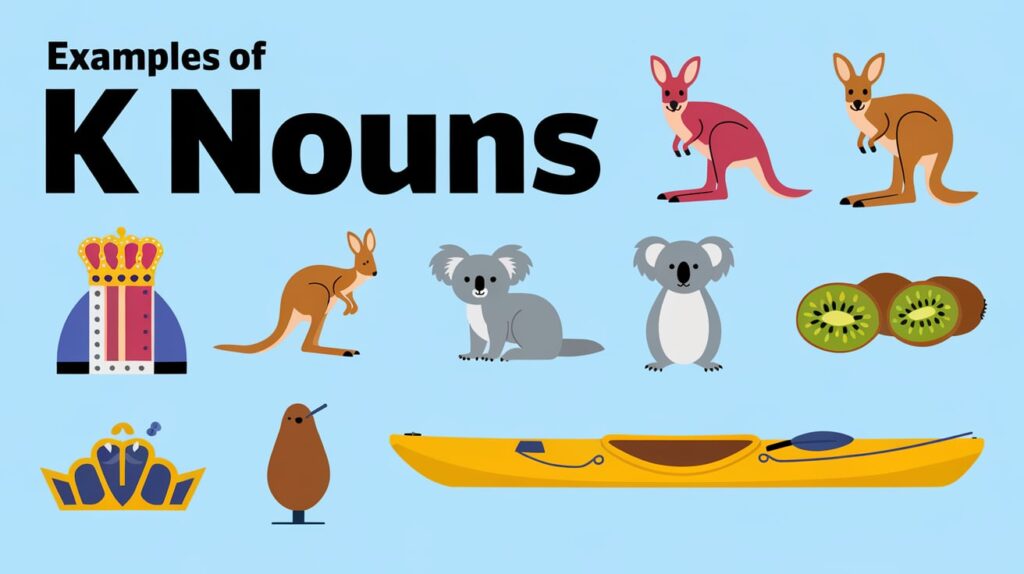
- Kangaroo: Native to Australia, the kangaroo is a marsupial well known for its powerful hind legs and pouch for carrying offspring.
- Koala: Another Australian marsupial, koalas are tree-dwelling creatures known for their diet of eucalyptus leaves and cuddly appearance.
- Koi: Koi are ornamental fish often found in outdoor ponds, prized for their vibrant colors and patterns.
- Kingfisher: Kingfishers are birds known for their vivid plumage and skill in hunting fish by diving into water from above.
- Kiwi (bird): Native to New Zealand, the Kiwi is a flightless bird with a long beak and a shy nature.
- Kinkajou: This rainforest mammal from Central and South America is nocturnal and has a prehensile tail, aiding in its arboreal lifestyle.
- Komodo dragon: The world’s largest lizard in Indonesia, Komodo dragons are formidable predators with a venomous bite.
- Kudu: Native to Africa, kudus are antelopes known for their long, spiral horns and graceful stature.
- Krill: Small crustaceans critical to ocean food chains, krill are a primary food source for many marine animals.
- Katydid: Katydids are insects known for their green coloration and leaf-like appearance, contributing to their camouflage.
3. Geographical Features
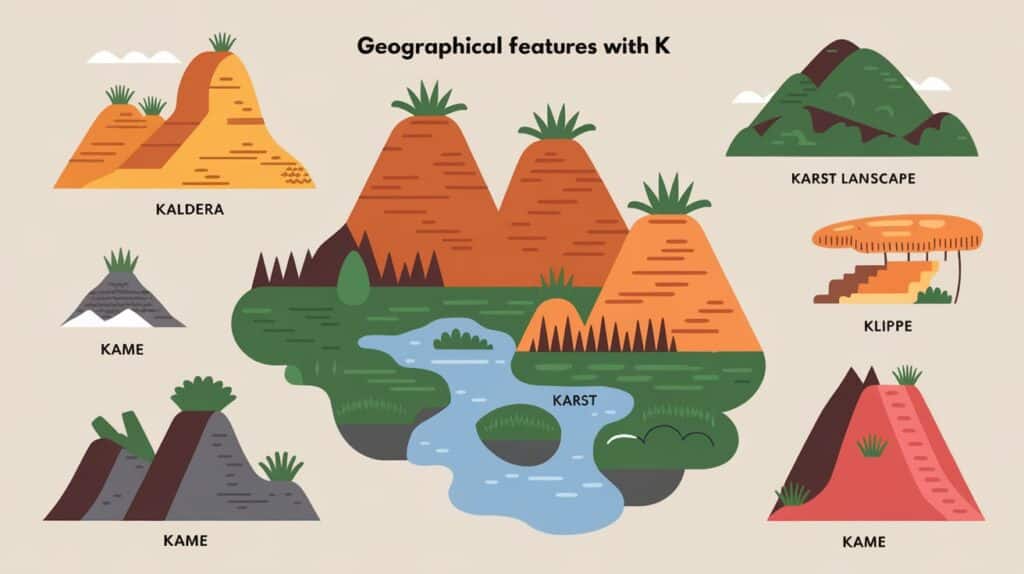
- Knoll: A small, rounded hill often found in gentler landscapes, providing a scenic variety to the terrain.
- Kettle (glacial): A depression in the ground formed by retreating glaciers, often filled with water to become kettle lakes.
- Karst: A landscape formed from dissolved soluble rocks characterized by sinkholes, caves, and underground drainage systems.
- Kame: A geological feature consisting of a mound or hill of sand and gravel deposited by melting glaciers.
- Key (low island): Typically formed from coral debris, keys are small, low-elevation islands in tropical regions.
- Knob (hill): A prominent, rounded protrusion that rises distinctly from its surroundings, often grassy or rocky.
- Kipuka: An island of land left untouched by lava flows, which creates a natural oasis in lava-covered regions.
- Kill (creek or river): A term used in parts of the northeastern U.S. to denote a small stream or river.
- Kettle hole: A shallow, sediment-filled body of water formed by retreating glaciers or draining floodwaters.
- Knickpoint: A break in the slope of a river, often marked by waterfalls or rapids, which indicates different erosion rates.
4. Musical Terms
- Key: In music, a key refers to the group of pitches, or scales, that form the basis of a music composition.
- Koto: A traditional Japanese stringed instrument played by plucking strings stretched over a hollow wooden body.
- Kazoo: A simple musical instrument that adds a buzzing timbral quality to a player’s voice when one hums into it.
- Keytar: A portable keyboard styled like a guitar, allowing musicians to perform more easily during live performances.
- Kettle drum: Also known as timpani, kettle drums are percussion instruments that produce a deep sound and can be tuned to different pitches.
- Keyboard: A versatile instrument capable of emulating various sounds, essential for composition and performance.
- Kinnor: An ancient stringed instrument mentioned in Biblical texts, resembling a lyre.
- Kalimba: An African musical instrument consisting of a wooden board with attached staggered metal tines, played by thumb plucking.
- Komungo: A traditional Korean zither-like stringed instrument played with a stick to strike the strings.
- Kora: A West African stringed instrument with a resonant body and a long neck, producing a harp-like sound.
5. Clothing Items
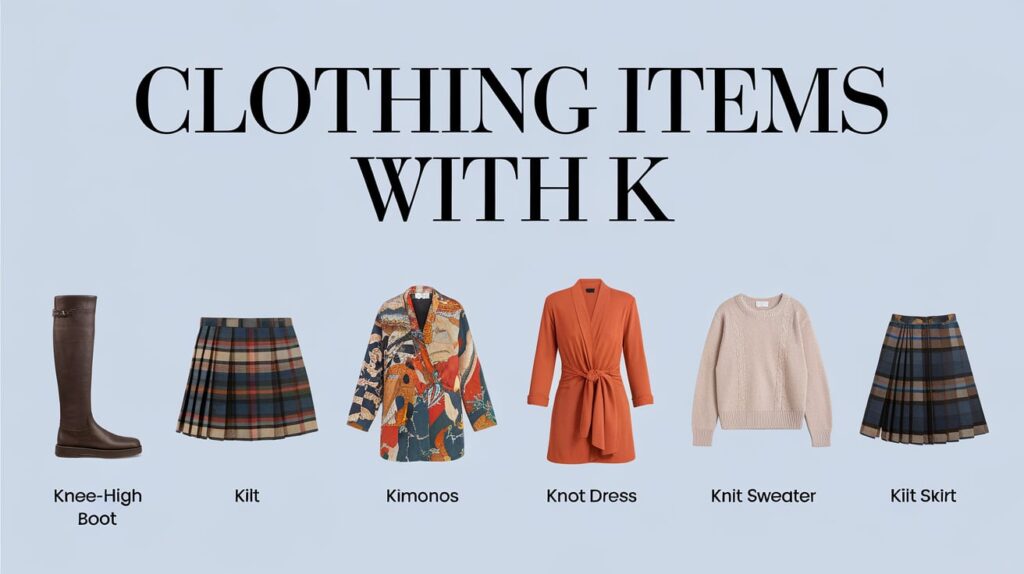
- Kimono: A traditional Japanese garment featuring wide sleeves and a wrap-around design, typically worn during special occasions.
- Kilt: A knee-length skirt of pleated tartan cloth worn by men as part of traditional Scottish Highland dress.
- Knickers: Loose-fitting trousers typically gathered at the knee or calf, historically worn by both men and women.
- Knee socks: Socks that extend up to the knee, often worn for fashion, warmth, or as part of a sports uniform.
- Knee-high boots: These boots extend up to the knee, providing extra warmth and style. They are popular in both casual and formal attire.
- Knit cap: A close-fitting cap made from knitted material, commonly worn in cold weather to retain heat.
- Kaftan: A long, loose garment, often with wide sleeves, traditionally worn in regions of Eastern Europe, the Middle East, and North Africa.
- Knee pads: Protective gear worn on the knees to cushion them against impact and abrasion, commonly used in sports and certain types of work.
- Keffiyeh: A traditional Middle Eastern headdress made from a square scarf, typically cotton, used to protect the head and neck from sun and sand.
- Knit dress: A dress made from knitted fabric, providing flexibility and comfort, suitable for casual and formal settings.
6. Plants

- Kale: A type of cabbage with green or purple leaves, known for its nutritional benefits and use in salads and smoothies.
- Kudzu: A fast-growing vine native to East Asia, infamous for its invasive qualities in the southeastern United States.
- Kiwi: A small fruit with a fuzzy brown exterior and bright green, sweet-tart interior, rich in vitamins C and K.
- Kaffir lime: Known for its aromatic leaves more than its fruit, the leaves are widely used in Southeast Asian cuisine.
- Kentia palm: An elegant, slow-growing palm popular as an indoor plant for its ability to adapt to low-light conditions.
- Knotweed: A highly invasive plant known for its ability to spread rapidly and dominate habitats, creating ecological challenges.
- King palm: A tall, straight palm native to Australia, valued for its ornamental appearance and rapid growth.
- Kava: A crop from the Pacific Islands, whose roots are used to make a drink with sedative and anesthetic properties.
- Kobus magnolia: A species of magnolia known for its early spring blossoms and robust, low-branching form.
- Khat: An evergreen shrub native to the Horn of Africa and the Arabian Peninsula, chewed for its stimulant effect.
7. Body Parts

- Kidney: A vertebrate organ that filters blood to produce urine and regulate essential bodily functions.
- Kneecap: This small bone covers and protects the knee joint, also known as the patella.
- Keratin: A type of protein found in hair, nails, and skin, providing strength and protection against environmental damage.
- Knee joint: A complex joint that connects the thigh to the shin, critical for movement and bearing body weight.
- Knuckle: The joints of the fingers that are visible as the fingers flex are crucial for hand movement and strength.
- Kidney stones: Hard deposits made of minerals and salts that form inside the kidneys, often painful when passed.
- Keratinocytes: Cells that produce keratin make up a significant part of the epidermis, the outer layer of the skin.
- Knee pit: The area at the back of the knee where the leg bends, similar to the armpit.
- Kneepan: Another term for the kneecap, providing protection and leverage to the muscles that straighten the leg.
- Kinesthetic sensors: Cells in muscles, tendons, and joints that provide information about body position and movement.
8. Vehicles

- Kayak: A small, narrow watercraft typically propelled through a double-bladed paddle.
- Ketch: A sailing craft with two masts, the aft mast shorter than the main mast ahead of it.
- Kite: Often referred to in context with kite surfing, where a large controllable kite on the water powers aboard.
- Keelboat: A boat with a fixed structural element along the base, improving stability and efficiency under sail.
- Kick scooter: A small platform with two or three wheels, propelled by a human rider pushing off the ground.
- KrAZ: A brand of heavy trucks from Ukraine known for their robustness and capacity in tough environments.
- Kinetic scooter: A scooter that converts kinetic energy from motion into additional power, enhancing mobility.
- Kombi: Also known as a Volkswagen Type 2, the Kombi is a van famous for its use by families and travelers in the 1960s and 1970s.
- Kart: A small, low-slung vehicle used in kart racing, providing high speeds and tight handling on specialized circuits.
- Kei car: A category of small vehicles in Japan, including compact cars, vans, and trucks, which enjoy tax and insurance benefits.
9. Foods
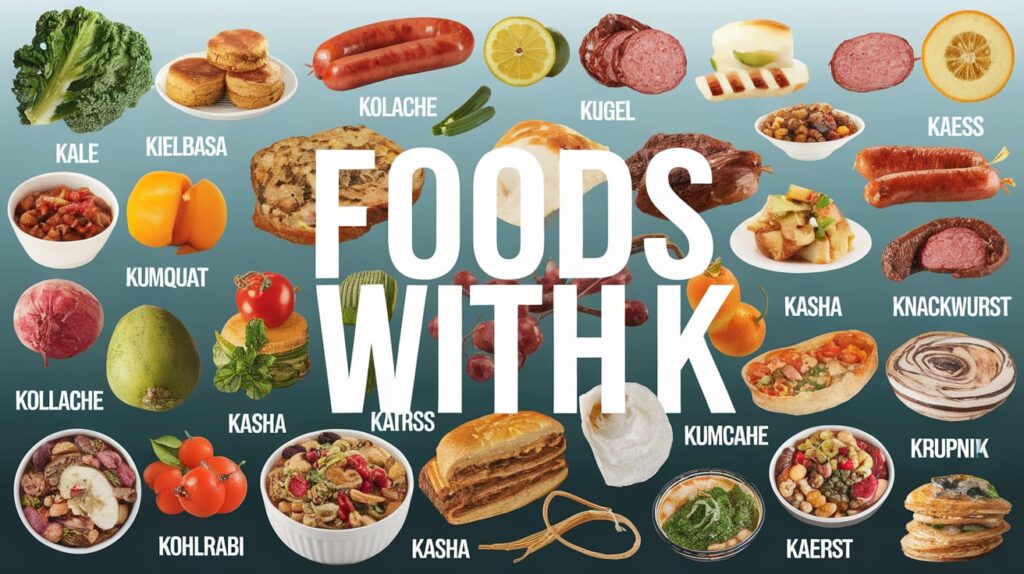
- Kebab: A popular dish consisting of skewered and grilled meat, often seasoned with various spices and served with vegetables.
- Ketchup: A sweet and tangy sauce typically made from tomatoes, vinegar, sugar, and assorted seasonings, commonly used as a condiment.
- Kasha: A dish made from buckwheat groats, often toasted and cooked with broth to a porridge-like consistency, popular in Eastern European cuisine.
- Kimchi: A traditional Korean dish of fermented vegetables, primarily napa cabbage and Korean radishes, seasoned with chili pepper and other spices.
- Kipper: A whole herring, split from tail to head, gutted, salted or pickled, and cold-smoked over smoldering woodchips.
- KitKat: A chocolate-covered wafer bar confection created by Rowntree’s of York, United Kingdom, and is now produced globally by Nestlé.
- Knish: It is an Eastern European snack of dough encasing a filling such as potato, meat, or cheese, typically baked or fried.
- Kahlua: A coffee-flavored liqueur from Mexico, made with sugar, syrup, and vanilla bean and used in various cocktails and desserts.
- Kava: A beverage made from the ground roots of the kava plant, traditionally consumed throughout the Pacific Ocean cultures of Polynesia.
- Key lime pie: This dessert consists of Key lime juice, egg yolks, and sweetened condensed milk in a pie crust topped with meringue or whipped cream.
10. People’s Names

- Kevin: A common masculine name of Irish origin, meaning “handsome” or “kind”.
- Kim: A unisex name of Vietnamese origin, meaning “golden,” or used as a diminutive form of Kimberly or Kimberley in English-speaking countries.
- Kyle: A Scottish name that can mean “strait,” “channel,” or “narrow,” often used for boys but also girls.
- Kurt: This name, which means “courteous” or “polite,” is of German origin and is known for its popularity in German-speaking countries.
- Kelsey: An English name derived from a place meaning “Cenel’s island,” used for both males and females.
- Katrina: A feminine name of German origin, a variant of Katherine, which means “pure.” It’s widely used in English and German-speaking countries.
- Keith: Derived from a Scottish place name, it is used as a given name and refers to a large expanse of woodland.
- Karen: This feminine name, derived from the Danish short form of Katherine, is popular in many English-speaking countries.
- Kenny: Often a diminutive form of Kenneth, this name has Gaelic origins meaning “born of fire” or “handsome.”
- Kiera: A feminine name of Irish origin, meaning “dark” or “black,” popular in Ireland and among the Irish diaspora.
Summing Up
In conclusion, nouns beginning with K highlight the incredible variety in just one letter of the alphabet. Here is what we have covered in the extensive list.
- Wide Range: From essential kitchen gadgets to rare animals and distinctive geographical features, the letter “K” introduces many useful and intriguing nouns.
- Cultural Connections: Items such as the kimono, koto, and kilt offer insights into the customs and heritage of their respective cultures, providing a window into worldwide traditions.
- Language Enrichment: These nouns broaden our vocabulary and enhance our appreciation for the English language.
Are you interested in discovering more? Continue your journey with us and uncover the fascinating stories that every letter of the alphabet holds.