

You open the Common App and see the GPA section. Your transcript says 4.2, but wait, is that on a 4.0 scale or 5.0? Should you report weighted or unweighted? And what if you mess it up?
GPA scale reporting confuses thousands of students every application season. One wrong number can make your grades look weaker than they are. But getting it right is simpler than you think.
This guide breaks down everything about gpa scale reporting meaning. You’ll learn what different GPA scales mean, how to find yours, and exactly how to report it on college applications.
We’ll cover the most common mistakes students make and show you how colleges actually read your GPA. By the end, you’ll report your grades with complete confidence.
What Is GPA Scale Reporting & Why Should You Care?
GPA scale reporting shows your grade point average according to a specific grading system. Your school might use a 4.0 scale, a 5.0 weighted scale, or a 100-point system.
When you apply to colleges, you report your GPA based on the scale your school uses. This helps admissions officers understand your academic performance in the right context.
Different high schools calculate grades differently, so reporting the correct scale prevents confusion. The scale tells colleges whether your 3.5 GPA is out of 4.0, 5.0, or another maximum value.
Why Is GPA Scale Reporting Important?
- It allows fair comparisons: Colleges can accurately compare applicants from schools with different grading systems.
- It prevents misinterpretation: A 3.8 on a 4.0 scale means something very different from a 3.8 on a 5.0 scale.
- It shows academic rigor: Weighted scales demonstrate that you took challenging courses like AP or honors classes.
- It builds trust: Accurate gpa scale reporting proves you understand your school’s system and report honestly.
- It impacts admissions decisions: Incorrect scale reporting can hurt your chances if your GPA appears lower than it actually is.
Types of GPA Scales with Examples
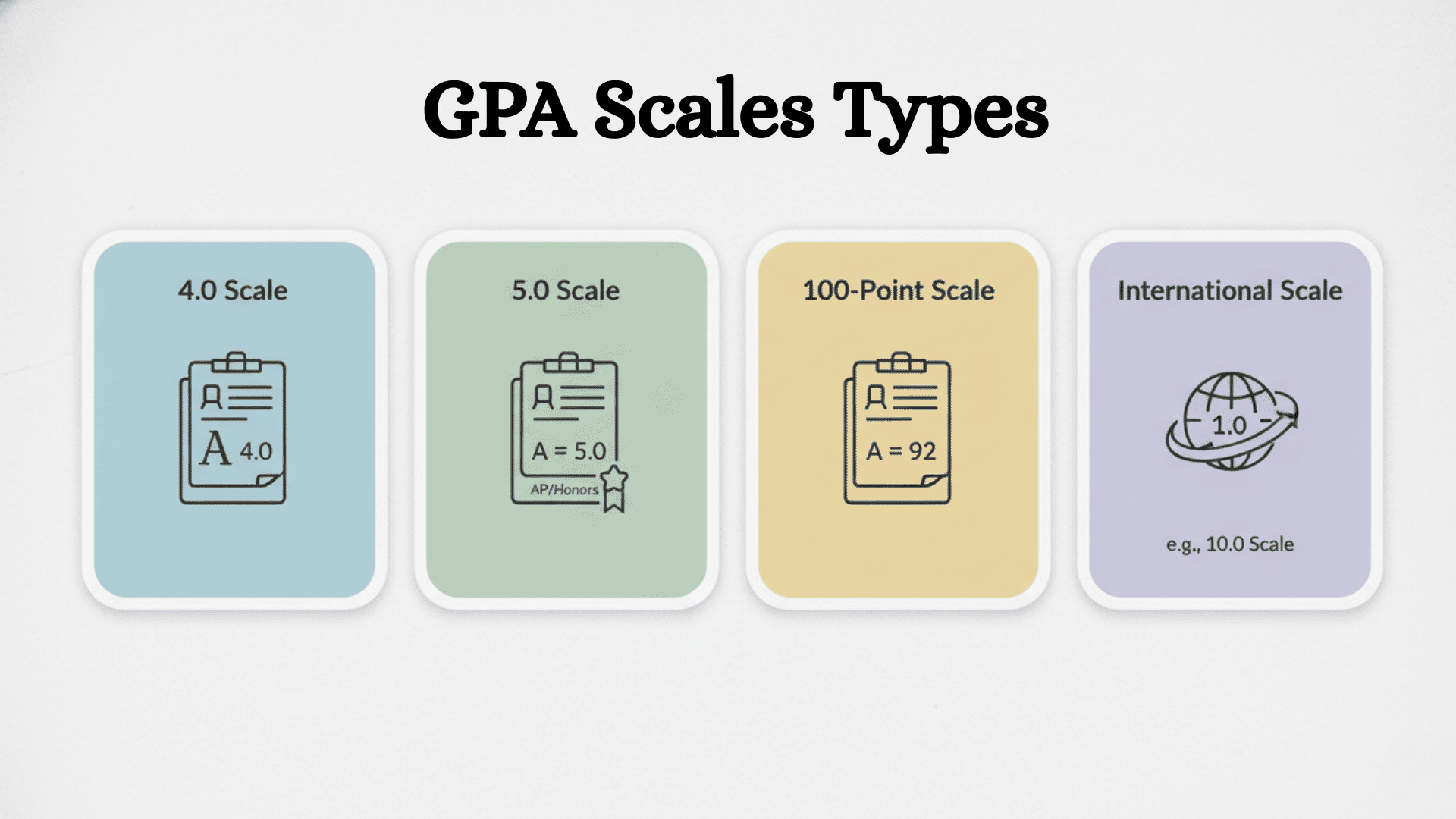
Not all schools use the same grading system. Understanding the different types of GPA scales helps you report your grades accurately when applying to colleges.
| GPA Scale Type | How It Works | Example |
|---|---|---|
| Unweighted GPA (4.0 Scale) | A = 4.0, B = 3.0, C = 2.0, D = 1.0, F = 0.0. All classes are weighted equally. | Straight A’s = 4.0 GPA |
| Weighted GPA (4.0+ Scale) | Extra points for AP/honors. A in regular = 4.0, A in AP = 5.0. | Can exceed 4.0 with advanced courses |
| 100-Point Scale | Based on percentages. A = 90-100, B = 80-89, C = 70-79. | 95 average = A grade |
| Other Scales (6.0, 10.0) | International or alternative systems with different maximums. | 6.0 scale: A = 6.0, B = 5.0 |
How to Find the Correct GPA Scale for Your College Application?
Knowing your GPA scale is vital for accurate reporting. Here’s how to find the right scale for your application:
- Check your official transcript: Your transcript shows the exact scale your school uses. Look for text like “GPA calculated on a 4.0 scale” or “weighted 5.0 scale” at the top or bottom of the document.
- Ask your school counselor: If the scale isn’t clearly marked, schedule a meeting with your counselor. They can explain whether your school uses weighted or unweighted calculations.
- Review your school’s grading policy: Most schools publish their grading systems in student handbooks or on their websites. Look for sections about academic policies or grade calculations.
- Look at your report card: Some report cards include the scale information along with your GPA. Check if it says “4.0 scale,” “100-point scale,” or another system.
- Contact your school’s registrar’s office: If you still can’t find the information, the registrar can provide official documentation about your school’s grading scale.
Pro Tip: When in doubt, report both your weighted and unweighted GPA on college applications. This gives admissions officers a complete view of your academic performance.
How to Report GPA Scale on the Common App?
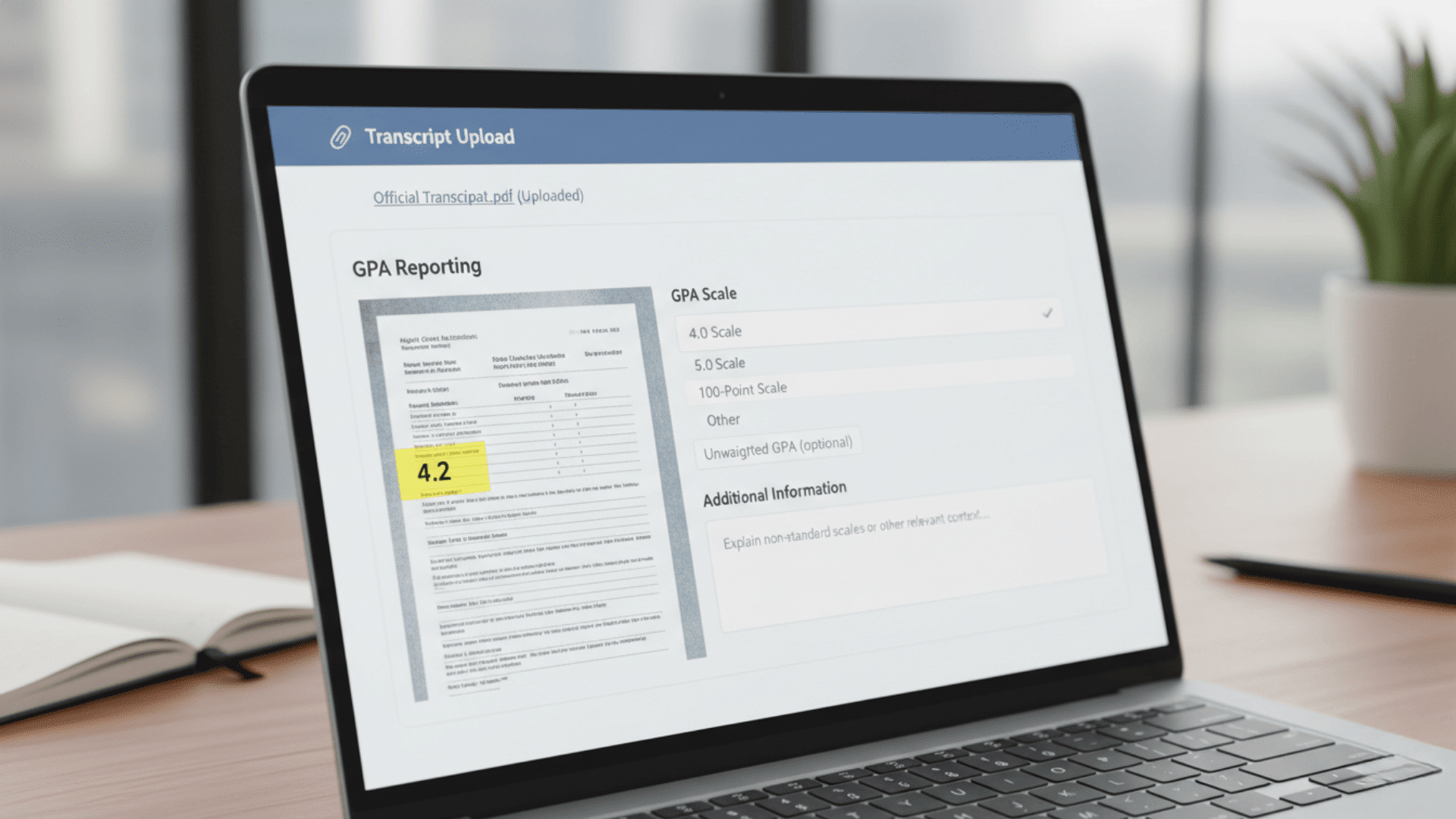
Reporting your GPA correctly on the Common App is critical for a strong college application. Follow these steps to ensure you enter your gpa scale reporting meaning information accurately.
1. Identify Your GPA
Find your cumulative GPA on your most recent official transcript. This is usually listed at the top or bottom of the page. If you can’t locate it, ask your school counselor to confirm the exact number.
Don’t calculate your GPA yourself because schools use specific formulas that might differ from your calculations.
2. Select the Correct Scale
The Common App will ask you to choose your GPA scale from a dropdown menu. Options typically include 4.0, 5.0, 6.0, or 100-point scales.
Pick the scale that matches what appears on your transcript. If your school uses an unusual scale, you can select “other” and specify the maximum value.
3. Enter Your GPA
Type your GPA exactly as it appears on your transcript, including all decimal places. Round only if the application system requires fewer decimal points.
If your school provides both weighted and unweighted GPAs, the Common App has separate fields for each.
4. Clarify Special Scales
Some schools use unique grading systems not covered by standard options. If your school has a custom scale like 10.0 or 20.0, explain this in the Additional Information section.
Briefly describe how your school calculates grades so admissions officers understand your academic performance correctly.
5. Double-Check Accuracy
Review all GPA information before submitting your application. Compare what you entered against your official transcript one more time.
Mistakes in gpa scale reporting meaning can raise red flags or hurt your chances. Have a parent, teacher, or counselor verify your entries if possible.
Common GPA Scale Reporting Mistakes to Avoid
Even small errors in gpa scale reporting meaning can create confusion for admissions officers. Here are the most common mistakes students make and how to avoid them.
| Common Mistake | How to Fix It |
|---|---|
| Selecting the wrong scale | Always match the scale on your transcript exactly (4.0, 5.0, or 100-point). |
| Rounding your GPA | Report your GPA with all decimal places shown on your transcript. Never round up or down. |
| Confusing weighted and unweighted | Report weighted GPAs only in weighted fields and unweighted GPAs in unweighted fields. |
| Not explaining unusual scales | Use the Additional Information section to clarify uncommon scales like 6.0 or 10.0. |
| Using self-calculated GPA | Only use the GPA printed on your official transcript. Don’t calculate it yourself. |
Key Reminder: When unsure about gpa scale reporting meaning, always consult your school counselor before submitting applications. One mistake can affect how colleges view your academic record.
How Colleges Interpret Different Scales?
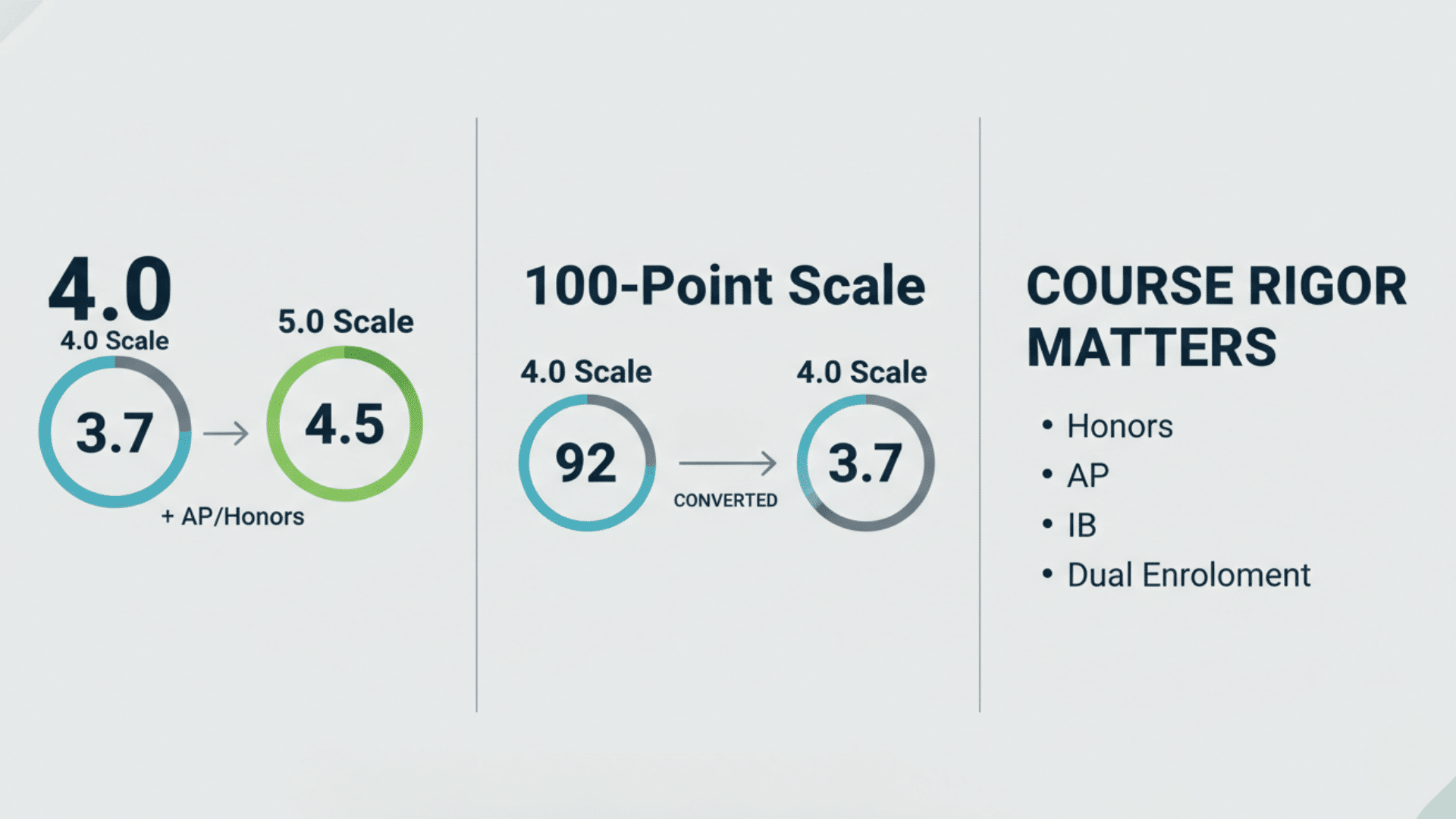
Colleges understand that high schools use different grading systems, so they often recalculate your GPA to their preferred scale, usually 4.0.
Admissions officers look beyond just the number and consider the difficulty of your courses, like AP, IB, or honors classes.
They also review your school’s specific grading policies through a school profile that accompanies your transcript.
This means a 3.7 from a school with rigorous courses might be viewed more favorably than a 4.0 from a school with easier classes.
Understanding the GPA scale reporting meaning helps admissions teams compare students fairly, even when they come from schools with completely different grading systems.
Final Thoughts
Understanding gpa scale reporting meaning is crucial for your college applications. Getting your GPA scale right ensures admissions officers see your true academic performance.
Whether your school uses a 4.0, weighted 5.0, or 100-point system, always report exactly what appears on your transcript. Check with your counselor if you’re unsure, and never round or guess your numbers.
Remember, colleges recalculate GPAs to compare applicants fairly. They look at course rigor, not just numbers. So focus on taking challenging classes and earning strong grades.
Ready to apply? Double-check your transcript, confirm your scale, and fill out that Common App with confidence. Your GPA tells your academic story, so make sure it’s told accurately.
Have questions about reporting your GPA? Drop a comment below, and we’ll help you get it right.