

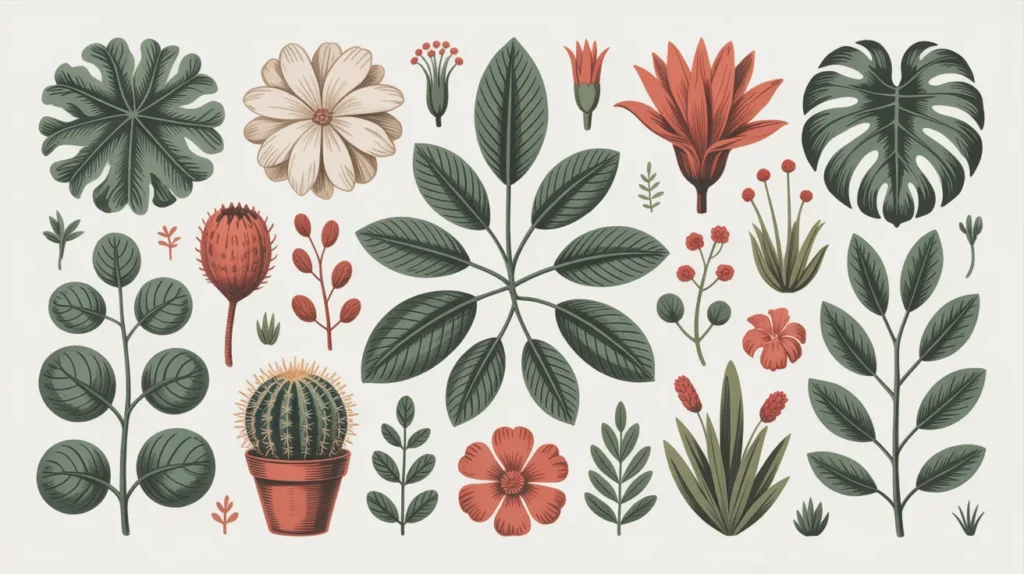
Plants are everywhere. On your desk, outside your window, in your food. But most of us walk right past them without a second thought. That is a mistake.
These quiet, rooted living things do far more than look green. They talk to each other underground. They can sense where water is. Some of them trick insects with fake smells.
The facts about plants are not just interesting. They are the kind of things that make you stop and say, “Wait, really?” So let us get into it.
You might see that little pot on your windowsill very differently by the time you finish reading.
What Most People Never Stop to Think About Plants
We grow them, eat them, and decorate our homes with them. But plants are doing a lot more than we notice.
They have been quietly running some of the most complex systems on Earth, long before humans showed up.
The more science looks at them, the more it finds that plants are active, responsive, and deeply wired into life as we know it.
41 Surprising Facts About Plants
Most people know plants need sunlight and water. That is just the start. From talking through roots to tricking insects, here is what plants are actually up to.
- Plants talk to each other through their roots using chemicals called root exudates.
- A 40-meter spruce tree can share carbon with nearby beech, larch, and pine trees.
- Plants tend to compete with strangers but are more relaxed around their siblings. This was shown in a McMaster University study.
- Pea plant roots can sense vibrations from water flowing underground and grow toward the source.
- Playing sound at specific frequencies increased sweet pepper yield by over 63%.
- Tomato yield went up by 13.2% when exposed to acoustic frequency technology.
- Plants can sense gravity. Scientists call this response gravitropism.
- Special cells called statocytes act as an internal compass inside plant roots and stems.
- Plant biologist Daniel Chamovitz found that plants can see, smell, feel, and remember.
- Bamboo is the fastest-growing woody plant on Earth.
- The coast redwood (Sequoia sempervirens) is the tallest tree in the world.
- 85% of all plant life is found in oceans, not on land.
- Trees are the longest-living organisms on Earth.
- Earth has more than 80,000 species of edible plants.
- Some orchids mimic female wasps in looks and scent to attract male wasps for pollination.
- Rafflesia arnoldii produces the largest single flower in the world, over a metre wide.
- Rafflesia smells like rotting meat to attract flies, which then carry its pollen.
- Some plants lure pollinators with the promise of nectar but produce none.
- Desert plants like cacti store water in their thick, fleshy leaves.
- Zebra Haworthia can survive long dry periods with very little water.
- Air plants grow on trees to reach sunlight in dense tropical rainforests.
- Gorse can fix its own nitrogen through root nodules in the soil.
- Gorse seeds sprout in response to heat, so fire actually helps the plant spread faster.
- Humans use more than 2,000 plant types to make food.
- The rose family also includes apples, pears, plums, cherries, almonds, peaches, and apricots.
- Black, green, and white teas all come from one plant: Camellia sinensis.
- Onions contain a mild antibiotic that can soothe burns and fight infections.
- 84% of a raw apple is water. A raw cucumber is 96% water.
- Dandelions are fully edible, from the petals right down to the roots.
- Small air pockets inside cranberries make them bounce and float in water.
- One of the oldest blue dyes comes from a plant called woad, used over 6,000 years ago.
- Around 70,000 plant species are used for medicinal purposes worldwide.
- Cannabis is one of the oldest known crops, used by humans for at least 12,000 years.
- Rice feeds more than half of the world’s population and grows in over 100 countries.
- 90% of the world’s rice production comes from Asia.
- The word “fruit” is a botanical term. The word “vegetable” is a culinary term, not a scientific one.
- Herb refers specifically to the leaf of a plant. Spice comes from the seed, bark, stem, bulb, or root.
- Peanuts are not nuts. They are related to beans and lentils.
- A notch cut into a tree stays at the same height forever as the tree grows upward.
- China has planted more than 66 billion trees along its northern border since 1978.
- Plants release water vapor through their leaves in a process that works a lot like sweating in humans.
What Scientists Are Still Learning About Plants
Science has come a long way with plants. But honestly? It has barely scratched the surface.
- Plant communication: Researchers are still mapping exactly how root chemicals carry signals between plants and what those signals actually mean.
- Plant memory: Studies suggest plants can retain information about past stress, but scientists have not yet confirmed how or where that memory is stored.
- Plant screaming: When stressed, plants release airborne chemicals that may act as distress signals, and researchers are still figuring out who, or what, picks them up.
- Stomata research: A new tool called Stomata In-Sight can now watch plants breathe in real time, which could lead to crops that need far less water.
- Forest soil and nitrogen: A long-term study in Panama found that adding nitrogen to tropical soil doubled tree growth, opening new doors for forest restoration efforts.
- Water cycle shifts: China’s large-scale tree planting has actually moved water across the country in ways scientists are only now beginning to track and understand.
How Plants Have Shaped Human Life?
Long before grocery stores, hospitals, or cotton mills, humans turned to plants for almost everything.
The food on your plate today, from apples to almonds, traces back to plant families that grew wild thousands of years ago.
The clothes dyed deep blue were colored with woad, a plant people have relied on for over 6,000 years. When people got sick, they reached for one of the 70,000 plant species now known to have medicinal value.
Rice alone built entire civilizations across Asia, feeding more than half the world’s population to this day. Even after 12,000 years of recorded plant use, humans are still finding new ways plants keep them alive.
Wrapping It Up
Plants are not just background scenery. The facts about plants covered here show something clear: these living things are more active, more aware, and more connected than most of us ever stop to think about.
They shape your food, your health, your air, and even your mood. Now that you know how plants talk, sense, and survive, maybe you will look at the ones around you a little differently.
Which of these plant facts surprised you the most? Drop it in the comments below. We would love to know.