
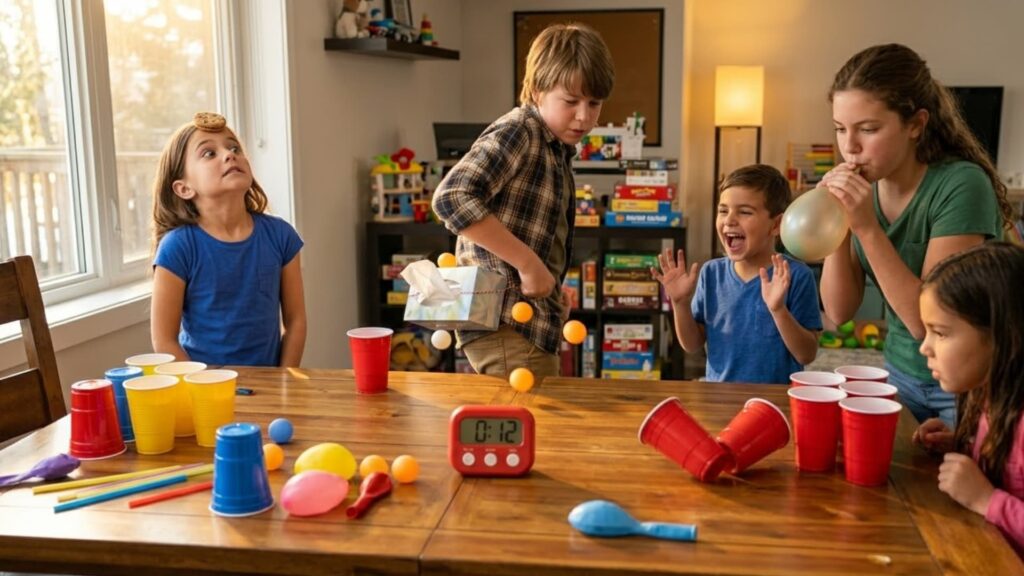
Pick any random Tuesday. You have a dozen kids, no WiFi, and someone just ate the last juice box. Sound like a disaster? Not if you have the right games ready.
Minute to Win It games for kids are exactly what parents, teachers, and party hosts reach for when they need something fast, funny, and zero stress.
No fancy setup. No expensive kits. No long rules to read out loud. Just everyday items from around the house and a 60-second timer.
This guide covers them, split by age, group size, and setting, so you can find the right one fast.
Let us get right into it.
What Are Minute to Win It Games?
Minute to Win It games are 60-second challenges that use simple items found around the house. They started as a popular NBC game show hosted by Guy Fieri in 2010.
Players have exactly 1 minute to finish a task; if they do, they win the round. The games are easy to set up, quick to play, and adaptable for any age group or occasion.
Why Kids Love These 60-Second Challenges
Ask any kid what they think of 60-second games, and the answer is always the same: more. There is a real reason these challenges keep kids coming back round after round.
- Builds motor skills: Stacking, transferring, and balancing objects helps kids develop hand and body coordination naturally.
- Sharpens quick thinking: Kids learn to make fast decisions when a clock is working against them.
- Builds teamwork: Group games push kids to communicate, plan, and work together under pressure.
- Fits short attention spans: A 60-second round ends before boredom ever gets a chance to settle in.
- Builds confidence: Completing a challenge before time runs out gives kids a genuine sense of achievement.
- No screen needed: These games give kids a solid reason to put their devices down and get active.
How to Play: 3 Simple Formats to Choose From
Before jumping into the games, pick the right format for your group. The format you choose determines how each round plays out.
| Format | How It Works | Best For |
|---|---|---|
| Player vs. Timer | One player races the clock. Finish the task in 60 seconds to win the round. | Small groups, solo play, family nights |
| Player vs. Player | Two players compete at the same time. First to finish wins. | Pairs, small gatherings, playdates |
| Team Play | Teams send one player per round. Most rounds won at the end take the prize. | Birthday parties, classrooms, large events |
Minute to Win It Games for Younger Kids (Ages 4 to 7)
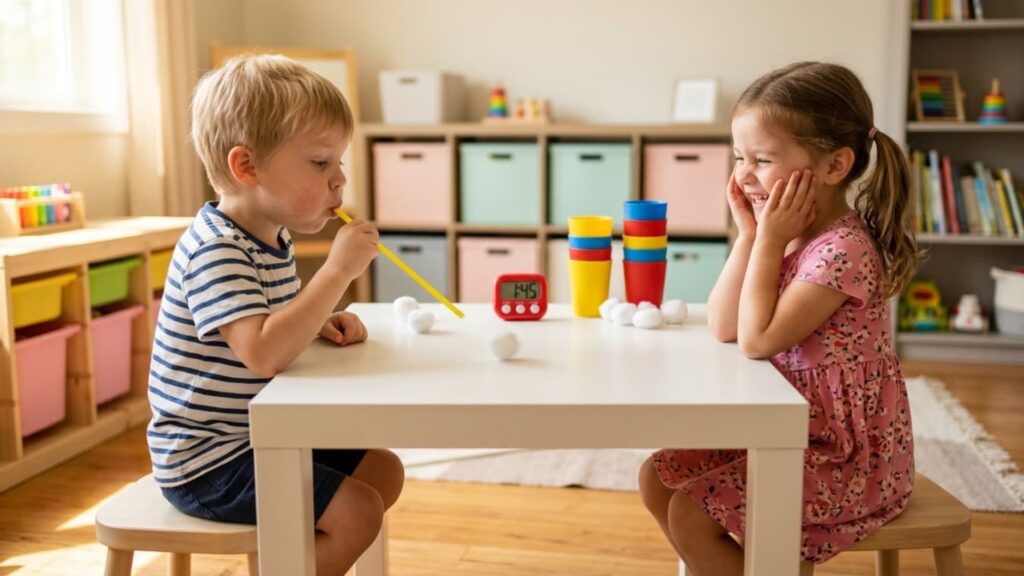
Small kids have big energy and even bigger reactions when they win. These 10 games are built for ages 4 to 7, with simple rules, safe materials, and zero frustration.
Game 1: Balloon Keep-Up
This one never gets old with young kids. They run, jump, and absolutely refuse to let the balloon touch the floor. It is one of the most requested games in this age group for good reason.
| Material | Quantity |
|---|---|
| Balloon | 1 per player |
| Timer | 1 |
- Blow up one balloon for each player.
- Start the timer when you say go.
- Players keep the balloon in the air for 60 seconds.
- If any balloon touches the ground, that player is out.
- The last player with their balloon still up wins.
Age Tip: Younger kids can use both hands. Allow only one hand for a small extra challenge.
Game 2: Cotton Ball Blow
This game looks easy the first time. Then the cotton ball drifts sideways, and the laughter starts. Young kids love the control challenge of steering something with only a straw.
| Material | Quantity |
|---|---|
| Straws | 1 per player |
| Cotton balls | 1 per player |
| Tape | To mark the start and finish lines |
| Timer | 1 |
- Mark a start line and a finish line on the table using tape.
- Place one cotton ball at the start line for each player.
- Give each player a straw.
- Start the timer.
- Players blow their cotton ball toward the finish line using the straw only.
- The first player to push past the finish line within 60 seconds wins.
Age Tip: Shorten the distance between the two lines for kids under 5.
Game 3: Cup Stack (Easy Version)
Stack them up, knock them down, build them again. This is one of the best starting games for ages 4 to 7. Ten cups hit the right balance for small hands and short rounds.
| Material | Quantity |
|---|---|
| Plastic cups | 10 per player |
| Timer | 1 |
- Give each player a column of 10 stacked cups.
- Start the timer.
- Players build a pyramid using all 10 cups.
- Once the pyramid is up, players stack them back into one column.
- Finish both steps within 60 seconds to win.
Age Tip: Drop it to 6 cups for children under 5 to keep it achievable.
Game 4: Spoon and Ball Roll
Coordination plus a moving target is the perfect recipe for giggles. Kids push a ball across the room using only a spoon, and it is far harder to control than it looks at this age.
| Material | Quantity |
|---|---|
| Plastic spoon | 1 per player |
| Ping pong ball or tennis ball | 1 per player |
| Tape | To mark the start and finish lines |
| Timer | 1 |
- Mark a start line and a finish line on the floor with tape.
- Give each player a spoon and a ball.
- Start the timer.
- Players push the ball from the start to the finish line using only the spoon.
- Hands cannot touch the ball at any point during the round.
- The first player to cross the finish line within 60 seconds wins.
Age Tip: Use a tennis ball instead of a ping pong ball for toddlers. It is easier to control.
Game 5: Sock Toss
You already have everything you need for this one right at home. Roll up some socks, set up a basket across the room, and let kids toss them. It is a perfect game for rainy afternoons with zero prep.
| Material | Quantity |
|---|---|
| Rolled-up sock balls | 6 to 10 per player |
| Laundry basket or large bowl | 1 |
| Timer | 1 |
- Place a laundry basket on the floor at the far end of the room.
- Mark a throwing line for players to stand behind.
- Give each player their sock balls.
- Start the timer.
- Players toss as many sock balls into the basket as possible within 60 seconds.
- Count how many are inside the basket when time is called.
Age Tip: Move the basket closer for younger players and farther back as kids improve.
Game 6: Color Sort
This game keeps kids busy and quietly builds sorting skills at the same time. Use colored pom-poms or small candy pieces to make the round feel more hands-on and exciting for this age group.
| Material | Quantity |
|---|---|
| Mixed colored pom-poms or candy pieces | 30 to 40 |
| Small cups or bowls | 1 per color |
| Timer | 1 |
- Mix all pieces together in one large bowl.
- Set out one small cup or bowl for each color.
- Place the mixed bowl in front of each player.
- Start the timer.
- Players sort each piece into the matching colored cup using one hand.
- Most pieces correctly sorted at 60 seconds wins.
Age Tip: Stick to 2 colors for ages 4 and 5. Add more colors as kids get older.
Game 7: Block Tower Build
Stack them as high as possible before the tower falls or time runs out. Foam blocks work best here since falling towers cause no concern, and kids can rebuild in seconds.
| Material | Quantity |
|---|---|
| Soft foam blocks or small boxes | 15 to 20 per player |
| Timer | 1 |
- Give each player a pile of blocks.
- Start the timer.
- Players stack as many blocks as possible without the tower falling.
- If the tower falls, players rebuild right away.
- The tallest tower still standing at the 60-second mark wins.
Age Tip: Count out loud together as each block gets placed. Young kids love the counting involvement.
Game 8: Feather Float
This is a calm-down game that works perfectly between high-energy rounds. Kids blow a craft feather into the air and keep it floating as long as possible without touching it.
| Material | Quantity |
|---|---|
| Craft feather | 1 per player |
| Timer | 1 |
- Give each player one craft feather.
- Start the timer.
- Players blow the feather into the air and keep it floating.
- Hands and body cannot touch the feather during the round.
- The player who keeps their feather in the air the longest within 60 seconds wins.
Age Tip: Use this game right after a physical round to bring the group’s energy back to a calm level.
Game 9: Paper Plate Toss
Turn paper plates into flying discs and watch young kids go all in. Set up a taped target on the floor, hand out the plates, and let them throw. It works well in any large room or outdoor space.
| Material | Quantity |
|---|---|
| Paper plates | 6 to 8 per player |
| Tape | To mark the target area on the floor |
| Timer | 1 |
- Mark a large circle or square on the floor with tape as the target zone.
- Mark a throwing line for players to stand behind.
- Give each player their paper plates.
- Start the timer.
- Players toss plates toward the target zone, frisbee style.
- Most plates inside the target zone at 60 seconds wins.
Age Tip: Make the target larger for very young players and smaller as kids get older.
Game 10: Sticker Dot Race
Fine motor skills meet a ticking clock in this simple but surprisingly engaging game. Give kids a sheet of numbered sticker dots and a matching chart, and watch them focus harder than expected.
| Material | Quantity |
|---|---|
| Sticker dot sheets | 1 per player |
| Numbered circle chart (printed or hand-drawn) | 1 per player |
| Timer | 1 |
- Print or draw a chart with numbered circles (1-20 works well).
- Give each player a chart and a sticker dot sheet.
- Start the timer.
- Players place each sticker dot onto its matching numbered circle as fast as possible.
- Most stickers correctly placed within 60 seconds wins.
Age Tip: Use larger stickers and bigger circles for toddlers. This one naturally builds number recognition, too.
Minute to Win It Games for School-Age Kids (Ages 8 to 12)
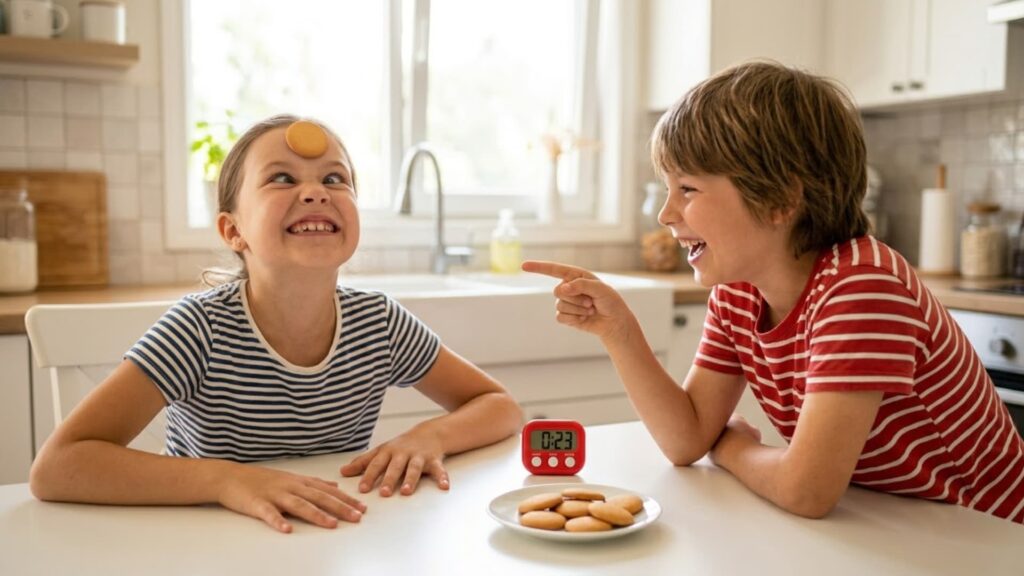
Kids in this age group want something that actually tests them. These 11 games bring in more coordination, faster thinking, and enough competitive energy to keep things interesting for a full session.
Game 11: Stack Attack
This one is a classic for a reason. Build a full pyramid with 36 cups, then take the whole thing back down into a single column, all before the timer reaches zero.
| Material | Quantity |
|---|---|
| Plastic cups | 36 per player |
| Timer | 1 |
- Give each player 36 cups in a single stacked column.
- Start the timer.
- Players build a full pyramid (6 at the bottom, scaling up to 1 at the top).
- Once complete, players stack all cups back into one column.
- Finish both steps within 60 seconds to win.
Age Tip: Skip the unstack step for first-timers. Let them master the pyramid build first.
Game 12: Cookie Face
Place a cookie on your forehead. Move it to your mouth. Use nothing but your face. It sounds ridiculous, and it absolutely is. This game brings more laughter than almost anything else on this list.
| Material | Quantity |
|---|---|
| Round flat cookie (vanilla wafer or similar) | 1 per player |
| Timer | 1 |
- Give each player one cookie.
- Players tilt their head back and place the cookie on their forehead.
- Start the timer.
- Players move the cookie from their forehead down into their mouth using only facial movements.
- Hands cannot touch the cookie at any point.
- The first player to get the cookie into their mouth wins.
Age Tip: Use a lighter cookie, like a vanilla wafer. Heavier cookies are much harder to slide down.
Game 13: Junk in the Trunk
A tissue box full of ping pong balls, tied to a player’s back. The job? Shake every last one out before time ends. This game is loud, funny, and impossible to watch without laughing.
| Material | Quantity |
|---|---|
| Empty tissue box | 1 per player |
| Ping pong balls | 6 to 8 per player |
| Belt or string | 1 per player |
| Timer | 1 |
- Fill each tissue box with ping pong balls.
- Attach the box to each player’s lower back using a belt or string.
- Start the timer.
- Players shake, jump, and wiggle to get every ball out.
- Hands cannot touch the box or balls at any point.
- The first player to empty their box completely wins.
Age Tip: Use 6 balls for a faster round and 8 for a harder challenge.
Game 14: Penny Tower
One hand, one stack, and a lot of concentration. Pennies slip easily on smooth surfaces, and the ticking of the clock does not help. This is one of the quieter games, but it pulls serious focus from every player.
| Material | Quantity |
|---|---|
| Pennies or coins | 50 to 100 per player |
| Small cloth or mat | 1 per player |
| Timer | 1 |
- Place a small cloth or mat on the table to reduce slipping.
- Give each player their pile of coins.
- Start the timer.
- Players stack as many coins as possible using one hand only.
- The second hand and body cannot touch the stack at any time.
- The tallest tower still standing at 60 seconds wins.
Age Tip: The cloth under the stack makes a bigger difference than most players expect.
Game 15: Marshmallow Toss
One player throws, and one player catches, but not with their hands. The catcher holds a paper cup and tries to collect as many marshmallows as possible. Both players stay fully involved throughout.
| Material | Quantity |
|---|---|
| Marshmallows | 20 to 30 per pair |
| Small paper cups | 1 per pair |
| Timer | 1 |
- Pair up, players.
- One player holds the paper cup at chest height.
- The other player stands a short distance away with all the marshmallows.
- Start the timer.
- The thrower tosses marshmallows one at a time toward the cup.
- The catcher keeps the cup steady throughout.
- Most marshmallows inside the cup at 60 seconds wins.
Age Tip: Set the starting distance based on each pair’s skill level. Adjust mid-game if needed.
Game 16: Movin’ On Up
This cup game runs on patience and rhythm. One differently colored cup starts at the very bottom of a 25-cup stack. Players move the top cup to the bottom, one at a time, until the colored one rises all the way up.
| Material | Quantity |
|---|---|
| Plastic cups in one color | 24 per player |
| Plastic cup in a different color | 1 per player |
| Timer | 1 |
- Stack all cups with the different-colored cup at the very bottom.
- Start the timer.
- Players move the top cup to the bottom of the stack, one cup at a time.
- Repeat until the different-colored cup reaches the top.
- The player who gets it to the top within 60 seconds wins.
Age Tip: Use 15 cups instead of 25 to speed up the round for the younger end of this age group.
Game 17: Chopstick Candy Transfer
This game tests grip, focus, and patience all at once. Players use chopsticks to move small candy pieces from one plate to another, and the round shapes make it far harder than it looks.
| Material | Quantity |
|---|---|
| Chopsticks | 1 pair per player |
| Candy or small items | 15 pieces per player |
| Plates | 2 per player |
| Timer | 1 |
- Place 15 candy pieces on a plate for each player.
- Set an empty plate directly beside it.
- Give each player a pair of chopsticks.
- Start the timer.
- Players pick up a piece of candy at a time and move it to the empty plate.
- No part of the body except the chopsticks can touch the candy.
- Most candy transferred at 60 seconds wins.
Age Tip: Swap candy for marshmallows for players new to chopstick games. They grip much more easily.
Game 18: Straw Cereal Thread
Hold a straw in your mouth and use suction to pick up cereal rings, then slide each one onto a standing pipe cleaner. It takes more coordination than players expect and gets very competitive quickly.
| Material | Quantity |
|---|---|
| Straw | 1 per player |
| Pipe cleaner (held upright in a base) | 1 per player |
| Froot Loops or Cheerios | 20 to 30 per player |
| Timer | 1 |
- Set up each pipe cleaner upright in a small clay base or tape it to an empty cup.
- Spread cereal pieces flat on a plate in front of each player.
- Give each player a straw.
- Start the timer.
- Players hold the straw in their mouth and use suction to pick up cereal pieces.
- Each piece must be slid off the straw and onto the pipe cleaner.
- Most pieces on the pipe cleaner at 60 seconds wins.
Age Tip: Slightly bend the top of the pipe cleaner to stop pieces from sliding off once placed.
Game 19: Rubber Band Shooting Gallery
Set up a row of empty cans and let kids knock them down with rubber bands. Mark a throwing line and count how many cans fall within 60 seconds. A very simple setup with a big reaction from the group.
| Material | Quantity |
|---|---|
| Rubber bands | 10 to 15 per player |
| Empty aluminum cans | 8 to 10 |
| Tape | To mark the throwing line |
| Timer | 1 |
- Line up the cans side by side on a table or flat surface.
- Mark a throwing line on the floor 10 feet away.
- Give each player their rubber bands.
- Start the timer.
- Players shoot rubber bands from behind the line to knock over cans.
- Each knocked-over can counts as 1 point.
- Most rounds are down to 60-second wins.
Age Tip: Move the line closer for players new to rubber-band aim.
Game 20: Bottle to Bottle Transfer
Fill one 2-liter bottle, tape an empty one upside down on top, and flip the whole thing. Players swirl and shake to get all items from the top bottle into the bottom one before the clock runs out.
| Material | Quantity |
|---|---|
| 2-liter soda bottles | 2 per player |
| Tape | To connect both bottles |
| Small items (Cheerios or jelly beans) | Enough to fill one bottle |
| Timer | 1 |
- Fill one bottle with the small items.
- Tape the second (empty) bottle to the opening of the first.
- The full bottle sits on top at the start.
- Start the timer.
- Players swirl and shake the bottles to move all items from the top down to the bottom.
- All items transferred before 60 seconds win.
Age Tip: Use Cheerios for a faster transfer. Jelly beans or heavier items make the round longer.
Game 21: Apple Stack
Five apples, one stack, and no support allowed. Players must balance all five on top of each other so the tower stands freely for at least three full seconds. It tests focus and very careful placement.
| Material | Quantity |
|---|---|
| Apples | 5 per player |
| Timer | 1 |
- Place 5 apples in front of each player.
- Start the timer.
- Players stack all 5 apples on top of each other, one by one.
- The finished stack must stand freely without the player holding it.
- It must stay upright for at least 3 unassisted seconds to count as a win.
- The first player to achieve a valid standing stack within 60 seconds wins.
Age Tip: Allow just 3 apples for players on the younger end of this group who are new to the game.
Minute to Win It Games for Tweens and Teens (Ages 13 and Up)
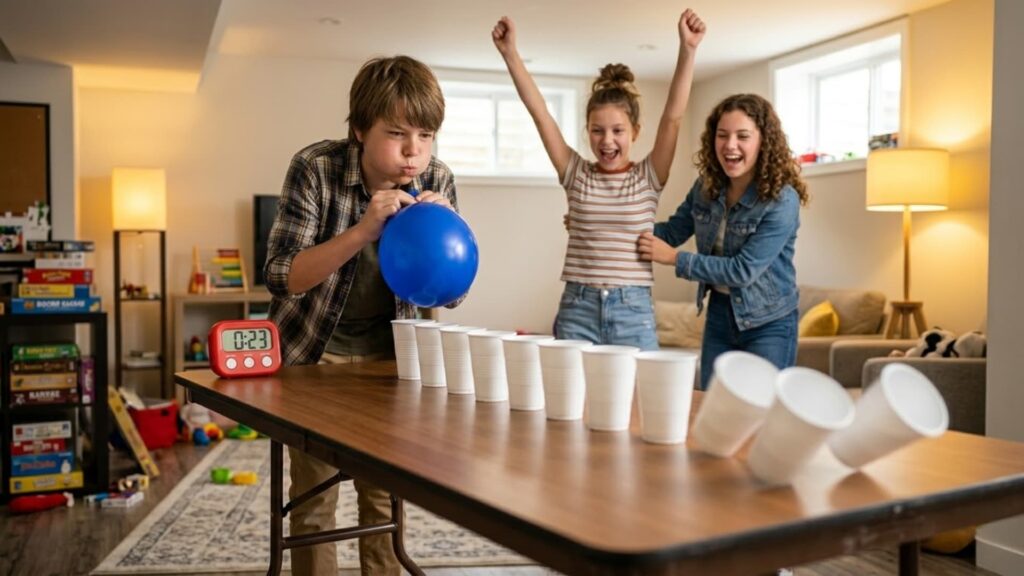
Older kids need games that match their energy and competitive streak. These 11 challenges are faster, sharper, and built to hold the attention of anyone over 13 who thinks they have outgrown fun games.
Game 22: This Blows
Blow up a balloon as fast as possible, then use the escaping air to knock over a line of cups. Players can use multiple balloons in a single round, and the strategy is to figure out the best release angle.
| Material | Quantity |
|---|---|
| Balloons | 3 to 4 per player |
| Plastic cups | 10 per player |
| Timer | 1 |
- Line up 10 cups in a row in front of each player.
- Give each player several balloons.
- Start the timer.
- Players blow up a balloon without tying it off.
- They aim the balloon opening at the cups and release the air to knock them over.
- Players can use multiple balloons throughout the 60 seconds.
- Most cups knocked down at 60 seconds wins.
Age Tip: Set a target number of cups to topple to create a clear win condition for each round.
Game 23: Dice on a Stick
This game looks completely impossible from the outside. Players hold a popsicle stick in their mouth and stack dice on the flat end, one by one. Drop the stack, and you start again from the first die.
| Material | Quantity |
|---|---|
| Popsicle sticks | 1 per player |
| Dice | 6 per player |
| Timer | 1 |
- Give each player a popsicle stick and 6 dice.
- Players hold the flat end of the stick horizontally in their mouth.
- Start the timer.
- Players pick up dice one at a time and place them on the end of the stick.
- If the stack falls at any point, players restart from the first die.
- Most dice stacked without falling at 60 seconds wins.
Age Tip: Start with 3 dice to build confidence before adding the full 6.
Game 24: Alphabet Backward Race
Most kids can say the regular alphabet in seconds. Going backward while writing it is a completely different challenge. Players write Z down to A as fast as possible with no reference and no head starts.
| Material | Quantity |
|---|---|
| Paper | 1 per player |
| Pen or pencil | 1 per player |
| Timer | 1 |
- Give each player a piece of paper and a pen.
- Start the timer.
- Players write the alphabet from Z to A.
- Writing the forward alphabet for reference is not allowed.
- The first player to write the full backward alphabet correctly within 60 seconds wins.
Age Tip: For a faster version, have players say it out loud instead of writing it.
Game 25: Anagram Blitz
Give players a long word and see how many smaller words they can pull from its letters before time runs out. It works the brain and gets very competitive once players start comparing their lists.
| Material | Quantity |
|---|---|
| Paper | 1 per player |
| Pen or pencil | 1 per player |
| Source word written on a board or card | 1 |
| Timer | 1 |
- Write a 7 to 10-letter word on a board that all players can see.
- Give each player a piece of paper and a pen.
- Start the timer.
- Players write as many smaller words as possible using letters from the source word.
- Letters may only be used as many times as they appear in the source word.
- No proper nouns are allowed.
- The most valid words at 60 seconds win.
Age Tip: Use words like “splinter” or “teachers” for older teens who need a real test.
Game 26: Pretzel Chopstick
Hold a chopstick in your mouth and thread ring-shaped pretzels onto it one by one with no hands. Keeping the stick at the right angle while bending toward the pretzels is harder than it sounds.
| Material | Quantity |
|---|---|
| Chopstick | 1 per player |
| Ring-shaped pretzels | 20 to 25 per player |
| Timer | 1 |
- Place a pile of ring-shaped pretzels flat on the table in front of each player.
- Players hold the chopsticks in their mouths, pointing forward and parallel to the table.
- Start the timer.
- Players lean forward and thread pretzels onto the chopstick without using their hands.
- Hands cannot touch the pretzels or the stick at any point.
- Most pretzels on the stick at 60 seconds wins.
Age Tip: Only ring-shaped pretzels thread cleanly. Straight or folded pretzels will not work.
Game 27: Card Sort Sprint
Throw a full deck of playing cards across the floor, then race to sort every card into its correct suit before time ends. It is physical, fast, and a real combined test of memory and movement.
| Material | Quantity |
|---|---|
| Full deck of playing cards | 1 per player |
| Tape | To mark 4 suit sorting zones |
| Timer | 1 |
- Tape 4 zones on the floor, one for each card suit.
- Give each player a full deck.
- Players throw their deck to scatter the cards across the floor.
- Start the timer.
- Players pick up cards and place each one in the correct suit zone as fast as possible.
- Most cards correctly sorted at 60 seconds wins.
Age Tip: For a harder version, sort by number order within each suit zone.
Game 28: Bottle Flip Challenge
Half-fill a water bottle, flip it, and land it upright. Each clean upright landing counts as one point. Players go back and forth until the timer ends. Every successful landing matters here.
| Material | Quantity |
|---|---|
| Plastic water bottle (one-third filled with water) | 1 per player |
| Timer | 1 |
- Fill each bottle approximately one-third of the way with water.
- Give each player their bottle.
- Start the timer.
- Players flip the bottle upward and try to land it upright on a flat surface.
- Each clean, upright landing counts as 1 point.
- Most successful landings at 60 seconds win.
Age Tip: Fill the bottle exactly one-third full. Too much or too little water makes clean landings rare.
Game 29: Tic-Tac Shake
Tape two full Tic Tac containers to both ends of a ruler. Players hold the ruler in their mouth and shake it side to side to empty both containers in under a minute. It is one of the funniest games on this list.
| Material | Quantity |
|---|---|
| Full Tic Tac containers | 2 per player |
| Ruler | 1 per player |
| Tape | To attach containers to the ruler ends |
| Timer | 1 |
- Tape one full Tic Tac container to each end of a ruler.
- Open both containers before the timer starts.
- Players hold the center of the ruler in their mouth.
- Start the timer.
- Players shake the ruler back and forth to empty both containers.
- First player to fully empty both within 60 seconds wins.
Age Tip: Save this one for when the group needs a burst of energy. It delivers every single time.
Game 30: Chopstick Ring Toss
Two players, one chopstick, and a pile of rings. One player holds the chopstick in their mouth while the other tosses rings onto it from a short distance. Both steadiness and communication are tested here.
| Material | Quantity |
|---|---|
| Chopstick | 1 per pair |
| Ring-shaped items (gummy rings, hair ties, or small rings) | 15 to 20 per pair |
| Timer | 1 |
- Pair up, players.
- One player holds the chopstick in their mouth, pointing forward.
- The other player stands 3 to 5 feet away with the rings.
- Start the timer.
- The tosser throws rings one at a time toward the chopstick.
- The holder keeps the stick as still as possible and cannot use their hands to help.
- Most rings on the stick at 60 seconds wins.
Age Tip: Move players farther apart once they start landing rings consistently.
Game 31: Price Order Challenge
Collect 10 household or food items at different price points. Players arrange them from highest to lowest price in 60 seconds. After time is up, reveal only how many are placed correctly, not which ones. The thinking never really stops.
| Material | Quantity |
|---|---|
| Common household or food items | 10 |
| Hidden price tags | 10 |
| Timer | 1 |
- Collect 10 items and write the real price of each on a hidden tag.
- Place all items on a table in random order.
- Start the timer.
- Players arrange the items from highest to lowest price within 60 seconds.
- After time ends, reveal only how many are in the correct position, not which ones.
- The most correctly placed items win.
Age Tip: Only telling players the correct number forces them to repeat strategic thinking on each attempt.
Game 32: Straw Wrapper Chain
Use paper wrappers from straws to build the longest chain possible in 60 seconds. Each wrapper links into the next. The chain that stretches the farthest when held up at the end of time wins.
| Material | Quantity |
|---|---|
| Straw paper wrappers | 30 to 40 per player |
| Timer | 1 |
- Give each player a pile of paper straw wrappers.
- Lightly scrunch both ends of each wrapper before play starts.
- Start the timer.
- Players link wrappers end-to-end as fast as possible.
- Each wrapper connects by pushing one scrunched end into the open end of the next.
- The longest single connected chain at 60 seconds wins.
Age Tip: Pre-scrunching the ends before the round saves seconds and helps players get started faster.
Team Minute to Win It Games for Kids (Group Play)
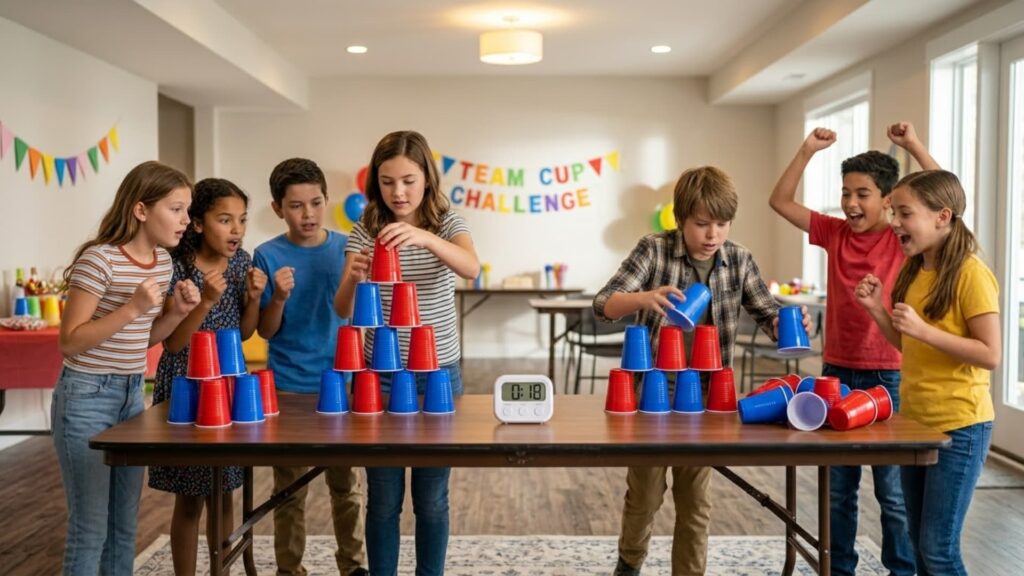
Some games feel completely different when a team is counting on you. These 11 challenges are built for groups, where working well together is the real gap between winning and a very funny loss.
Game 33: Sticky Note Cover
One teammate sticks as many sticky notes as possible on their partner in 60 seconds. Notes cannot overlap, and both players must commit for this to work well. The competitive energy builds fast.
| Material | Quantity |
|---|---|
| Sticky note pads | 2 to 3 per pair |
| Timer | 1 |
- Pair up all players.
- Give one player in each pair the sticky notes.
- Start the timer.
- The active player sticks as many notes as possible on their partner.
- Notes cannot overlap at any point.
- Most non-overlapping notes are placed at 60-second wins.
Team Tip: Large sticky note pads work better than small ones for sticking evenly to clothing.
Game 34: Balloon Square
Three players stand inside a taped square and keep three balloons in the air at the same time. No one steps outside the square. All three balloons must stay up for the full 60 seconds to win.
| Material | Quantity |
|---|---|
| Balloons | 3 per team |
| Tape | To mark the square on the floor |
| Timer | 1 |
- Tape a square on the floor approximately 4 feet by 4 feet.
- Blow up 3 balloons and hand them to the team.
- Three players stand inside the square.
- Start the timer.
- All 3 balloons must stay in the air for the full 60 seconds.
- A balloon hitting the floor or a player stepping outside ends the round for that team.
Team Tip: Shrink the square or add a fourth balloon to challenge stronger teams.
Game 35: Spoon Circle Pass
Players sit in a circle and pass a ping-pong ball from spoon to spoon, with no hands allowed. Drop the ball, and it goes back to the person who dropped it. The team tries to complete as many full laps as possible.
| Material | Quantity |
|---|---|
| Plastic spoons | 1 per player |
| Ping pong ball | 1 per group |
| Timer | 1 |
- Players sit in a circle, each holding a spoon.
- Place the ping pong ball on the first player’s spoon.
- Start the timer.
- Players pass the ball around the circle using only their spoons.
- Hands cannot touch the ball at any point.
- If the ball drops, it returns to the player who dropped it, and the pass continues from there.
- The team with the most full-circle passes at 60 seconds wins.
Team Tip: For large groups, run two separate circles competing against each other at the same time.
Game 36: Cup and Ball Catch Walk
Two players start toe to toe. One tosses a ball into the other player’s cup. If caught, both take one step back. The pair that ends up standing the farthest apart at 60 seconds wins the round.
| Material | Quantity |
|---|---|
| Plastic cups | 1 per player |
| Small ball or ping pong ball | 1 per pair |
| Timer | 1 |
- Pair players up and have them stand toe-to-toe.
- Give each player one cup.
- Decide who starts as the thrower.
- Start the timer.
- The thrower tosses the ball gently into the other player’s cup.
- A successful catch means both players take exactly one step backward.
- A missed toss means both stay in place and try again.
- The pair standing the farthest apart at 60 seconds wins.
Team Tip: Run multiple pairs at the same time to keep all players active throughout the round.
Game 37: Team Cup Pyramid
Each team gets a pile of cups and exactly 60 seconds to build the tallest pyramid possible. Assign roles before starting. One person hands cups, others build. Strategy matters just as much as speed here.
| Material | Quantity |
|---|---|
| Plastic cups | 25 to 36 per team |
| Timer | 1 |
- Give each team a pile of cups.
- Start the timer.
- Teams race to build the tallest pyramid structure they can within 60 seconds.
- Cups can be arranged in any pyramid style the team chooses.
- The pyramid must still be standing when time is called.
- The team with the tallest standing pyramid wins.
Team Tip: Having one person handle cups prevents the whole team from grabbing at once and slows everyone down.
Game 38: Human Conveyor Belt
Teams line up and pass a soft object from one end to the other using only their elbows. No hands at any point. Drop the object, and it goes back to the person who dropped it and restarts from there.
| Material | Quantity |
|---|---|
| Small stuffed animal or rolled-up socks | 1 per team |
| Timer | 1 |
- Teams stand in a straight line side by side.
- Give the object to the first player in each team’s line.
- Start the timer.
- Players pass the object from person to person using only their elbows.
- Hands cannot make contact with the object at any point.
- If the object drops, it goes back to the player who dropped it.
- First team to pass the object from one end to the other wins.
Team Tip: Do a quick grip practice run before starting so everyone understands how to hold the object correctly.
Game 39: Back-to-Back Balloon
Two players stand back-to-back, with a balloon pressed between them and no hands. They must walk together from a start line to a finish line without dropping the balloon. Drop it, and the pair returns to the start.
| Material | Quantity |
|---|---|
| Balloon | 1 per pair |
| Tape | To mark the start and finish lines |
| Timer | 1 |
- Blow up one balloon for each pair.
- Mark a start line and a finish line on the floor.
- Each pair stands back-to-back, with the balloon held between them.
- Start the timer.
- Pairs walk together from the start to the finish line.
- Hands and arms cannot touch the balloon during the walk.
- If the balloon falls, the pair returns to the start.
- The first pair to cross the finish line wins.
Team Tip: Set up a relay version by having the next pair continue after each successful crossing.
Game 40: Marshmallow Tower
Build the tallest free-standing structure possible using only marshmallows and uncooked spaghetti sticks. Teams split the building tasks and race to get their tower higher than every other team in the room.
| Material | Quantity |
|---|---|
| Marshmallows | 20 per team |
| Uncooked spaghetti sticks | 15 to 20 per team |
| Timer | 1 |
- Give each team the same number of marshmallows and spaghetti sticks.
- Start the timer.
- Teams use marshmallows as joints and spaghetti as beams to build the tallest structure possible.
- The structure must stand freely on its own.
- Players cannot hold it up when time is called.
- The tallest free-standing structure at 60 seconds wins.
Team Tip: A wider base almost always leads to a taller final build. Teams that rush straight up usually fall first.
Game 41: Newspaper Walk
Each player gets exactly two sheets of newspaper. They can only step on those sheets to move across the room. Players pick up, place forward, and step as they go. First full team with everyone across the finish line wins.
| Material | Quantity |
|---|---|
| Newspaper sheets | 2 per player |
| Tape | To mark the start and finish lines |
| Timer | 1 |
- Mark a start line and a finish line on the floor.
- Give each player two sheets of newspaper.
- Start the timer.
- Players may only step on their newspaper sheets and cannot touch the floor otherwise.
- They step onto the front sheet, pick up the back sheet, place it forward, and step onto it.
- Teams work to get all members across the finish line.
- The first team with every player past the finish line within 60 seconds wins.
Team Tip: This game works best on smooth floors. Carpet makes sheets less predictable and harder to pick up cleanly.
Game 42: Tissue Box Shake Relay
Fill a tissue box to the top, start a relay, and let both players pull. Player one pulls for the first 30 seconds. Player two takes over immediately after. The team that pulls out the most tissues wins.
| Material | Quantity |
|---|---|
| Full tissue box | 1 per team |
| Timer | 1 |
- Fill each tissue box with a fresh pack of tissues.
- Split each team into pairs.
- Start the timer.
- Player one pulls tissues out one at a time using one hand for the first 30 seconds.
- At 30 seconds, player two takes over and continues.
- The team with the most tissues out at 60 seconds wins.
Team Tip: A steady pull works better than a fast yank. Rushing crumples multiple tissues and slows the count.
Game 43: Hula Hoop Pass
A team of 6 to 10 players stands in a circle holding hands. One hula hoop starts on a pair of joined hands. The team must pass it around the full circle without anyone letting go of their neighbor’s hand.
| Material | Quantity |
|---|---|
| Hula hoop | 1 per team |
| Timer | 1 |
- Teams of 6 to 10 stand in a circle and hold hands.
- Place one hula hoop over a pair of joined hands before starting.
- Start the timer.
- Teams pass the hoop around the full circle by stepping through it and leaning.
- No player may release their neighbor’s hand at any point.
- The first team to pass the hoop around the complete circle within 60 seconds wins.
- For a harder version, add a second hoop going in the opposite direction at the same time.
Team Tip: The player receiving the hoop should lean toward it. Waiting for the person next to them to push it loses seconds.
No-Prep Minute to Win It Games for Kids
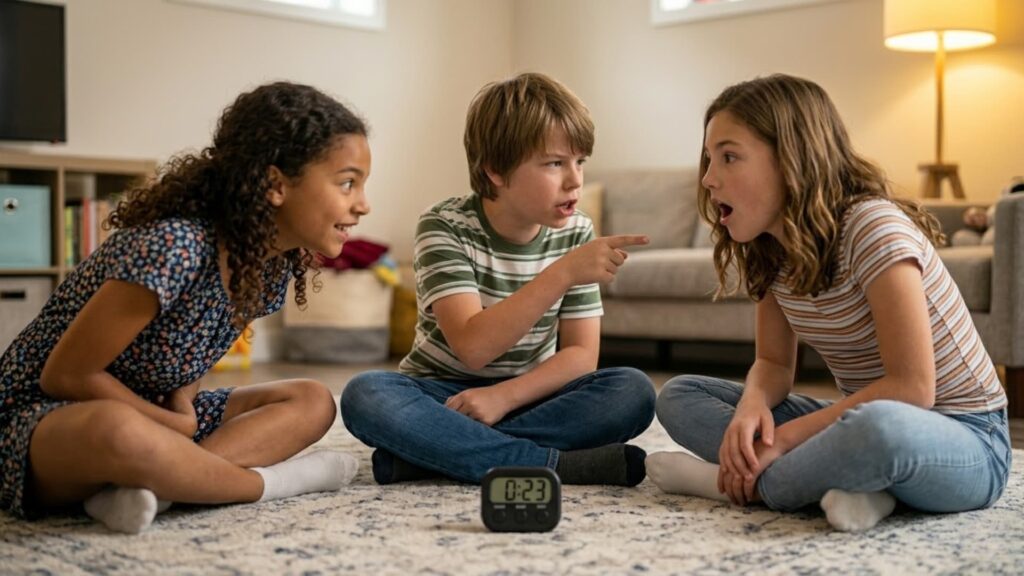
Sometimes you need a game with no bag to grab, no supplies to find, and absolutely no setup. These 11 challenges need nothing but the kids themselves and a working timer to run a full, engaging round.
Game 44: Thumb War Tournament
Two players lock hands and battle in thumb wars for a full 60 seconds. The goal is to win as many rounds as possible before the timer ends. Fast, physical, and it needs absolutely nothing but two players and a timer.
| Material | Quantity |
|---|---|
| Timer | 1 |
- Pair up, players.
- Both players lock hands in the standard thumb-war position.
- Start the timer.
- Players compete in as many thumb war rounds as possible within 60 seconds.
- Each individual round won counts as 1 point.
- The player with the most wins at 60 seconds takes the game.
No-Prep Tip: For larger groups, run a tournament bracket and have the winners face off each round.
Game 45: Alphabet Backward (Spoken)
Going backward with no pencil in hand is a completely different challenge. Players say the full alphabet out loud, starting from Z and working down to A, with no writing and no hints allowed throughout.
| Material | Quantity |
|---|---|
| Timer | 1 |
- Players stand or sit with nothing in their hands.
- Start the timer.
- Each player says the alphabet out loud, starting from Z down to A.
- No writing, counting on fingers, or miming letters is allowed.
- A pause of more than 3 seconds means starting over from Z.
- First player to say the full backward alphabet correctly within 60 seconds wins.
No-Prep Tip: Watch how many players freeze somewhere around the letter P. It happens almost every round.
Game 46: Memory Chain
Player one says a word. Player two repeats it and adds one more. Each player repeats the full growing list and adds their own word. Forget the order or add the wrong word, and the chain resets right from your spot.
| Material | Quantity |
|---|---|
| Timer | 1 |
- Players sit or stand in a circle.
- Player one says one word to begin.
- Player two repeats the word and adds a new one after it.
- Each player repeats the entire list in order and adds one more word.
- If a player gets the chain wrong, the chain resets from their position with a new starting word.
- The longest chain successfully built within 60 seconds wins.
No-Prep Tip: Pick a theme like animals or foods before starting to make the chain easier to build logically.
Game 47: Word Chain
Say a word. The next player must say a word that starts with the last letter of the previous one. Keep going without repeating anything. A 3-second pause or a repeated word removes that player from the round.
| Material | Quantity |
|---|---|
| Timer | 1 |
- Players sit or stand in a circle.
- Player one says any word to begin.
- The next player says a word that starts with the last letter of the previous word.
- No word from this round can be reused.
- A pause of more than 3 seconds means that the player is out.
- The last player still in at 60 seconds wins.
No-Prep Tip: Setting a theme like food, animals, or cities adds a knowledge test to the speed challenge.
Game 48: Rock Paper Scissors Marathon
Two players face off in back-to-back rock-paper-scissors rounds for a full 60 seconds. Speed is the whole point here. Count wins, count losses, and see who comes out ahead when the timer goes off.
| Material | Quantity |
|---|---|
| Timer | 1 |
- Pair up, players.
- Start the timer.
- Both players count to three and show their hand sign at the same time.
- Note who wins each round.
- Players go directly into the next round without any pause between them.
- The player with the most wins at 60 seconds takes the game.
No-Prep Tip: Run a full bracket with larger groups. Winners from each pair face each other in the next round.
Game 49: Number Skip Count
Count from 1 upward as fast as possible. The catch is that every number containing the digit 3 must be silently skipped. Say one of those numbers out loud, and the whole count resets back to 1.
| Material | Quantity |
|---|---|
| Timer | 1 |
- Start the timer.
- The player counts out loud from 1 and goes upward as fast as possible.
- Any number containing the digit 3 must be silently passed over without saying it.
- This covers 3, 13, 23, 30, 31, 32, 33, 34, 35, 36, 37, 38, 39, and so on.
- Saying a forbidden number out loud resets the count to 1.
- The highest correct number reached at 60 seconds wins.
No-Prep Tip: Allow one quick practice run before the timed round so players fully understand the 3 rule.
Game 50: Name That Category
Call out a theme, and players take turns naming things that fit. Anyone who repeats a word already said or pauses for more than 3 seconds is out of the round. The last player still in at 60 seconds wins.
| Material | Quantity |
|---|---|
| Timer | 1 |
- Choose a category before the round starts (animals, food, sports, movie characters, etc.).
- Players stand or sit in a circle.
- Players take turns calling out one item in the category per turn.
- Repeating an item already said means that the player is immediately out.
- A pause of more than 3 seconds also removes that player.
- The last player still in the round at 60 seconds wins.
No-Prep Tip: Start with easy categories and progressively get harder as players warm up and the rounds go on.
Game 51: Simon Says Sprint
The fastest Simon Says round anyone in the group has ever played. Commands fly one after another with almost no gap between them. Any player who follows a command without the “Simon says” opener is immediately out.
| Material | Quantity |
|---|---|
| Timer | 1 |
- Choose one player to act as Simon.
- Start the timer.
- Simon calls out commands as fast as possible, one after another.
- All other players must only follow commands that begin with “Simon says.”
- Following a command without that opener removes that player from the round immediately.
- Commands should come every 2 to 3 seconds to keep the pace fast.
- The last player still in at 60 seconds wins.
No-Prep Tip: Rotate who plays Simon in longer sessions so everyone gets a turn giving commands.
Game 52: Tongue Twister Race
Pick one tongue twister and see who can repeat it correctly the most times in 60 seconds. Each clean, full recitation counts as one point. Any stumble on a word means that the attempt does not count toward the total.
| Material | Quantity |
|---|---|
| Timer | 1 |
- Agree on one tongue twister that all players will use in the round.
- Start the timer.
- Players say the tongue twister as clearly and as fast as possible.
- Each complete, correctly spoken recitation counts as 1 point.
- Any stumbled version does not count toward the total.
- Most clean recitations at 60 seconds win.
No-Prep Tip: “She sells seashells” and “Red lorry yellow lorry” work well since most kids already know them.
Game 53: Would You Rather Rapid Fire
One player fires rapid “Would You Rather” questions at the group. Each player must answer within 2 seconds. A pause longer than 2 seconds earns player 1 a penalty point. The fewest penalty points at 60 seconds wins.
| Material | Quantity |
|---|---|
| Timer | 1 |
| Optional prepared question list | 1 |
- One player prepares as the question-asker before the round starts.
- Start the timer.
- The asker fires “Would You Rather” questions one after another.
- Every player must call out their answer within 2 seconds of hearing the question.
- A pause longer than 2 seconds earns player 1 a penalty point.
- The asker should deliver roughly one question every 5 to 7 seconds.
- The player with the fewest penalty points at 60 seconds wins.
No-Prep Tip: Keep every question age-appropriate and lighthearted. Heavy topics slow the energy down fast.
Game 54: Story One Word at a Time
Players build a story together by each saying exactly one word at a time in order. The story must stay logical. Say something that breaks the flow, and you are out. The game gets funnier and harder the longer it runs.
| Material | Quantity |
|---|---|
| Timer | 1 |
| An optional phone to record the story | 1 |
- Players sit in a circle.
- Start the timer.
- Player one says one word to begin the story.
- Each player adds exactly one word to continue it.
- A player who says something completely nonsensical or that breaks the sentence is out.
- Continue building the story until time ends.
- Optional: record the story on a phone and play it back for everyone to hear afterward.
No-Prep Tip: Start the story with a simple word like “Once” or “Yesterday” to help younger players jump in quickly.
Minute to Win It Games for Kids at School (Classroom-Friendly)
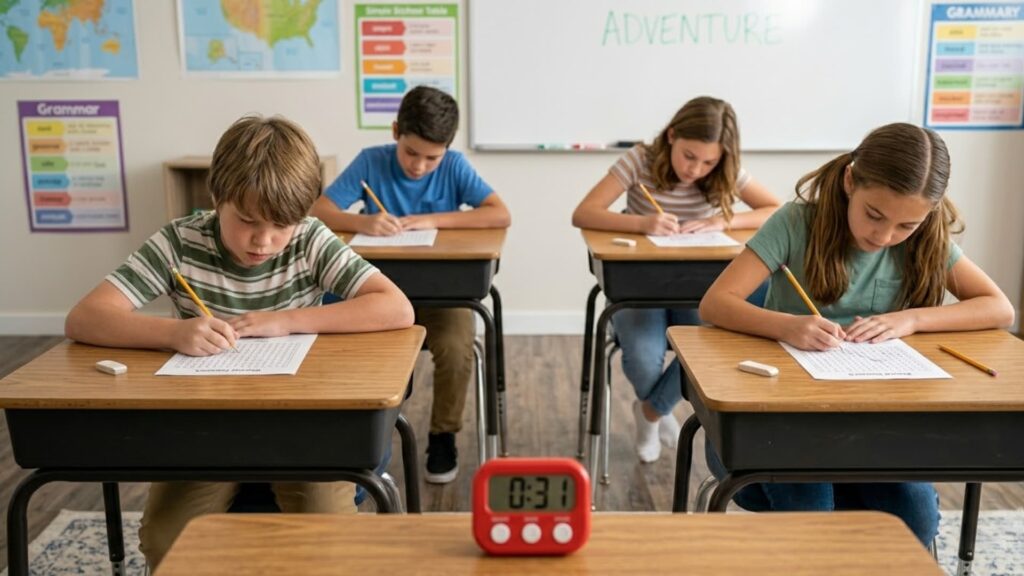
These 11 games were chosen specifically for classroom settings. They are low-mess, low-noise options that a teacher or activity leader can run smoothly with a full group in a short amount of time.
Game 55: Card Match Race
Lay matching cards face down across a desk. Players flip two at a time, searching for pairs. Remembering where each card landed while the clock counts down is the real challenge of this game.
| Material | Quantity |
|---|---|
| Playing cards or a matching card set | 1 deck per player |
| Timer | 1 |
- Lay a set of cards face down in a grid on each player’s desk.
- Start the timer.
- Players flip two cards at a time, looking for a matching pair.
- Matched pairs are left face up on the desk.
- Non-matching pairs are flipped back face down, and the player tries again.
- Most matched pairs found at 60 seconds wins.
Classroom Tip: This works well as a paired activity at adjoining desks. Great for a 2-minute brain break between lessons.
Game 56: Scrambled Words Sprint
Write common words with their letters out of order on index cards. Hold up one card at a time. The first student to call out the correctly unscrambled word scores a point for their team.
| Material | Quantity |
|---|---|
| Index cards with scrambled words | 10 to 15 |
| Timer | 1 |
- Prepare index cards with scrambled words before the session.
- Split students into two teams standing in lines facing the teacher.
- Start the timer.
- Hold up one scrambled word card at a time.
- The first student from either team to call out the correct word scores 1 point.
- Rotate through all cards for the full 60 seconds.
- The team with the most points at 60 seconds wins.
Classroom Tip: Use current vocabulary words from an active lesson to connect the game to subject content.
Game 57: Sticky Note Partner Cover
This game works best as a short, high-energy break between focused lessons. Students stick as many sticky notes as possible on their partner in 60 seconds, without any notes overlapping.
| Material | Quantity |
|---|---|
| Sticky note pads | 2 to 3 per pair |
| Timer | 1 |
- Pair students up at or near their desks.
- Give one sticky note pad the each student in each pair.
- Start the timer.
- The active student sticks as many notes as possible on their partner.
- Notes cannot overlap at any point.
- Most non-overlapping notes are placed at 60-second wins.
Classroom Tip: Push desks slightly apart before starting so students have room to move without bumping neighbors.
Game 58: Egg Crate Bounce
Players bounce ping pong balls off a table and try to land them inside the cups of an egg carton. Every ball that lands and stays inside a cup without bouncing back out counts as one point.
| Material | Quantity |
|---|---|
| Empty egg carton (12 or 18 cups) | 1 per player |
| Ping pong balls | 8 to 10 per player |
| Timer | 1 |
- Place an egg carton flat on the table in front of each player.
- Give each player their ping pong balls.
- Players stand on one side of the table.
- Start the timer.
- Players bounce ping pong balls off the table surface, one at a time.
- Balls that land and stay inside an egg cup count as 1 point each.
- Balls that bounce back out do not count.
- Most valid landings at 60 seconds wins.
Classroom Tip: Run this one in a hallway using a folding table to keep the bouncing contained and noise away from other classrooms.
Game 59: Paper Clip Chain
Students link as many paper clips together as possible in 60 seconds. It tests fine motor control and speed equally. No special materials are needed beyond a standard pile of paper clips.
| Material | Quantity |
|---|---|
| Paper clips | 30 to 40 per student |
| Timer | 1 |
- Give each student a pile of paper clips.
- Start the timer.
- Students link paper clips end to end as fast as possible.
- The chain must be a single, continuous line, not separate pieces.
- The longest connected chain at 60 seconds wins.
Classroom Tip: This game is very quiet and very tidy. It works well as a calm individual station activity.
Game 60: Word Search Blitz
Print the same word search for every student. When the timer starts, everyone works at the same time. Most words correctly circled at 60 seconds wins. Use a topic-related search to make it connect to current lessons.
| Material | Quantity |
|---|---|
| Printed word search sheets | 1 per student |
| Pencils or pens | 1 per student |
| Timer | 1 |
- Print identical word search sheets for all students.
- Give each student a sheet and a pencil.
- Start the timer.
- Students circle as many hidden words as they can find in 60 seconds.
- Count the correctly circled words when time is called.
- The student with the most correct words wins.
Classroom Tip: A word search tied to the current lesson topic feels like a reward and still reinforces subject content.
Game 61: Cup Tower (Desk Version)
Individual cup stacking at each desk keeps things neat, organized, and competitive at the same time. Students build as high as they can in 60 seconds without letting their structure fall. No pyramid shape required.
| Material | Quantity |
|---|---|
| Plastic cups | 10 per student |
| Timer | 1 |
- Give each student 10 plastic cups at their desk.
- Start the timer.
- Students stack all cups as high as possible in any formation they choose.
- If the stack falls, students rebuild immediately.
- The tallest standing structure at 60 seconds wins.
Classroom Tip: Cups on carpet surfaces are quieter than on hard desks. Move students to a carpeted area when possible.
Game 62: Name That Letter
Flash alphabet cards one at a time at a steady pace. Students write down one word starting with each letter shown as fast as they can. The first player to write the most valid words correctly within 60 seconds wins the round.
| Material | Quantity |
|---|---|
| Alphabet flashcards | 1 set |
| Paper | 1 sheet per student |
| Pencils or pens | 1 per student |
| Timer | 1 |
- Give each student a sheet of paper and a pencil.
- Hold up alphabet flashcards one at a time at a steady, consistent pace.
- Start the timer.
- Students write one word that starts with each letter shown.
- Words must clearly begin with the letter on the card.
- Most correctly written words at 60 seconds wins.
Classroom Tip: Use letters from a current spelling or word list to make this activity directly useful for that week’s content.
Game 63: Balloon Keep-Up (Classroom Version)
This classroom version of the balloon challenge gives small groups a physical activity they can run in a hallway or gym. Three players keep three balloons in the air inside a taped square for a full 60 seconds.
| Material | Quantity |
|---|---|
| Balloons | 3 per team |
| Tape | To mark the square |
| Timer | 1 |
- Tape a square on the floor approximately 4 by 4 feet in a hallway or open space.
- Blow up 3 balloons and give them to the team.
- Three students stand inside the square.
- Start the timer.
- All 3 balloons must stay in the air for the full 60 seconds.
- A balloon touching the floor or a student stepping outside the square ends the round.
Classroom Tip: Run this one in a hallway to keep the noise away from ongoing lessons nearby.
Game 64: Cotton Ball Chopstick Sort
Mix two colors of cotton balls in one bowl. Students use chopsticks to sort them into two separate bowls as fast as possible. Quiet, tidy, and a genuine coordination test for students of most ages.
| Material | Quantity |
|---|---|
| Cotton balls in 2 colors | 20 to 25 total per student |
| Chopsticks | 1 pair per student |
| Small bowls | 3 per student (1 mixed, 2 for sorting) |
| Timer | 1 |
- Mix both colors of cotton balls together in one large bowl per student.
- Place two empty bowls beside it, one for each color.
- Give each student a pair of chopsticks.
- Start the timer.
- Students sort cotton balls by color using only chopsticks.
- Hands cannot touch the cotton balls during the round.
- Most correctly sorted cotton balls at 60 seconds wins.
Classroom Tip: This is one of the quietest and least messy games on the full list. It works well as a calming individual station.
Game 65: Anagram Board Race
Write a long word on the board where the whole class can see it. Students write as many smaller words as possible from its letters in 60 seconds. Tie the source word to the current lesson and it becomes a vocabulary activity too.
| Material | Quantity |
|---|---|
| Board and marker (or projector) | 1 for the teacher |
| Paper | 1 sheet per student |
| Pencils or pens | 1 per student |
| Timer | 1 |
- Write a 7 to 10-letter word on the board clearly for all students to see.
- Give each student a paper and a pencil.
- Start the timer.
- Students write as many words as possible using only the letters in the source word.
- Letters can only be used as many times as they appear in the source word.
- No proper nouns are allowed.
- The most valid words written within 60 seconds win.
Classroom Tip: Choosing a source word connected to the current lesson topic reinforces vocabulary while still making the game feel like a reward.
Safety Guidance to Keep in Mind
These games are meant to be fun, and a few simple checks before you start can make sure every round stays that way. Keep these six points in mind before the first timer goes off.
- Under 4 years old: Avoid small items like coins or tiny candy pieces as they are a choking risk for very young children.
- Balloons: Pieces from a burst balloon are a hazard for toddlers, so keep a close adult eye on this age group during any balloon game.
- Slipping hazards: Keep the floor in the play area dry before any game that involves fast movement or running.
- Space check: Always ensure there is enough room around each player before starting any game with physical movement.
- Food allergies: Check for food allergies before running games like Cookie Face, Chopstick Candy Transfer, or the Gummy Worm challenge.
- Adult supervision: Keep a grown-up close for all physical challenges whenever children under 7 are involved.
How to Host a Minute to Win It Party for Kids
Pick 6 to 10 games from this list and write each one on a poster board before guests arrive. Pre-pack each game’s supplies into labeled zip bags so transitions between rounds take under 30 seconds.
Decide on team play or solo rounds based on your group size, and assign one person to run the timer and keep score throughout.
Run one easy practice round at the start so every player knows what to expect from the format. Then keep the energy up by moving between games quickly and cheering every attempt, not just the wins.
To Sum It Up
Sixty seconds is all it takes. A cookie on a forehead, a balloon in the air, a pile of cups, and suddenly every kid in the room is off their phone and fully present. That is the real value of Minute to Win It games for kids.
You do not need a large party budget or a full afternoon to make it work. Pick three or four games from this list, grab what you already have at home, and go.
Did one game from this list become a favorite in your house or classroom? Drop the name in the comments below. We would love to know which one made the biggest mess.