


Stuck somewhere with nothing to do? Paper games have saved countless boring afternoons for generations.
All you need is a pen and paper to start having fun. No batteries, no screens, no downloads required. These simple games work anywhere.
You can play them at home, in waiting rooms, during long car rides, or at restaurants. Kids and adults both enjoy them. Most games to play on paper take less than five minutes to learn.
This guide shows you classic paper games with clear instructions. You’ll learn how to play each one in just three simple steps.
We’ll also cover what supplies you need, when to play these games, and tips to make them more fun.
What You’ll Need to Play Paper Games
Before you start, let’s check what supplies you need. The good news is that you probably already have everything.
| Must-Have Items | Nice-to-Have Items |
|---|---|
| ✓ Paper (any kind works) | ✓ Colored pens or markers |
| ✓ Pen or pencil | ✓ Graph paper for grids |
| ✓ Flat writing surface | ✓ Timer for timed games |
| ✓ Ruler for straight lines |
That’s all you need. No special equipment, no expensive materials. Even a napkin and a borrowed pen work in a pinch.
Games to Play on Paper With Easy Instructions
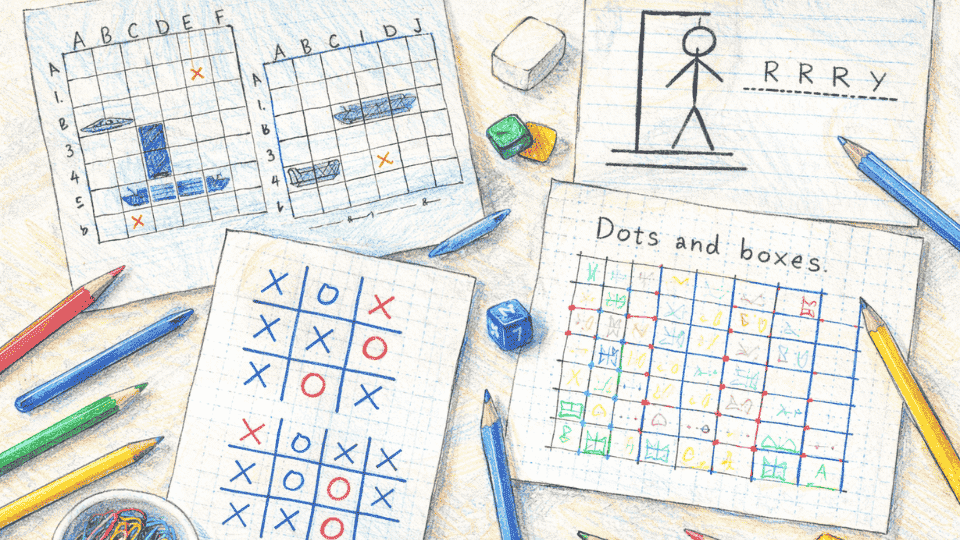
Now that you have your supplies ready, let’s get into the games. Each game includes a brief description and three simple steps to start playing right away.
1. Tic-Tac-Toe
This classic grid game needs just two players and a pen. You win by getting three marks in a row. It’s quick, simple, and perfect for kids.
How to Play:
- Step 1: Draw a 3×3 grid with two horizontal and two vertical lines.
- Step 2: Player one marks X in any square. Player two marks O in another square.
- Step 3: Take turns marking squares. First person to get three in a row (horizontal, vertical, or diagonal) wins.
2. Dots and Boxes
Two players compete to create boxes by connecting dots. The person who completes the most boxes wins. This game requires strategy and planning.
How to Play:
- Step 1: Draw a grid of dots (start with 6×6 for beginners).
- Step 2: Players take turns drawing one line between two adjacent dots.
- Step 3: When you complete a box, write your initial inside and take another turn. Count boxes at the end to find the winner.
3. Hangman
One player thinks of a word while the other guesses letters. You have a limited number of wrong guesses before you lose. This game builds vocabulary and spelling skills.
How to Play:
- Step 1: Player one thinks of a word and draws blank lines for each letter. Draw a gallows structure.
- Step 2: Player two guesses one letter at a time. If correct, write it on the blank lines. If wrong, draw one body part on the gallows.
- Step 3: Continue until the word is guessed or the hangman drawing is complete (usually 6-7 wrong guesses).
4. Battleship
Two players hide ships on grids and try to sink each other’s fleet. You call out coordinates to make your attacks. The first person to sink all ships wins.
How to Play:
- Step 1: Each player draws two 10×10 grids labeled A-J (vertical) and 1-10 (horizontal). One grid is for your ships; the other tracks your attacks.
- Step 2: Draw your ships on your grid (5 ships of different lengths: 5, 4, 3, 3, and 2 squares). Keep this hidden from your opponent.
- Step 3: Take turns calling out coordinates (like “B5”). Mark hits and misses on your attack grid. First to sink all enemy ships wins.
5. MASH
This fortune-telling game predicts your future using categories such as house, car, and spouse. Kids love the suspense of finding out their “destiny.” It’s purely for fun and laughs.
How to Play:
- Step 1: Write “MASH” at the top (Mansion, Apartment, Shack, House). Add 3-4 options for categories like car, job, spouse, and number of kids.
- Step 2: Draw a spiral while someone says “stop.” Count the loops to get your magic number.
- Step 3: Count through all options, crossing out every nth item (using your magic number). The last remaining option in each category is your “future.”
6. SOS
Players write S or O on a grid to spell “SOS” in any direction. Each completed SOS earns a point. The player with the most points wins.
How to Play:
- Step 1: Draw a grid (5×5 or larger works well).
- Step 2: Players take turns writing either S or O in any empty square.
- Step 3: If you complete “SOS” in any direction (horizontal, vertical, or diagonal), draw a line through it and score one point. You get another turn. Play until the grid is full.
7. Sprouts
This topological game starts with dots and ends when no more moves are possible. Players draw lines connecting dots while following specific rules. It requires careful thinking.
How to Play:
- Step 1: Start by drawing 3-6 dots on the paper.
- Step 2: Players take turns drawing a line connecting two dots or one dot to itself. Add a new dot somewhere on this line. No line can cross another line, and no dot can have more than three lines coming from it.
- Step 3: The last player who can make a valid move wins.
8. Consequences
This storytelling game creates hilarious, random stories. Each player writes one line, then folds the paper to hide it. The final story is always funny and unexpected.
How to Play:
- Step 1: Each player writes the first line (like a character’s name), then folds the paper to hide their writing and passes it to the next person.
- Step 2: Continue with prompts like: “met” (another character), “at” (a place), “he said,” “she said,” “and then,” “the consequence was.”
- Step 3: Unfold and read the complete stories aloud after everyone finishes the last line.
9. Categories (Scattergories)
Players list words in different categories, all starting with one letter. You score points for unique answers. This game tests your vocabulary and quick thinking.
How to Play:
- Step 1: Write 5-10 categories across the top (like animals, foods, cities, colors, names). Pick a random letter.
- Step 2: Set a timer for 2-3 minutes. Each player writes one word for each category, starting with that letter.
- Step 3: Compare answers. You get 1 point for unique answers that no one else wrote. The highest score wins.
10. Bulls and Cows
One player creates a secret number code. The other player guesses and receives clues. “Bulls” mean correct numbers in correct positions. “Cows” means correct numbers in wrong positions.
How to Play:
- Step 1: Player one writes a 4-digit secret number with no repeating digits. Keep it hidden.
- Step 2: Player two guesses a 4-digit number. Player one responds with how many “bulls” (right digit, right place) and “cows” (right digit, wrong place).
- Step 3: Player two keeps guessing based on the clues. Count how many guesses it takes to win.
11. Word Squares
Build a grid where words read the same across and down. This puzzle challenges your vocabulary and spatial thinking. Larger grids are harder to complete.
How to Play:
- Step 1: Start with a blank 4×4 or 5×5 grid.
- Step 2: Write words going across so that the same words also read going down (like a crossword with identical rows and columns).
- Step 3: Players can compete to see who completes a valid square first, or work together to build the largest possible square.
12. Connect the Dots
One player creates a dot-to-dot puzzle with numbered dots. The other player connects them to reveal a hidden picture. You can make these as simple or complex as you want.
How to Play:
- Step 1: Player one draws a simple picture, then places numbered dots along the outline. Erase the original lines.
- Step 2: Pass the paper to player two.
- Step 3: Player two connects the dots in numerical order to reveal the picture. Switch roles and play again.
13. Pictionary
One person draws a word while others guess what it is. No letters, numbers, or speaking allowed. This fast-paced game creates lots of laughs.
How to Play:
- Step 1: Write different words on small paper pieces. Fold them and put them in a pile.
- Step 2: One player picks a word and has 60 seconds to draw it. No talking, writing letters, or using hand gestures.
- Step 3: Other players shout out guesses. First correct guess wins the round. Take turns being the artist.
14. Squares
Two players compete to complete more squares than their opponent. You draw lines on a dot grid, similar to Dots and Boxes. Strategy matters more as the grid fills up.
How to Play:
- Step 1: Create a grid of dots (6×6 or larger).
- Step 2: Players alternate drawing one horizontal or vertical line between two adjacent dots.
- Step 3: When you complete a square, write your initial inside and take another turn. Most squares at the end win.
15. Sim
Six dots arranged in a circle create this strategic game. Two players draw lines in different colors, trying to avoid making a triangle. The first person to make a triangle loses.
How to Play:
- Step 1: Draw 6 dots in a circle. Each player picks a different color pen.
- Step 2: Players take turns connecting any two dots with a line in their color.
- Step 3: The first player to create a triangle (three dots connected by their color) loses the game.
16. Paper Telephone
This drawing-and-guessing game combines Pictionary and the Telephone game. Messages get hilariously distorted through drawing and writing. You need at least 4 players.
How to Play:
- Step 1: Each player writes a sentence at the top of a paper and passes it to the next person.
- Step 2: That person draws the sentence, folds the paper to hide the words, and passes it on. The next person writes what they think the drawing shows.
- Step 3: Continue alternating between drawing and writing. Unfold everything at the end to see how much the message changed.
All these games require minimal supplies and provide hours of fun. Try different variations to keep them fresh and interesting!
Tips for More Fun With Paper Games
You’ve learned all the games. Here are some ways to make your paper game sessions even more enjoyable and memorable.
- Create a game rotation. Don’t play the same game every time. Mix it up to keep things fresh. Try a different game each day of the week.
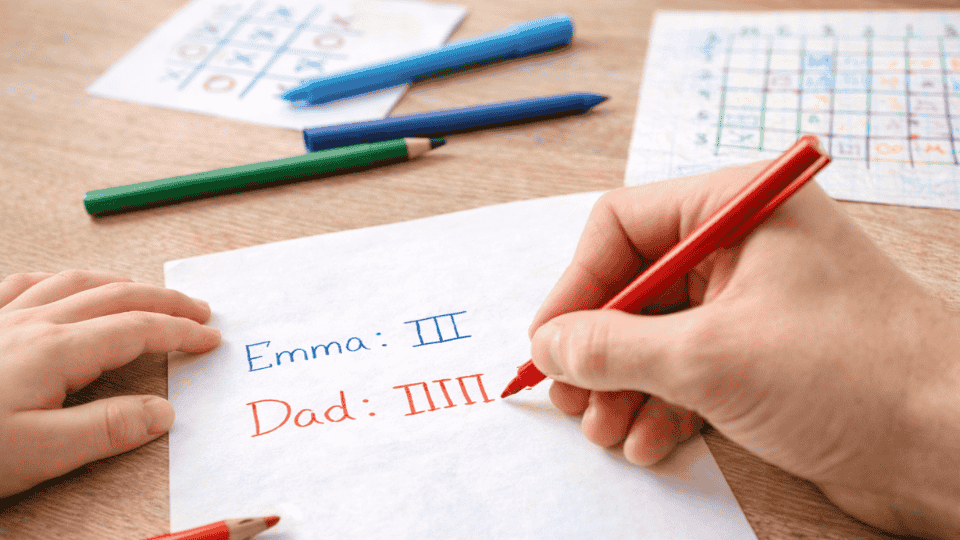
- Make a tournament. Play several games in a row and keep score. The person with the most wins gets bragging rights. This works great for family game nights.
- Adjust difficulty levels. Make games harder or easier based on who’s playing. Use bigger grids for advanced players. Simplify rules for young children.
- Set time limits. Adding a timer creates urgency and excitement. This works well for Categories, Pictionary, and Bulls and Cows.
- Keep a game notebook. Dedicate one notebook to your paper games. You’ll have all your grids, scores, and memories in one place. It becomes a fun keepsake.
- Teach kids to create their own games. Once they understand the basics, encourage them to invent new rules or variations. This builds creativity and problem-solving skills.
Looking Ahead
Games to play on paper offer timeless fun for everyone. You don’t need expensive toys or technology. Just grab a pen and paper, and you’re ready to play.
These games provide hours of entertainment. Some take 30 seconds per round. Others can last 20 minutes or more. You can play them anywhere, anytime.
Start with simple games like Tic-Tac-Toe and Hangman if you’re new. Then try strategy games like Battleship and Dots and Boxes. Each game brings something different to the table.
The best part? You’re creating memories while having fun. Years from now, you’ll remember these simple moments. You’ll recall the laughter, the competition, and the time spent together.
So what are you waiting for? Pick up a pen and start playing. Which game will you try first? Share your favorite paper game in the comments below.