
Your kid just asked why the sky turns orange at sunset. You gave your best guess. They weren’t completely satisfied. Sound familiar?
Kids’ science experiments at home are the simplest fix for that. No ordering kits online, no waiting for packages. Your kitchen cabinet already has most of what this list needs.
This blog covers science experiments for kids, organized across five categories: chemistry, physics, biology, earth science, and engineering.
Every experiment includes the exact materials, a plain science explanation, the right age group, and what your child walks away knowing.
No fancy equipment needed. Just a curious kid, a kitchen counter, and a bit of free time.
Why Kids Should Do Science Experiments at Home?
When kids do science at home, they stop treating it like something that only happens in a classroom. They ask real questions, test real ideas, and figure out what went wrong when something doesn’t work.
Research in early childhood education consistently shows that hands-on learning builds reasoning skills faster than reading or watching alone.
And it’s a genuinely great way to spend an afternoon together without anyone reaching for a screen.
What You Need Before You Start
Before you pick an experiment, take two minutes to check what you have. Most of these science activities for kids use items already sitting in your kitchen, bathroom cabinet, or craft drawer.
| Material Type | What You Need |
|---|---|
| Kitchen Basics | Baking soda, white vinegar, salt, sugar, cornstarch, eggs, lemon juice, and whole milk |
| Pantry Items | Vegetable oil, honey, dish soap, food coloring, dry yeast |
| Craft Supplies | Balloons, tape, cardboard, paper cups, straws, scissors, rubber bands, string |
| Science Essentials | Safety goggles, zip-lock bags, clear glass jars or cups, a tray or baking sheet |
| From the Yard | Leaves, soil, small rocks, seeds, fresh flowers |
| For Older Kids | Small LED bulbs, connecting wires, AA batteries (optional) |
Chemistry Experiments for Kids at Home
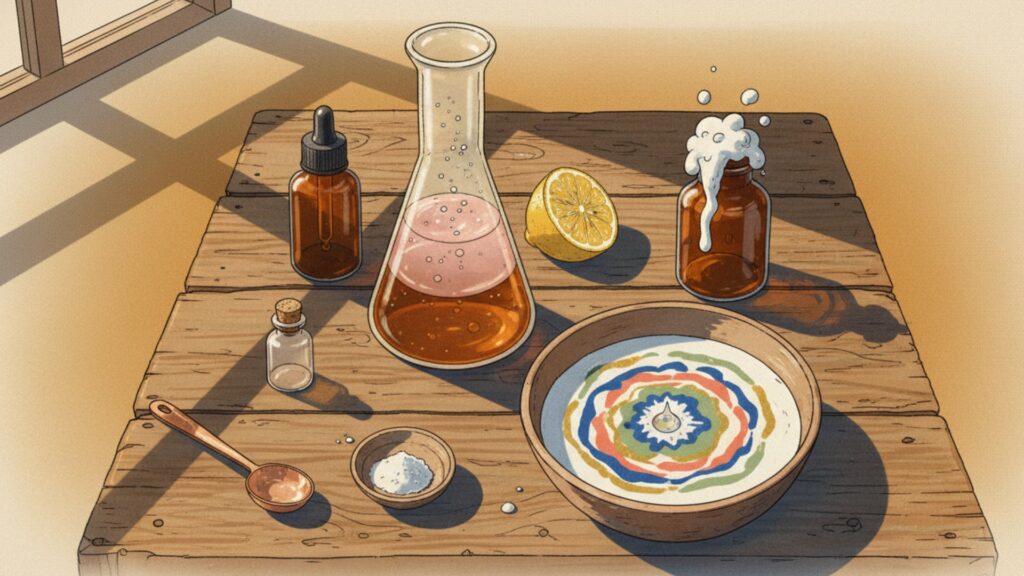
Chemistry sounds like something that needs a lab coat. It doesn’t. Most of these reactions happen using things already in your kitchen, and every single one of them teaches your child something real about how materials change, combine, and behave.
1. Baking Soda and Vinegar Volcano
This is often the first experiment kids ask for, and there’s a solid reason for that. Pour vinegar into a cup of baking soda and watch the fizz take over the tray. Simple, satisfying, and it teaches something genuine about how acids and bases interact.
- Materials: Baking soda, white vinegar, dish soap, food coloring, a small bottle or cup, a tray
- Science Concept: Acid-base reaction: vinegar (acid) reacts with baking soda (base) to release carbon dioxide gas, which causes the fizzing eruption
- Age: 4 and up
- Difficulty: Easy
- Time: 10 minutes
- What Kids Learn: What an acid-base reaction looks like and where CO2 gas comes from
2. Lemon Volcano
Same idea as the classic volcano, but this time the lemon does two jobs at once. It acts as both the container and the acid source. Kids enjoy squeezing it and watching the reaction change as they add more.
- Materials: A lemon, baking soda, food coloring, a toothpick, or a spoon
- Science Concept: The citric acid in the lemon reacts with baking soda the same way vinegar does, releasing carbon dioxide gas
- Age: 4 and up
- Difficulty: Easy
- Time: 10 minutes
- What Kids Learn: Different acids (lemon vs. vinegar) produce the same type of chemical reaction
3. Elephant Toothpaste
When the foam shoots up out of the bottle, kids almost always take a step back in surprise. Yeast acts as a catalyst, speeding up the breakdown of hydrogen peroxide and releasing oxygen gas in a rush of foam. This one needs an adult present, but the reaction is well worth the extra care.
- Materials: 3% hydrogen peroxide, dry yeast, warm water, dish soap, food coloring, a plastic bottle
- Science Concept: Catalyst reaction: yeast speeds up hydrogen peroxide breakdown, releasing oxygen gas rapidly and creating large volumes of foam
- Age: 8 and up
- Difficulty: Medium
- Time: 15 minutes
- Safety Note: Adults must handle hydrogen peroxide; safety goggles are required
- What Kids Learn: What a catalyst does and how gas produced through a chemical reaction can create dramatic physical results
4. Oobleck (Non-Newtonian Fluid)
This one confuses kids in the best way. Punch it, and it feels solid. Hold it gently, and it flows like a liquid. The cornstarch and water mixture doesn’t follow the usual rules because it’s a non-Newtonian fluid, a material that changes its behavior with pressure.
- Materials: Cornstarch, water, food coloring (optional)
- Science Concept: Non-Newtonian fluid: acts like a liquid when at rest, but like a solid under pressure
- Age: 3 and up
- Difficulty: Easy
- Time: 5 minutes
- What Kids Learn: Not all liquids behave the same way; pressure changes how some materials act
5. Homemade Slime
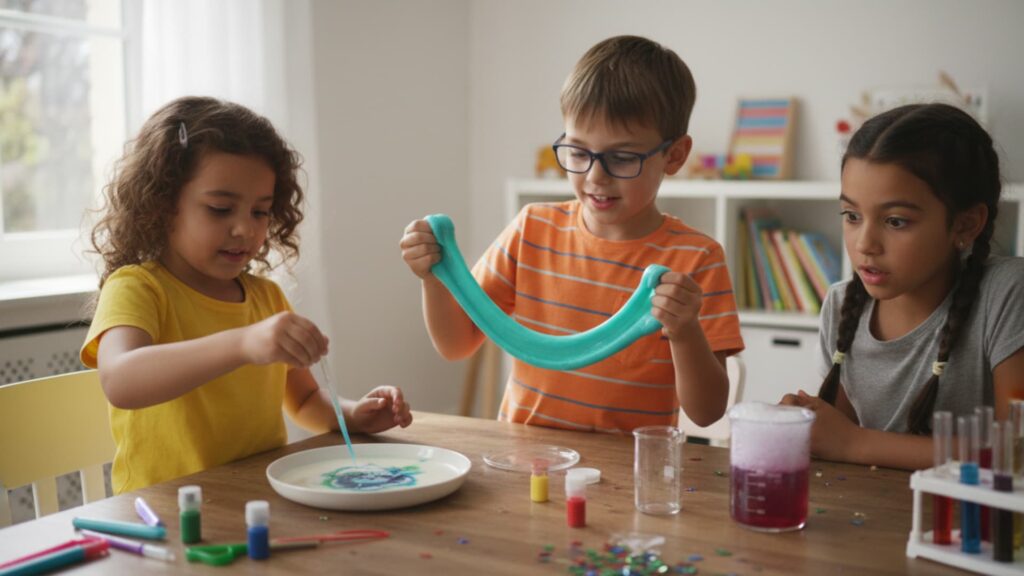
Slime is the experiment kids always want to make, and it’s a genuinely useful one for teaching polymer science. Mixing glue with an activator causes the molecules to link up and form a stretchy, long-chain material. Let kids adjust the amounts to see how the texture changes.
- Materials: White school glue, liquid starch or contact lens solution with baking soda, food coloring
- Science Concept: Polymer science: glue molecules link together into long chains when mixed with the activator, creating a flexible, stretchy material
- Age: 5 and up
- Difficulty: Easy
- Time: 10 minutes
- What Kids Learn: Polymers are long-chain molecules; mixing ingredients can completely change their physical properties
6. Magic Milk
Drop a bit of dish soap into a shallow bowl of whole milk with food coloring added, and the colors shoot outward in swirling bursts. The soap breaks the fat bonds in the milk, and the surface tension collapses in a visible rush of color. It looks like magic, but the chemistry behind it is well established.
- Materials: Whole milk, food coloring, dish soap, a cotton swab, a shallow dish
- Science Concept: Surface tension: soap lowers the surface tension of milk by breaking the fat bonds, causing the food coloring to move rapidly outward
- Age: 3 and up
- Difficulty: Easy
- Time: 5 minutes
- What Kids Learn: Surface tension exists in liquids; soap reduces it and causes visible movement
7. Skittles Rainbow
Arrange Skittles around the edge of a white plate, pour warm water into the center, and watch the colors move outward without mixing. The sugar and dye spread through the water through a process called diffusion. It’s a visually clear way to show how particles move from areas of high concentration to low concentration.
- Materials: Skittles candy, warm water, a white plate
- Science Concept: Diffusion: sugar and dye spread outward from the candy through water, moving from high concentration toward low concentration
- Age: 4 and up
- Difficulty: Easy
- Time: 10 minutes
- What Kids Learn: Diffusion is the natural movement of particles through a liquid, from where there’s more of something toward where there’s less
8. Red Cabbage pH Indicator
Boil red cabbage, strain the liquid, and you have a natural pH tester kids can use on any household liquid. Add different liquids and watch the color shift from red to purple to green. Acids and bases are not just in science labs. They’re in everyday items already in your kitchen.
- Materials: Red cabbage, water, various household liquids (vinegar, baking soda, water, lemon juice, milk)
- Science Concept: pH testing: red cabbage juice contains a pigment that changes color depending on whether a liquid is an acid or a base
- Age: 7 and up
- Difficulty: Medium
- Time: 20 minutes
- Safety Note: The adult handles the boiling step
- What Kids Learn: Acids and bases are all around us; pH measures how strong they are on a scale
9. Invisible Ink (Lemon Juice)
Write a message with lemon juice on white paper using a cotton swab, let it dry completely, and hold the paper near a lamp. The heat causes the lemon juice to oxidize and turn brown, revealing the hidden message. Kids love writing secret notes to each other using this method.
- Materials: Lemon juice, a cotton swab or small paintbrush, white paper, a lamp or hair dryer
- Science Concept: Oxidation: lemon juice is mostly water that evaporates when dry; when heated, the remaining organic compounds oxidize and turn brown
- Age: 5 and up
- Difficulty: Easy
- Time: 10 minutes
- What Kids Learn: Heat triggers chemical changes; oxidation is the same process that makes cut apples turn brown
10. Homemade Butter
Put heavy cream in a jar, seal it tight, and shake it. After about 15 to 20 minutes of steady shaking, the fat in the cream clumps together and separates from the liquid. What’s left is real, edible butter. Kids feel a genuine sense of achievement knowing they made food from scratch using science.
- Materials: Heavy whipping cream, a clean jar with a tight lid, a pinch of salt
- Science Concept: Emulsion breakdown: shaking causes fat globules in cream to cluster together and separate from the remaining liquid, which becomes buttermilk
- Age: 4 and up
- Difficulty: Easy
- Time: 15 to 20 minutes of shaking
- What Kids Learn: Fat and liquid can be separated by physical force; this is the basic process behind commercial butter production
11. Dancing Raisins
Drop a few raisins into a glass of sparkling water and watch them rise, fall, and rise again repeatedly without stopping. Carbon dioxide bubbles attach to the rough surface of each raisin and carry it upward. When the bubbles pop at the surface, the raisin sinks, and the process starts over.
- Materials: Sparkling water or lemon-lime soda, raisins, a clear glass
- Science Concept: Buoyancy and gas bubbles: CO2 bubbles attach to raisins and make them buoyant enough to rise; once the bubbles pop, the raisins sink
- Age: 3 and up
- Difficulty: Easy
- Time: 5 minutes
- What Kids Learn: Gas bubbles can lift objects; buoyancy changes when something attached to an object changes its overall density
12. Density Tower
Pour honey, dish soap, colored water, and vegetable oil into a tall glass without stirring, and they settle into four distinct layers. Each liquid sits at its own level based on its density per unit volume. Kids can then test which small objects sink to which layer to see density in action.
- Materials: Honey, dish soap, water (with food coloring), vegetable oil, a tall, clear glass
- Science Concept: Liquid density: each liquid has a different mass per unit of volume; denser liquids sink lighter ones below and form stable layers
- Age: 6 and up
- Difficulty: Medium
- Time: 15 minutes
- What Kids Learn: Density determines whether a liquid floats or sinks relative to others; this is a physical property, not a random one
13. Coffee Filter Chromatography
Draw a thick dot of washable marker on a coffee filter, dip the edge lightly in water, and watch the water carry the ink upward. Different dye molecules in the ink travel at different speeds, so they separate into visible colored bands. A black marker often turns out to contain blue, yellow, and red all mixed together.
- Materials: Coffee filters, washable markers, water, a cup, a pencil
- Science Concept: Chromatography: water carries ink molecules through the filter at different speeds depending on their size, separating them into distinct color bands
- Age: 6 and up
- Difficulty: Easy
- Time: 20 minutes
- What Kids Learn: Many colors we see are actually mixtures of multiple dyes; separation techniques reveal the individual components
14. Rock Candy (Sugar Crystals)
This one takes a week, but kids check the jar every single morning. Dissolve a large amount of sugar in hot water, pour it into a jar with a string hanging inside, and wait. Sugar molecules settle onto the string and slowly build up into crystals that kids can actually eat at the end.
- Materials: Sugar, water, a jar, a wooden stick or string, a clothespin, food coloring
- Science Concept: Crystallization: as the sugar solution cools, dissolved sugar molecules arrange themselves into organized, repeating solid structures on the string
- Age: 8 and up
- Difficulty: Medium
- Time: 7 days (setup: 20 minutes)
- Safety Note: An adult handles the boiling water step
- What Kids Learn: Crystals form when molecules organize into a repeating pattern; temperature change drives this process
15. Soap-Powered Paper Boat
Cut a small notch at the back of a cardboard boat shape, place a drop of dish soap in the notch, and set it on a still tray of water. The soap lowers the surface tension directly behind the boat, and the higher tension at the front pulls it forward. The boat moves entirely on its own.
- Materials: A small piece of cardboard or thin foam, dish soap, a shallow tray of water, and scissors
- Science Concept: Surface tension propulsion: soap reduces water tension behind the boat, creating an imbalance that pulls the boat toward the area of higher tension
- Age: 5 and up
- Difficulty: Easy
- Time: 10 minutes
- What Kids Learn: Surface tension creates force; soap disrupts it, and that disruption produces actual movement
Physics Experiments for Kids at Home
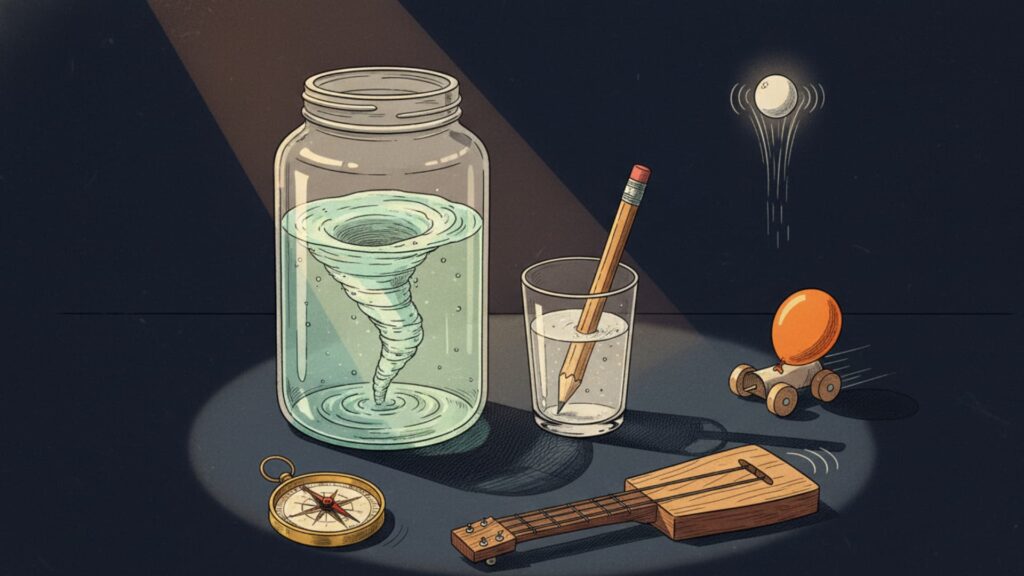
Physics is just how the world moves, pushes, pulls, and makes sound. These simple science experiments for kids show that physics is not something in a textbook. It’s happening in every room of your house, all the time.
16. Balloon-Powered Car
Tape a straw to a balloon, then attach the balloon to a small toy car. Blow up the balloon through the straw, set the car on a flat surface, and let go. Air rushes out backward, and the car shoots forward. It’s a direct, hands-on way to show Newton’s Third Law without a single word of theory.
- Materials: A small toy car or bottle cap base, a straw, a balloon, and tape
- Science Concept: Newton’s Third Law: air pushed backward out of the balloon pushes the car forward with equal and opposite force
- Age: 6 and up
- Difficulty: Medium
- Time: 20 minutes
- What Kids Learn: For every action, there is an equal and opposite reaction; this same principle applies to real rockets
17. Homemade Lava Lamp
Fill a jar with oil and add water with food coloring. Drop in a piece of Alka-Seltzer and watch colored blobs rise and fall through the oil continuously. Gas bubbles lift colored water droplets up through the denser oil layer, pop at the top, and the water sinks back down.
- Materials: A glass jar, water, vegetable oil, food coloring, Alka-Seltzer tablet
- Science Concept: Density and gas: oil floats on water because it’s less dense; CO2 bubbles lift colored water through the oil, and when bubbles pop, the water drops again
- Age: 5 and up
- Difficulty: Easy
- Time: 15 minutes
- What Kids Learn: Oil and water don’t mix; gas bubbles create cyclical movement between layers
18. Light Refraction with a Pencil
Put a pencil in a glass of water and look at it from the side. It looks bent right where it hits the water surface. Light slows down when it moves from air into water, and that change in speed bends the light beam at the boundary. The pencil isn’t bent. Your eye is following the light.
- Materials: A clear glass, water, a pencil
- Science Concept: Refraction: light changes speed when passing from air to water, causing it to bend at the boundary and making submerged objects appear to shift position
- Age: 5 and up
- Difficulty: Easy
- Time: 5 minutes
- What Kids Learn: Light bends when it moves from one material to another; this is called refraction, and it’s what makes lenses and glasses work
19. Mini Tornado in a Jar
Fill a jar with water, add a drop of dish soap and a splash of vinegar, seal it, and swirl it quickly in a circle. A spinning column of water forms in the center, with a clear funnel shape visible all the way through the liquid. This is a vortex, and it follows the same basic physics as real tornadoes.
- Materials: A jar with a lid, water, dish soap, a small amount of vinegar, glitter (optional for visibility)
- Science Concept: Vortex: circular motion creates a low-pressure center; water spins around this center and forms a funnel shape due to centripetal force
- Age: 6 and up
- Difficulty: Easy
- Time: 10 minutes
- What Kids Learn: Vortices form when fluid spins in a circular path; atmospheric tornadoes follow the same rotational physics
20. Egg Drop Challenge
The challenge is simple: build a structure to protect a raw egg from a two-story drop using only household materials. The science is harder. The structure has to absorb and spread the impact force over a longer period and a wider area. Every cracked egg teaches something a successful drop never could.
- Materials: A raw egg, cotton balls, bubble wrap, straws, tape, cardboard (whatever is available)
- Science Concept: Force absorption: a well-designed protective structure spreads impact force across a larger area and a longer time interval, reducing the peak force on the egg
- Age: 8 and up
- Difficulty: Hard
- Time: 45 minutes to design and build, plus drop test
- What Kids Learn: Engineering design matters; force distribution is the key to protecting fragile objects from impact
21. Paper Bridge Strength Test
Lay a flat piece of paper between two stacks of books and stack coins on it until it collapses. Then fold the same paper into an accordion shape and try again. The folded version holds significantly more weight. A shape completely changes how a flat material responds to force.
- Materials: Two stacks of books, sheets of paper, small coins or pebbles for weight testing
- Science Concept: Structural engineering: folding creates multiple supporting ridges that distribute weight more evenly; flat surfaces have no such distribution
- Age: 7 and up
- Difficulty: Easy
- Time: 20 minutes
- What Kids Learn: Shape affects strength; the same material can perform very differently depending on how it’s arranged
22. Homemade Compass
Stroke a sewing needle along a strong magnet in one direction about 40 to 50 times to magnetize it. Float the needle on a small leaf or cork in a still bowl of water. The needle rotates slowly until it points north, following Earth’s magnetic field. Kids are often genuinely surprised that something so simple actually works reliably.
- Materials: A sewing needle, a strong magnet, a small leaf or cork, a bowl of water
- Science Concept: Magnetism: stroking the needle with a magnet aligns the iron atoms inside it; Earth’s magnetic field then pulls the magnetized needle toward its north pole
- Age: 8 and up
- Difficulty: Easy
- Time: 15 minutes
- What Kids Learn: Earth has a magnetic field; magnetized metal aligns with it, which is the principle behind every compass ever made
23. Static Electricity with a Balloon
Rub a balloon on someone’s hair for about 10 seconds, then hold it near small pieces of paper, a wall, or a can on a flat surface. The balloon picks up extra electrons from the hair, giving it a negative charge that attracts other surfaces. The hair standing on end afterward is always good for a laugh.
- Materials: A balloon, a wall, small pieces of paper, a wool sweater or dry hair
- Science Concept: Static electricity: friction transfers electrons from hair to the balloon, giving it a negative charge that attracts positively charged or neutral surfaces
- Age: 4 and up
- Difficulty: Easy
- Time: 5 minutes
- What Kids Learn: Objects can gain electric charge through friction; opposite charges attract each other
24. Rubber Band Guitar
Stretch rubber bands of different thicknesses across an open tissue box and pluck them. Thinner and tighter bands vibrate faster and produce a higher pitch. Thicker bands vibrate more slowly and make a lower sound. This is a direct and audible way to show how musical instruments produce different notes.
- Materials: An empty tissue box or small open cardboard box, rubber bands of different thicknesses, and a pencil for raising them slightly
- Science Concept: Sound waves: pitch depends on the frequency of vibration; tight, thin bands vibrate at higher frequencies (higher pitch) than loose, thick bands
- Age: 5 and up
- Difficulty: Easy
- Time: 10 minutes
- What Kids Learn: Sound is produced by vibration; pitch is determined by how fast that vibration happens
25. Water Bottle Chimes
Fill several identical glass bottles with varying levels of water, and tap each gently with a metal spoon. The bottle with more water produces a lower pitch; the one with less water produces a higher sound. The volume of air space inside the bottle determines how the air vibrates when it’s struck.
- Materials: Several identical glass bottles, water at different levels, a metal spoon
- Science Concept: Sound and resonance: air vibrates inside the bottle when struck; more water means less air space, which changes the natural frequency of vibration
- Age: 5 and up
- Difficulty: Easy
- Time: 10 minutes
- What Kids Learn: The amount of air in a container changes the sound it produces when struck; this is the same principle behind wind instruments
26. Straw Rockets
Wrap a small piece of paper around a pencil, tape it into a tight tube, add a pointed nose cone from folded paper, and slide it off the pencil onto a straw. Blow hard, and the paper rocket launches. Changing the shape of the fins or the angle of the nose affects how far and straight it flies.
- Materials: A straw, a pencil, paper, tape, and scissors
- Science Concept: Air pressure and aerodynamics: blowing creates high-pressure air that pushes the rocket forward; fins stabilize the flight path by keeping the nose pointed forward
- Age: 5 and up
- Difficulty: Easy
- Time: 15 minutes
- What Kids Learn: Air pressure creates thrust; the shape of a projectile affects how it moves through the air
27. Coin and Card Trick (Inertia)
Balance a playing card on top of a cup, then place a small coin directly above the opening on the card. Flick the card to the side with a quick snap. The card flies off, but the coin drops straight down into the cup. The coin didn’t move sideways because it was at rest and resisted the sudden sideways motion.
- Materials: A playing card, a small coin, a cup
- Science Concept: Inertia: an object at rest stays at rest unless acted on by a force; the quick card removal didn’t apply enough sideways force to move the coin before gravity pulled it down
- Age: 6 and up
- Difficulty: Easy
- Time: 5 minutes
- What Kids Learn: Objects resist changes in their motion; this resistance is called inertia, and it’s Newton’s First Law
28. Floating Paperclip (Surface Tension)
Lay a small piece of tissue paper flat on the surface of still water in a bowl. Place a paperclip on the tissue paper, then gently push the tissue down with a pencil tip until it sinks. The paperclip stays on the surface, resting on the thin tension layer formed by water molecules at the top.
- Materials: A bowl of water, a paperclip, a small piece of tissue paper, a pencil
- Science Concept: Surface tension: water molecules at the surface attract each other and form a thin “skin”; a light enough object rests on this layer without breaking through
- Age: 6 and up
- Difficulty: Medium
- Time: 10 minutes
- What Kids Learn: Water has surface tension; this layer can support objects denser than water if they’re light enough not to break through
29. Hovering Ball with a Straw (Bernoulli’s Principle)
Blow through a straw aimed upward and hold a ping pong ball or small foil ball in the moving airstream. Release it slowly. The ball hovers in place within the stream of air without falling. Fast-moving air has lower pressure than the surrounding still air, holding the ball in the stream.
- Materials: A straw, a small ping pong ball, or a crumpled foil ball
- Science Concept: Bernoulli’s Principle: fast-moving air has lower pressure than still air; the surrounding high-pressure air pushes the ball into the low-pressure airstream and keeps it there
- Age: 7 and up
- Difficulty: Easy
- Time: 5 minutes
- What Kids Learn: Moving air creates low pressure; this is the same principle that generates lift under airplane wings
30. Magnetic Fishing Game
Cut small fish shapes from cardstock, attach a paper clip to each one, and scatter them in a box. Tie a piece of string to a stick and attach a magnet to the end. Fish for the paper-clipped shapes. As a second round, kids test which other household objects the magnet picks up and which ones it ignores.
- Materials: Cardstock, paper clips, a stick, string, a magnet
- Science Concept: Magnetism: magnets attract iron and certain other metals; they have no effect on materials that don’t contain these metals
- Age: 3 and up
- Difficulty: Easy
- Time: 15 minutes to build, plus play time
- What Kids Learn: Magnets attract only specific metals; magnetic force works at a short distance without physical contact
Biology Experiments for Kids at Home
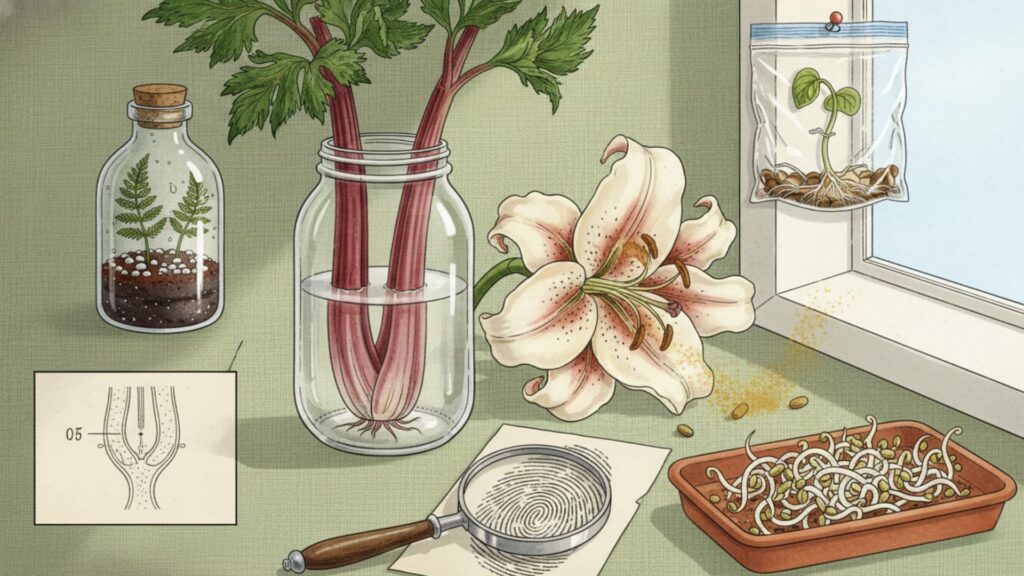
Biology is the study of living things, and there’s plenty of it happening in your backyard, your kitchen, and even your own body. These fun science experiments for kids bring living science to the kitchen table without a single petri dish.
31. Celery in Colored Water (Transpiration)
Stand a stalk of celery with leaves in a glass of water with several drops of food coloring added. Check it the next morning. The color has traveled up through the tiny tubes inside the stem and into the leaves. This process, called transpiration, is how plants pull water up from the soil roots.
- Materials: A stalk of celery with leaves, a glass of water, red or blue food coloring
- Science Concept: Transpiration and capillary action: plants pull water upward through tube-like vessels called xylem; the colored water makes this invisible process visible
- Age: 5 and up
- Difficulty: Easy
- Time: 24 to 48 hours (setup: 5 minutes)
- What Kids Learn: Plants actively transport water upward through their stems against gravity; the same process feeds leaves with the water they need
32. Flower Dissection
Take a fresh flower, a lily or tulip works well, and carefully pull apart each layer. Identify the petals, the stamens covered in yellow pollen, the central pistil, and the green sepals at the base. Each part plays a specific role in helping the plant reproduce.
- Materials: A fresh flower, scissors or a small knife, paper, a magnifying glass
- Science Concept: Plant anatomy: flowers have specialized structures that work together in pollination and reproduction; each part has a distinct function
- Age: 5 and up
- Difficulty: Easy
- Time: 20 minutes
- Safety Note: The adult handles any cutting
- What Kids Learn: Flowers are not just decorative; each structure has a biological job in the plant’s reproductive process
33. Mold Bread Experiment
Place one slice of plain bread in a zip-lock bag with a few drops of water and seal it. Place another slice in a dry bag and seal it too. Check both daily for 7 to 10 days. The moist bag grows mold much faster, showing that mold, a type of fungus, needs warmth and moisture to grow.
- Materials: Two slices of plain bread, two zip-lock bags, a small amount of water
- Science Concept: Microbiology: mold is a living fungus that requires moisture, warmth, and an organic food source to grow; the dry bag acts as a control in the experiment
- Age: 8 and up
- Difficulty: Easy
- Time: 7 to 10 days of observation (setup: 5 minutes)
- What Kids Learn: Mold is a living organism with specific growth conditions; controlling one variable (moisture) and comparing results is a core scientific method
34. Growing Seeds in a Zip-Lock Bag
Dampen a paper towel, fold a few bean seeds into it, and slip it into a zip-lock bag taped to a sunny window. Within a few days, a root appears first, then a small shoot. Watching it through the clear bag makes the germination process easy to follow step by step.
- Materials: A zip-lock bag, a damp paper towel, bean or lentil seeds, tape, a sunny window
- Science Concept: Germination: seeds contain a dormant embryo that activates when exposed to moisture and warmth; the root always emerges first to anchor the plant before the shoot rises
- Age: 4 and up
- Difficulty: Easy
- Time: 3 to 7 days (setup: 5 minutes)
- What Kids Learn: Seeds contain a fully formed plant waiting for the right conditions; water and warmth are the two main triggers for germination
35. Water Cycle in a Bag
Add a small amount of blue-tinted water to a zip-lock bag, seal it, and tape it to a sunny window. Over a few hours, water vapor rises to the top of the bag and forms small droplets along the inner surface. Those droplets eventually run back down, completing a mini version of the full water cycle.
- Materials: A zip-lock bag, water, blue food coloring, tape, a sunny window
- Science Concept: The water cycle: the sun’s warmth causes evaporation; vapor condenses into droplets on the cooler upper surface (like clouds); droplets fall back down (like rain)
- Age: 5 and up
- Difficulty: Easy
- Time: A few hours (setup: 5 minutes)
- What Kids Learn: Evaporation, condensation, and precipitation happen in a continuous loop; this is the same process that drives weather on Earth
36. Mini Ecosystem in a Bottle
Layer small pebbles, then soil, then a few small plants or seedlings into a large clear bottle. Add a small amount of water, seal the top, and place it in indirect light. The plants release oxygen, absorb carbon dioxide, and the water cycles between soil, air, and leaf surfaces without any external input.
- Materials: A large clear plastic bottle, small pebbles, potting soil, small plants or seedlings, water
- Science Concept: Closed ecosystem: plants produce oxygen through photosynthesis, absorb CO2, and recycle water through transpiration and condensation without requiring external resources
- Age: 8 and up
- Difficulty: Medium
- Time: 30 minutes to build; observe over several weeks
- What Kids Learn: Living systems recycle matter; a properly balanced ecosystem can sustain itself with only energy input from light
37. Bean Plant Growth Journal
Plant a bean seed in a cup of soil and water it lightly every day. Write down or draw what changes each day: the sprout breaking the surface, the first leaves opening, the stem growing taller. Keeping track of daily changes teaches kids that science is built on careful, long-term observation.
- Materials: A few bean seeds, small pots or paper cups, potting soil, water, a notebook
- Science Concept: Plant growth stages: seeds germinate, produce a root (radicle) and shoot (plumule), develop leaves for photosynthesis, and grow in a predictable sequence driven by light and water
- Age: 5 and up
- Difficulty: Easy
- Time: 2 weeks of daily observation (5 minutes per day)
- What Kids Learn: Growth is a process, not an event; measuring and recording change over time is the foundation of biological research
38. Leaf Rubbings and Structure
Place a leaf vein-side up under a sheet of paper and rub a crayon across the surface with steady pressure. The pattern of veins is clearly visible on the paper. Those lines are the leaf’s internal transport system, carrying water from the stem and sending photosynthetic products back out.
- Materials: Fresh leaves, white paper, crayons, or colored pencils
- Science Concept: Plant structure: leaf veins are vascular bundles containing xylem (water transport) and phloem (food transport); their branching pattern maximizes coverage of the leaf surface
- Age: 3 and up
- Difficulty: Easy
- Time: 15 minutes
- What Kids Learn: Leaves have a structured internal system; veins distribute water and carry the food produced by photosynthesis to the rest of the plant
39. Homemade Lung Model
Cut the bottom off a plastic bottle and stretch a balloon over the cut opening at the bottom. Tie a second balloon inside the bottle at the neck opening. When you pull the bottom balloon down, the inner balloon inflates. When you push the bottom one back up, it deflates. This is exactly how the diaphragm controls breathing.
- Materials: A plastic bottle, two balloons, tape, and scissors
- Science Concept: Respiratory mechanics: the diaphragm’s downward movement increases the chest cavity’s volume, reducing air pressure inside the lungs and causing air to rush in
- Age: 7 and up
- Difficulty: Medium
- Time: 20 minutes to build
- What Kids Learn: Breathing is driven by pressure changes, not by the lungs actively pulling air; the diaphragm does most of the work
40. Heartbeat Before and After Exercise
Have your child sit quietly for two minutes, find their pulse on the inside of their wrist, and count the beats for 30 seconds. Multiply by two for the beats per minute. Then do 60 seconds of jumping jacks and check again. The rate goes up because working muscles need more oxygen, fast.
- Materials: A clock or timer, a notebook for recording
- Science Concept: Cardiovascular response: during exercise, muscles consume oxygen faster; the heart increases its rate of pumping to meet that increased demand
- Age: 7 and up
- Difficulty: Easy
- Time: 15 minutes
- What Kids Learn: The heart responds to the body’s needs in real time; heart rate is a direct measure of how hard the cardiovascular system is working
41. Yeast and Sugar Carbon Dioxide Test
Mix dry yeast with warm water and sugar in a plastic bottle, then stretch a balloon over the opening. Within 30 minutes, the balloon starts to inflate. Yeast is a living organism. It feeds on sugar and releases carbon dioxide gas as a byproduct. That same gas is what makes bread dough rise in the oven.
- Materials: Dry yeast, warm water, sugar, a balloon, a plastic bottle
- Science Concept: Cellular respiration in yeast: yeast cells break down sugar through fermentation and release CO2 gas; this process is called anaerobic respiration
- Age: 7 and up
- Difficulty: Easy
- Time: 30 minutes
- What Kids Learn: Living organisms produce gas as a byproduct of feeding; yeast fermentation is the same process that bakers have used for thousands of years
42. Growing Mung Bean Sprouts
Soak mung beans in water overnight, then drain them into a jar covered with cheesecloth or fine mesh. Rinse them twice a day and keep them somewhere warm and out of direct sunlight. Tiny white sprouts appear within two to three days. Kids can eat what they grow, which makes the result feel genuinely worthwhile.
- Materials: Mung beans, a jar, cheesecloth or mesh fabric, water, a rubber band
- Science Concept: Germination without soil: seeds require only water, warmth, and air to sprout; soil is not required for germination, only for continued growth
- Age: 5 and up
- Difficulty: Easy
- Time: 3 to 5 days (2 minutes of rinsing per day)
- What Kids Learn: Seeds store enough energy to begin growing without soil; water activates the process, and the seed itself provides the initial nutrients
43. Ant Observation Setup
Collect a small group of ants from the yard along with some soil and put them in a clear container with a mesh lid. Add small crumbs of food and watch over several days. Ants follow the same paths repeatedly, carry pieces back to one spot, and work together without any visible direction from a leader.
- Materials: A clear container, soil from the yard, ants, a mesh or cloth lid, and small food scraps
- Science Concept: Animal behavior and communication: ants follow chemical trails called pheromones; they work as a coordinated colony using chemical signals rather than verbal communication
- Age: 5 and up
- Difficulty: Easy
- Time: 15 minutes to set up; observe over several days
- What Kids Learn: Ants coordinate through chemistry, not language; studying animal behavior is a branch of biology called ethology
44. Fingerprint Science
Rub a pencil across paper to create a graphite patch. Press your fingertip firmly onto it, then lift it off with clear tape and press the tape onto white paper. Study the print under a magnifying glass. Fingerprint patterns fall into three types: loops, whorls, and arches. No two people share the exact same pattern.
- Materials: A pencil, paper, clear tape, and a magnifying glass
- Science Concept: Biometrics: fingerprint ridges form before birth and remain unique to each person throughout their life; ridge patterns are categorized into three basic types
- Age: 5 and up
- Difficulty: Easy
- Time: 15 minutes
- What Kids Learn: The human body has built-in unique identifiers; fingerprint analysis is one of the most widely used tools in forensic science
45. Potato Eyes Sprouting
Poke three toothpicks evenly around the middle of a potato with visible buds, called eyes. Rest the potato over a jar of water so the bottom third is submerged. Within one to two weeks, roots grow down into the water and shoots grow up from the buds. This is a plant reproducing from its own stored tissue.
- Materials: A potato with eyes (small buds), a jar, water, and three toothpicks
- Science Concept: Vegetative reproduction: potatoes can grow new plants from their eyes without seeds; this is asexual reproduction where the stored starch in the potato fuels the new growth
- Age: 5 and up
- Difficulty: Easy
- Time: 1 to 2 weeks (setup: 5 minutes)
- What Kids Learn: Some plants reproduce without seeds; the stored food in a tuber supports new growth until the plant can photosynthesize on its own
Earth Science Experiments for Kids at Home
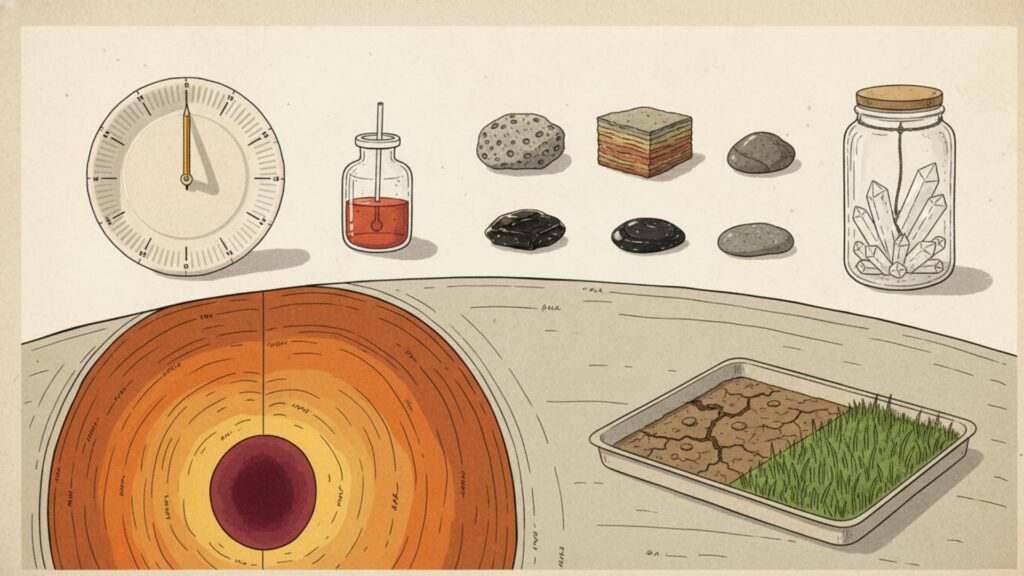
From rocks in the backyard to rain clouds forming inside a glass jar, earth science is all around the house. These experiments help kids look at the planet they live on and actually understand what they’re seeing.
46. Layers of the Earth Model (Dessert Cups)
Use different dessert layers in a clear cup to represent Earth’s internal structure: chocolate pudding for the inner core, caramel for the outer core, peanut butter or a soft layer for the mantle, and crushed cookies pressed firmly on top for the crust. It makes an abstract geological fact genuinely easy to remember.
- Materials: Clear cups, chocolate pudding, caramel sauce, peanut butter or similar, crushed cookies
- Science Concept: Earth’s internal structure: the planet has four distinct layers with different materials, temperatures, and states, ranging from the solid inner core to the thin solid crust at the surface
- Age: 5 and up
- Difficulty: Easy
- Time: 20 minutes
- What Kids Learn: Earth is not solid all the way through; each layer has different physical properties based on temperature and pressure at that depth
47. Soil Erosion Experiment
Fill two identical trays with soil. Plant grass seeds in one and leave the other completely bare. After a week of growth, pour the same amount of water over both trays from a height and observe what happens to the soil in each. The bare tray loses soil fast. The planted tray holds together.
- Materials: Two flat trays, soil, grass seeds, a watering can
- Science Concept: Erosion: plant roots bind soil particles together, and slow water runoff; bare soil has no such binding and washes away easily under the same conditions
- Age: 7 and up
- Difficulty: Easy
- Time: 1 week of growth (setup: 10 minutes); observation: 10 minutes
- What Kids Learn: Plants protect soil from being lost to water; removing vegetation is a major cause of accelerated erosion in real environments
48. Rain Cloud in a Jar
Pour very hot water into a clear jar until it’s about one-third full. Stretch plastic wrap tightly over the top and pile several ice cubes on the plastic. Within a few minutes, condensation forms on the underside of the plastic wrap and drips back down into the jar like rain. The same basic process forms real clouds.
- Materials: A clear glass jar, very hot water, plastic wrap, ice cubes
- Science Concept: Condensation and precipitation: hot water produces vapor; vapor rises and contacts the cold plastic surface, cools rapidly, and condenses into water droplets that fall back down
- Age: 8 and up
- Difficulty: Easy
- Time: 10 minutes
- Safety Note: Adults must handle the hot water
- What Kids Learn: Clouds form when warm, moist air rises and meets cooler air; the droplets that form are the beginning of precipitation
49. Water Filtration System
Cut a plastic bottle in half and invert the top half into the bottom half as a funnel. Layer cotton balls at the bottom of the funnel, then sand, then gravel on top. Pour muddy water (soil stirred into water) through the layers and watch cleaner water collect in the bottom section. Each layer removes different-sized particles.
- Materials: A plastic bottle, cotton balls, clean sand, small gravel, muddy water (soil and water)
- Science Concept: Mechanical filtration: gravel traps large particles, sand catches medium ones, and cotton catches fine sediment; this is the physical basis of water treatment before chemical purification
- Age: 8 and up
- Difficulty: Medium
- Time: 30 minutes to build, plus filtration test
- What Kids Learn: Clean water requires multiple stages of filtration; the size of filter material determines what gets removed at each stage
50. Homemade Sundial
Push a pencil through the center of a paper plate and anchor it upright with clay. Take it outside on a clear day and mark where the pencil’s shadow falls at each hour using a marker. By the end of the day, you have a working time-teller that runs on Earth’s rotation alone.
- Materials: A paper plate, a pencil, clay, a marker, and a compass for orientation
- Science Concept: Earth’s rotation: as Earth rotates on its axis, the sun’s apparent position changes across the sky at a consistent rate; the shadow cast by the pencil moves predictably with it
- Age: 7 and up
- Difficulty: Easy
- Time: 30 minutes to set up; mark hourly throughout the day
- What Kids Learn: Earth’s rotation causes the apparent movement of the sun; ancient civilizations used this same principle to measure time
51. Salt Crystal Growing
Dissolve as much salt as possible in very hot water to make a saturated solution. Pour it carefully into a jar and hang a piece of string into it from a pencil resting across the top. Over two to five days, as the water evaporates, salt molecules come out of the solution and stack onto the string in a cubic crystal pattern.
- Materials: Table salt, hot water, a jar, a string, a pencil, and black paper placed behind the jar to see the crystals clearly
- Science Concept: Crystallization: salt stays dissolved while the solution is hot and saturated; as temperature drops and water evaporates, salt molecules lose energy and organize into a repeating cubic lattice
- Age: 7 and up
- Difficulty: Easy
- Time: 2 to 5 days of growth (setup: 15 minutes)
- What Kids Learn: Crystals are organized solid structures that form when dissolved particles arrange into repeating geometric patterns as conditions change
52. Earthquake Tower Challenge
Build a small tower using dry spaghetti and marshmallows. When it’s done, place it on a flat tray and shake the tray side to side rapidly. Which shapes survive? Towers built with triangular bracing hold up far better than those built with square shapes, because triangles distribute sideways force across three sides instead of four corners.
- Materials: Dry spaghetti, mini marshmallows, a flat tray
- Science Concept: Seismic engineering: triangles resist deformation under lateral force because each side of the triangle carries part of the load; squares collapse more easily under sideways pressure
- Age: 8 and up
- Difficulty: Medium
- Time: 30 minutes to build, plus shake test
- What Kids Learn: Shape affects a structure’s resistance to movement; engineers use triangular supports in bridges, cranes, and earthquake-resistant buildings for exactly this reason
53. Stalactites and Stalagmites (Epsom Salt)
Fill two jars with a hot, heavily saturated Epsom salt solution. Connect them with a piece of wool string that dips low between the two jars with a plate underneath the lowest point. Over several days, the solution travels along the wet string and deposits salt crystals where it drips, building formations that closely resemble real cave structures.
- Materials: Two jars, Epsom salt, hot water, a thick wool string, a plate
- Science Concept: Mineral deposition: the saturated solution moves along the string by capillary action; water evaporates at the lowest point, leaving salt minerals behind in growing formations
- Age: 8 and up
- Difficulty: Medium
- Time: 5 to 7 days of growth (setup: 15 minutes)
- What Kids Learn: Real stalactites and stalagmites grow the same way over thousands of years as mineral-rich water drips slowly and deposits material with every drop
54. Make a Fossil Mold
Press a leaf, shell, or small bone firmly into a flat piece of air-dry clay, then carefully remove it. Let the clay dry completely. What remains is a clear impression of the object in the clay surface.
This is exactly how mold fossils form in nature when organisms press into soft sediment that later hardens into rock.
- Materials: Air-dry clay or salt dough, leaves, shells, or small bones, a small amount of petroleum jelly to prevent sticking
- Science Concept: Fossil formation: organisms leave impressions in soft sediment; over time, sediment hardens into rock and preserves the shape; filling the mold with material creates a cast fossil
- Age: 5 and up
- Difficulty: Easy
- Time: 20 minutes to press and shape, plus drying time
- What Kids Learn: Fossils are physical records of ancient life; the process of preservation requires specific conditions of pressure, moisture, and mineral content
55. Wind Vane from a Straw
Cut two arrow shapes from cardstock and tape them to opposite ends of a straw, one pointing forward and one as a tail fin. Push a pin through the center of the straw into a pencil eraser so it spins freely. Take it outside with a compass. The arrow turns and consistently points into the wind direction.
- Materials: A straw, cardstock, tape, scissors, a pin, a pencil, a compass
- Science Concept: Wind direction measurement: the tail of the arrow catches more air and swings downwind; the arrow points into the wind, identifying the direction the wind is coming from
- Age: 7 and up
- Difficulty: Easy
- Time: 20 minutes to build
- What Kids Learn: Wind direction is a key weather variable; meteorologists use wind vanes at weather stations to track how wind patterns shift before storms
56. Homemade Thermometer
Fill a small, clear bottle with a mix of equal parts water and rubbing alcohol, tinted with red food coloring. Insert a clear straw into the bottle and seal the gap tightly with modeling clay. When the temperature rises, the liquid expands and moves up the straw. When it drops, the liquid contracts and falls.
- Materials: A small clear glass bottle, water, rubbing alcohol, red food coloring, a clear straw, and modeling clay
- Science Concept: Thermal expansion: most liquids expand when heated and contract when cooled; the straw acts as a visible measuring column for this volume change
- Age: 8 and up
- Difficulty: Medium
- Time: 20 minutes to build
- What Kids Learn: Real thermometers use this same property of liquids; measuring temperature is fundamentally about measuring how much a material has expanded or contracted
57. Cloud Types Observation Journal
Every day for 1 to 2 weeks, go outside and look at the sky carefully. Draw or describe the clouds: flat and layered (stratus), puffy and round (cumulus), thin and wispy high up (cirrus), or tall and dark (cumulonimbus). Over time, kids begin noticing a consistent connection between cloud type and the weather that follows.
- Materials: A notebook, crayons or colored pencils, a cloud identification reference (library book or trusted online source)
- Science Concept: Meteorology: cloud type and altitude indicate the atmospheric conditions; for example, cumulonimbus clouds signal thunderstorms, while cirrus clouds often signal an approaching weather change
- Age: 6 and up
- Difficulty: Easy
- Time: 5 minutes per day for 1 to 2 weeks
- What Kids Learn: Weather is predictable through observation; professional meteorologists use cloud identification as one of many tools in forecasting
58. Rock Sorting and Classification
Collect rocks from outside and spread them on a flat surface. Sort them by color, weight, texture, grain size, and surface features. Use a library reference or a trusted educational website to identify each one as igneous, sedimentary, or metamorphic. Each type reflects a completely different set of conditions in which it was formed.
- Materials: Rocks collected from outside, a magnifying glass, water (to see surface features more clearly), paper, a pencil
- Science Concept: Geology: rocks are classified by formation process: igneous rocks cool from magma, sedimentary rocks form from compressed layers of material, and metamorphic rocks change under extreme heat and pressure
- Age: 6 and up
- Difficulty: Easy
- Time: 30 minutes
- What Kids Learn: Rocks are not all the same; each type carries a record of how and where it formed, which is how geologists read the history of the Earth
59. Volcano Model with Clay
Build a small mountain shape around a small plastic bottle using air-dry clay. Paint it once dry. Fill the bottle with baking soda, add a few drops of dish soap and red food coloring, then pour in vinegar. The classic acid-base reaction now looks like an actual geological event rather than a cup on a tray.
- Materials: Air-dry clay, paint, a small plastic bottle, baking soda, vinegar, dish soap, food coloring
- Science Concept: Volcanic modeling: the acid-base reaction visually represents how magma, which is under pressure underground, erupts through a vent in the Earth’s crust as lava
- Age: 6 and up
- Difficulty: Medium
- Time: 1 to 2 days to build and dry the model, then 10 minutes for the eruption
- What Kids Learn: Volcanoes form where magma finds a path through the crust; the model connects a chemical reaction to a real geological process
60. Make It Rain Indoors (Water Cycle Demo)
Fill a heat-safe bowl with very hot water. Cover the top tightly with plastic wrap and set several ice cubes on top. Watch the underside of the plastic for small droplets forming and eventually running down or falling back into the water. This is condensation followed by precipitation inside a bowl.
- Materials: A clear heat-safe bowl, very hot water, plastic wrap, ice cubes
- Science Concept: Precipitation: water vapor from the hot surface rises and contacts the cold plastic, where it condenses into droplets that grow heavy enough to fall back down as indoor “rain.”
- Age: 7 and up
- Difficulty: Easy
- Time: 15 minutes
- Safety Note: Adults must handle the hot water
- What Kids Learn: Rain forms when water vapor in clouds cools enough to condense into drops heavy enough to fall; this demonstration runs the full precipitation cycle in a controlled space
Engineering and STEM Challenges for Kids at Home
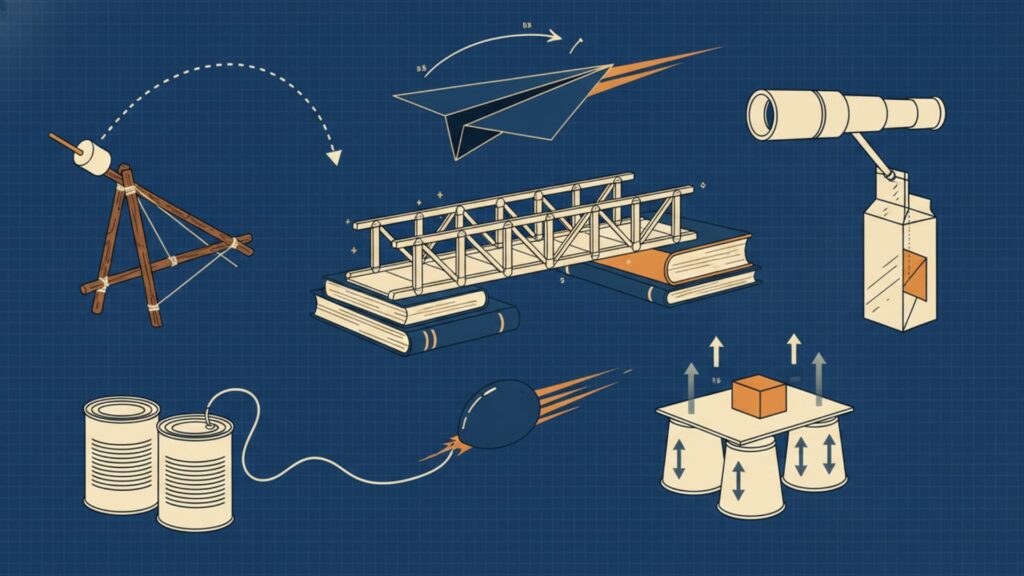
Engineering is about solving real problems by building things. These home STEM challenges push kids to plan, build, test, fail, adjust, and try again. That loop is exactly how engineers work in the real world.
61. Popsicle Stick Bridge
Build a bridge between two stacks of books using only popsicle sticks and school glue. Let it dry completely before testing. Then, stack coins in the center of the bridge until it fails. Kids who plan a truss pattern using triangular shapes typically build a bridge that holds far more weight than those who use simple flat layers.
- Materials: Popsicle sticks, school glue or a low-temperature glue gun, two stacks of books, coins for weight testing
- Science Concept: Structural engineering: triangular trusses distribute load across the entire structure rather than concentrating it at a single point; this is the same principle used in real bridges
- Age: 8 and up
- Difficulty: Medium
- Time: 45 minutes to build, plus drying time, plus load test
- Safety Note: An adult supervises when a low-temp glue gun is used
- What Kids Learn: Bridge design is not guesswork; the geometry of the structure determines how much load it can carry before failing
62. Tallest Paper Tower Challenge
Give each child one sheet of paper, a small piece of tape, and a pair of scissors. The goal is to build the tallest tower that stands completely on its own with no support. Rolling the paper into a tube or folding it into an accordion shape makes it dramatically stronger than leaving it flat. Planning first usually beats starting immediately.
- Materials: One sheet of paper per child, tape, scissors, and a ruler for measuring
- Science Concept: Structural engineering: cylindrical and accordion shapes resist compression from above much better than flat sheets because they distribute force along the walls rather than across a flat surface
- Age: 7 and up
- Difficulty: Easy
- Time: 20 minutes
- What Kids Learn: Material shape determines structural performance; the same sheet of paper behaves completely differently depending on how it’s formed
63. Balloon Rocket on a String
Thread a straw onto a long piece of string and stretch the string tightly between two chairs or anchor points. Blow up a balloon, pinch the end, and tape it securely to the straw. Release the balloon end and watch it shoot along the string as air escapes. This is rocket propulsion at a scale kids can hold in their hands.
- Materials: A balloon, a long piece of string, a straw, and tape
- Science Concept: Newton’s Third Law and thrust: air escaping backward from the balloon pushes the balloon (and attached straw) forward with equal force in the opposite direction
- Age: 5 and up
- Difficulty: Easy
- Time: 15 minutes
- What Kids Learn: Rockets move by pushing gas in one direction; the reaction force pushes the rocket the other way at equal magnitude
64. Cardboard Marble Maze
Use a cardboard box lid as the base and cut strips of cardboard to build walls, tunnels, ramps, and channels inside it. Place a marble at the starting point and tilt the board to guide it toward a target. Kids quickly learn that both the path and the slope matter, and they redesign the maze repeatedly to eliminate dead ends and wrong angles.
- Materials: A cardboard box lid, cardboard strips, scissors, glue, and a marble
- Science Concept: Engineering design and gravity: the marble follows the path of least resistance under gravity; angle and channel width determine how it moves through each section
- Age: 6 and up
- Difficulty: Medium
- Time: 45 minutes
- What Kids Learn: Gravity is constant; controlling how an object moves under gravity requires careful planning of angles, widths, and barriers
65. Popsicle Stick Catapult
Stack and bind popsicle sticks with rubber bands, attach a plastic spoon to the top end of the arm, and pull the arm back. When released, the energy stored in the bent structure launches whatever is in the spoon. Kids test different loads and compare distances, then adjust the arm tension to change the range.
- Materials: 10 popsicle sticks, rubber bands, a plastic spoon, small soft projectiles such as marshmallows or paper balls
- Science Concept: Potential and kinetic energy: bending the arm stores elastic potential energy in the rubber bands and sticks; releasing it converts that stored energy into kinetic energy (motion)
- Age: 8 and up
- Difficulty: Medium
- Time: 30 minutes to build, plus launch testing
- What Kids Learn: Energy can be stored in a stretched or bent material and released on demand; the amount of stored energy determines how far the projectile travels
66. Homemade Periscope
Build a long rectangular tube from two milk cartons or a cardboard box. Angle a small mirror at 45 degrees at each end, one at the top facing forward and one at the bottom facing the opposite direction. Light bounces from the top mirror to the bottom mirror, allowing the user to see over walls or around corners.
- Materials: Two milk cartons or a long cardboard box, two small flat mirrors, tape, scissors, a protractor for the angle
- Science Concept: Light reflection: light travels in a straight line; mirrors redirect it by reflecting at the same angle at which it arrives; two angled mirrors create a path that bends around obstacles
- Age: 8 and up
- Difficulty: Medium
- Time: 30 minutes
- What Kids Learn: Mirrors redirect light at predictable angles; periscopes use this property to see around and over objects that would otherwise block the line of sight
67. Paper Airplane Design Challenge
Fold four different paper airplane designs, take them outside, and test each one for distance, air time, and accuracy over three throws each. Change one design variable at a time, such as wing width or nose fold type, and record how each change affects performance. Scientific testing means changing one thing at a time.
- Materials: Paper, a ruler, a tape measure, and a notebook for recording results
- Science Concept: Aerodynamics: four forces act on a flying object: lift (upward), drag (backward), thrust (forward), and gravity (downward); wing shape and nose angle affect all four of these
- Age: 6 and up
- Difficulty: Easy
- Time: 20 minutes of folding and 20 minutes of flight testing
- What Kids Learn: Flight performance depends on shape; testing one variable at a time is the correct way to identify what causes a specific change in results
68. Plastic Bag Parachute
Cut a square from a plastic grocery bag, tie equal lengths of string to each corner, and attach the strings to a small figurine or coin weight. Drop it from a height and compare it to dropping the same weight without the parachute. The bag catches air, creating drag that slows the fall noticeably.
- Materials: A plastic grocery bag, string, scissors, a small figurine, or several coins taped together
- Science Concept: Air resistance and drag: the parachute creates a large surface area that pushes against air as it falls; this resistance (drag) acts upward and slows the downward acceleration of gravity
- Age: 5 and up
- Difficulty: Easy
- Time: 15 minutes to build, plus drop tests
- What Kids Learn: Air resistance slows falling objects; a larger surface area creates more drag; this is the engineering principle behind real parachutes and safety airbags
69. Pinhole Camera (Camera Obscura)
Tape a small piece of tin foil over one end of a shoebox and poke a tiny hole in it with a pin. Cut a piece of wax paper to fit tightly across the other end inside the box. Point the pinhole toward a bright outdoor scene or lit window. A small upside-down image of the scene appears on the wax paper screen inside.
- Materials: A shoebox, tin foil, a pin, wax paper, tape, and scissors
- Science Concept: Light travels in straight lines: light rays from different parts of a scene pass through the small hole and project onto the screen at opposite positions, creating an inverted image
- Age: 8 and up
- Difficulty: Medium
- Time: 30 minutes
- What Kids Learn: Light travels in straight lines; this simple optical principle is the foundation of photography and how the human eye forms images on the retina
70. Paper Cup and Cardboard Chair
Arrange 12 paper cups in a three-by-four grid on a hard floor. Lay a flat piece of cardboard on top. Test how much weight it holds by carefully stacking books one at a time. The cups share the load across the entire grid. The same load-sharing principle is used in buildings to spread weight from floors down through columns to the foundation.
- Materials: 12 paper cups, a flat piece of cardboard, books for weight testing
- Science Concept: Load distribution: weight placed on the cardboard spreads across all 12 cups equally; each cup carries only a fraction of the total load, making the structure far stronger than a single support
- Age: 8 and up
- Difficulty: Medium
- Time: 20 minutes to set up, plus load testing
- What Kids Learn: Distributing weight across multiple supports dramatically increases what a structure can hold; this is the structural logic behind columns, arches, and foundation engineering
71. Water Wheel from Cardboard
Cut six to eight identical paddles from cardboard and attach them evenly around a central axle made from a pencil or wooden skewer. Hold the axle horizontally over a bowl and pour water from a cup onto the paddles. The water pushes each paddle as it contacts it, spinning the wheel continuously.
- Materials: Cardboard, scissors, a pencil or wooden skewer, tape, a bowl, a cup for pouring
- Science Concept: Hydropower: falling water carries kinetic energy; when it contacts a paddle, that energy transfers to the wheel as rotational force; this converts linear water movement into rotational mechanical energy
- Age: 8 and up
- Difficulty: Medium
- Time: 30 minutes
- What Kids Learn: Moving water can perform mechanical work; water wheels have been used for grinding grain and powering machinery for over two thousand years
72. Simple Pulley with a Spool and String
Tie a spool to a doorframe or horizontal rod. Run a string over it, attach a small weighted bucket to one end, and pull the other end downward. The pulley doesn’t reduce the amount of force needed to lift, but it changes the direction of pull, which is often all that’s needed to make a job physically manageable.
- Materials: A thread spool or similar wheel, string, a rod or hook to attach it to, two small buckets or cups, and weights such as coins
- Science Concept: Simple machines: a single pulley changes the direction of force; a double pulley system also reduces the force required by distributing it across two rope segments
- Age: 8 and up
- Difficulty: Medium
- Time: 20 minutes to set up
- What Kids Learn: Simple machines don’t create energy; they redirect or distribute force to make tasks physically easier or more controllable
73. Tin Can Telephone
Punch a small hole in the bottom of two clean tin cans. Thread a long piece of string through both holes and tie a firm knot on the inside of each can to hold it. Hold one can each, pull the string tightly between you, and speak into your can while the other person holds theirs to their ear.
- Materials: Two clean, empty tin cans, a long piece of strong string, a nail or sharp tool for punching holes
- Science Concept: Sound transmission through solids: voice vibrations travel through the can, into the taut string, and along the string to the second can, which vibrates and reproduces the sound
- Age: 5 and up
- Difficulty: Easy
- Time: 15 minutes
- Safety Note: Adults should smooth the can edges and punch the holes
- What Kids Learn: Sound is a mechanical vibration that travels through solid materials, not just air; a taut string transmits vibration efficiently over a surprising distance
74. Build a Raft That Holds Weight
Use popsicle sticks, straws, foil, or any available flat materials to build a small raft. Float it in a tub of water and add coins one at a time, placing them evenly across the surface, until it sinks. Teams that build a wider, flatter base hold more weight. The shape of the hull matters as much as the material.
- Materials: Popsicle sticks, straws, foil, tape, a tub of water, coins for weight testing
- Science Concept: Buoyancy and displacement: an object floats when the weight of water it displaces equals its own weight; a wider base displaces more water and increases the maximum load before sinking
- Age: 7 and up
- Difficulty: Medium
- Time: 30 minutes to build, plus float testing
- What Kids Learn: Archimedes’ principle: the shape and size of the hull determines how much water is displaced and therefore how much weight the raft can carry
75. Spaghetti and Marshmallow Tower
Give each child or team 20 pieces of dry spaghetti and 20 mini marshmallows. Set a timer for 18 minutes and challenge them to build the tallest freestanding tower they can.
Teams that sketch a quick plan and use triangular cross-bracing consistently build taller, more stable structures than those that start building immediately without a plan.
- Materials: 20 pieces of dry spaghetti, 20 mini marshmallows per team, a tape measure, a timer
- Science Concept: Structural engineering: triangles are the strongest geometric shape under load because force applied to any side is distributed along all three sides; this makes triangular bracing far more stable than square or vertical-only construction
- Age: 7 and up
- Difficulty: Hard
- Time: 18 to 25 minutes
- What Kids Learn: Planning and geometry are as important as materials; the spaghetti and marshmallow challenge is used in real engineering education programs to teach structural thinking
What to Do When an Experiment Does Not Work
Not every experiment works the first time, and that’s completely normal in real science, too.
Start by checking your materials: whole milk works better than skim for magic milk, and fresh yeast outperforms old yeast in the CO2 balloon test.
Check your measurements next, since a small change in ratio can change the result entirely. Then ask your child what they think went wrong and let them decide what to adjust on the next run.
Running the same experiment twice with one small change is not a failure. It’s the scientific method working exactly as it should.
Final Thoughts
Science doesn’t need to happen in a lab to be real. It happens when your kid watches raisins rise in sparkling water and asks, “Why did that happen?”
That question is everything.
These kids’ science experiments at home give you a solid starting point across chemistry, physics, biology, earth science, and engineering.
You don’t have to do all of them. Start with one that fits your child’s age and whatever you already have in your kitchen.
Over time, you’ll notice a shift. They’ll start questioning things without being asked. That’s the real win.
Got a favorite from this list? Or one that went sideways in the most interesting way? Drop it in the comments below. We’d love to hear how it went.