


Your transcript shows a 3.7 GPA. But is that weighted or unweighted?
Most high school students get confused when they see different GPA numbers on their report cards. Some schools report a 4.2, while others cap it at 4.0.
Your counselor mentions weighted points, but your college application asks for unweighted grades. It gets messy fast.
Understanding what an unweighted GPA is and how it differs from a weighted GPA changes everything about how you plan your classes.
This guide breaks down both GPA types, shows you exactly how they’re calculated, and explains what colleges actually care about when they review your application.
What is an unweighted GPA?
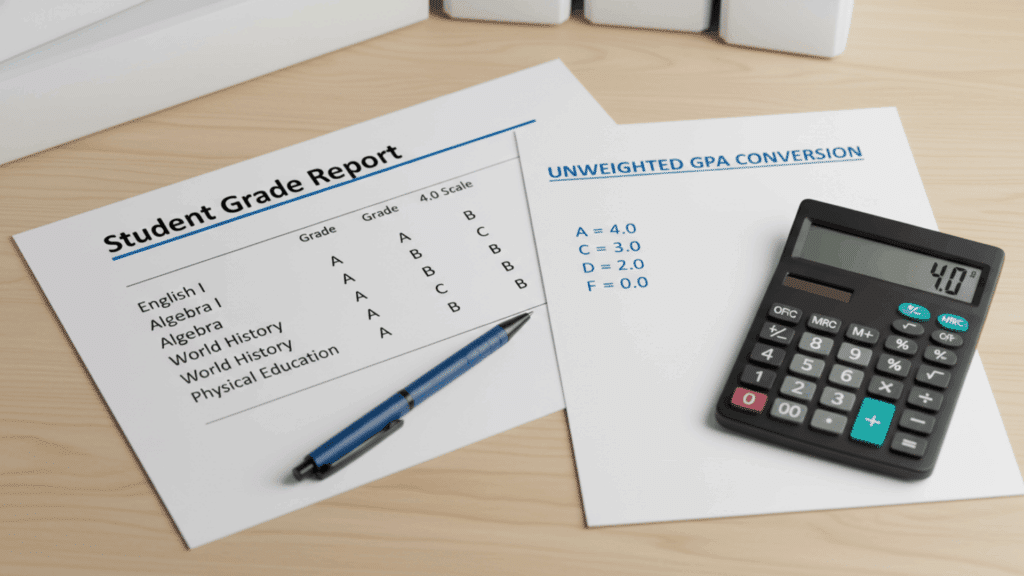
An unweighted GPA is a grade point average calculated on a standard 4.0 scale. It treats all classes equally, no matter how hard they are.
This means an A in a regular class counts the same as an A in an honors or AP class. Schools use this system to measure your academic performance, without accounting for course difficulty.
The highest unweighted GPA you can earn is 4.0, which means you got straight As in all your classes.
How It’s Calculated:
Schools convert your letter grades into numbers using a standard point system. Here’s how the conversion works:
| Letter Grade | Grade Point Value |
|---|---|
| A | 4.0 |
| B | 3.0 |
| C | 2.0 |
| D | 1.0 |
| F | 0.0 |
To calculate your unweighted GPA, add up all your grade points and divide by the total number of classes. Some schools also use plus and minus grades. An A minus might be 3.7, while a B plus could be 3.3. The process stays the same regardless of your class type.
Example Calculation: If you earned grades A, A, B, B, and C in five classes, your unweighted GPA would be (4.0 + 4.0 + 3.0 + 3.0 + 2.0) ÷ 5 = 3.2.
What Is a Weighted GPA?

A weighted GPA is a grade point average that gives extra credit for harder classes. Unlike an unweighted GPA, this system recognizes that AP, Honors, and IB courses require more effort than regular classes.
Schools add bonus points to your grades in these advanced courses. The weighted GPA scale typically goes above 4.0, often reaching 5.0 or higher.
This means students who take challenging courses can earn a GPA that reflects their extra academic work.
How It’s Calculated
Schools add bonus points to your grade in advanced classes before calculating your GPA. The bonus amount depends on the course level:
| Course Type | Grade Earned | Standard Points | Bonus Points | Total Points |
|---|---|---|---|---|
| Regular | A | 4.0 | 0 | 4.0 |
| Honors | A | 4.0 | +0.5 | 4.5 |
| AP/IB | A | 4.0 | +1.0 | 5.0 |
| Regular | B | 3.0 | 0 | 3.0 |
| Honors | B | 3.0 | +0.5 | 3.5 |
| AP/IB | B | 3.0 | +1.0 | 4.0 |
Example Calculation: If you take 3 regular classes (earning A, A, B) and 2 AP classes (earning A, B), your calculation would be: (4.0 + 4.0 + 3.0 + 5.0 + 4.0) ÷ 5 = 4.0 weighted GPA.
Weighted vs Unweighted GPA: 5 Key Differences

Understanding the differences between these two GPA types helps you make better academic decisions. Here are five key ways they differ.
1. Course Difficulty Consideration
Unweighted GPA: This system treats all classes the same way. An A in regular math counts exactly the same as an A in AP Calculus.
Weighted GPA: This system awards extra points for more difficult classes. Taking AP, Honors, or IB courses earns you bonus points that boost your overall GPA.
2. GPA Scale Differences
Unweighted GPA: The scale maxes out at 4.0, which represents straight As. You cannot go higher than this number, even if you take the hardest classes available.
Weighted GPA: The scale can exceed 4.0, often reaching 5.0 or higher. Students taking advanced courses can earn GPAs like 4.5 or 4.8.
3. Impact on Class Rank
Unweighted GPA: Class rankings based on this system favor students who avoid challenging courses. Someone taking easy classes might rank higher than someone struggling through AP courses.
Weighted GPA: Class rankings reward students who take more challenging courses. This system ensures that students challenging themselves get recognition for their efforts, even with occasional lower grades.
4. College Admissions Implications
Unweighted GPA: Colleges recalculate GPAs using this scale to fairly compare students. It helps admissions officers see your pure academic performance across all schools.
Weighted GPA: Some colleges prefer this because it shows academic rigor. However, they often convert it back to unweighted to standardize comparisons between applicants from different high schools.
5. Potential for Honors or AP Credit Boosts
Unweighted GPA: No bonus points are available in this system. Your grade is your grade, regardless of how difficult the class was.
Weighted GPA: You earn bonus points ranging from 0.5 to 1.0 for advanced courses. These boosts can significantly raise your overall GPA and improve your academic standing.
How Colleges Evaluate GPAs?
Most colleges look at both weighted and unweighted GPAs during the application process.
Many admissions offices recalculate your GPA using their own system to compare students fairly across different high schools.
They examine your transcript to see which classes you chose and review course difficulty patterns throughout each year.
Admissions officers understand that a B in AP Chemistry shows greater effort than an A in a regular science course. This holistic review process means colleges look beyond just numbers.
Taking harder classes, even with slightly lower grades, often impresses admissions committees more than perfect grades in easy courses.
Strategies for Improving Weighted and Unweighted GPAs

Raising your GPA takes effort, but the right strategies make it easier. Here are six practical ways to boost both your weighted and unweighted GPAs.
1. Prioritize Challenging Classes
Taking honors, AP, or IB courses immediately improves your weighted GPA. These classes add bonus points even if you earn a B instead of an A.
Colleges also notice when you challenge yourself with harder coursework. Start with one or two advanced classes if you’re worried about the workload.
2. Stay Consistent with Study Habits
Good study habits lead to better grades in all your classes. Set aside specific times each day to review notes and complete assignments.
Create a study schedule that breaks big tasks into smaller, manageable steps. Consistency matters more than cramming the night before a test.
3. Engage in Class Discussions
Teachers often give participation grades that can lift your overall score. Speaking up in class shows you’re paying attention and care about the subject.
Ask questions when you don’t understand something instead of staying quiet. Active involvement can especially help in English, history, and social studies classes.
4. Focus on Areas of Weakness
Identify subjects where your grades are lowest and give them extra attention. Spending more time on weak areas brings up your overall GPA faster.
Work on understanding the basics before moving on to more advanced topics. Even raising one grade from a C to a B makes a real difference.
5. Ask for Extra Credit
Many teachers offer extra credit assignments that can boost your final grade. Talk to your teachers early in the semester about these opportunities.
Extra credit projects show initiative and can make up for a bad test score. Just make sure you complete regular assignments first before taking on extra work.
6. Seek Academic Support
Tutors and study groups help you better understand difficult material. Your school might offer free tutoring services or peer study sessions.
Working with others lets you learn from different perspectives and teaching styles. Don’t wait until you’re failing to ask for help.
GPA Calculation Tools and Resources for Students
Tracking your GPA doesn’t have to be complicated with the right tools. Here are helpful resources that make calculating and monitoring your GPA much easier.
| Resource Type | What It Does |
|---|---|
| GPA Calculator Websites | Automatically calculate weighted and unweighted GPAs by entering your grades and course types |
| School-Provided Calculators | Match your school’s specific grading scale for the most accurate results |
| GPA Conversion Tables | Show how letter grades convert to GPA points on both weighted and unweighted scales |
| Grade Tracking Apps | Monitor your GPA in real time as you input grades throughout the semester |
Do Colleges Look at Weighted or Unweighted GPA?
Colleges typically look at both weighted and unweighted GPAs when reviewing your application.
Many admissions offices recalculate your GPA to ensure fairness when comparing students from different schools with varying grading systems.
Some colleges focus on weighted GPA because it shows the rigor of your coursework and whether you challenged yourself with advanced classes.
Your unweighted GPA demonstrates how well you performed overall without the bonus points from harder courses. Both numbers matter in the admissions process.
Weighted GPA highlights academic challenge, while unweighted GPA shows consistent performance across all subjects.
The Bottom Line
Understanding what an unweighted GPA is helps you make smarter decisions about your high school courses. The difference between weighted and unweighted GPAs matters less than you think.
Most colleges recalculate everything anyway. What really counts is challenging yourself with harder classes while maintaining solid grades.
Your GPA tells part of your academic story, but it’s not the whole picture. Colleges want students who push themselves, stay consistent, and show real growth over four years.
Ready to boost your GPA? Start by talking to your counselor about which advanced courses fit your strengths.
Check your current grades using a GPA calculator. Then create a plan that balances challenging classes with realistic expectations. What’s your current GPA goal? Share your thoughts in the comments below.