
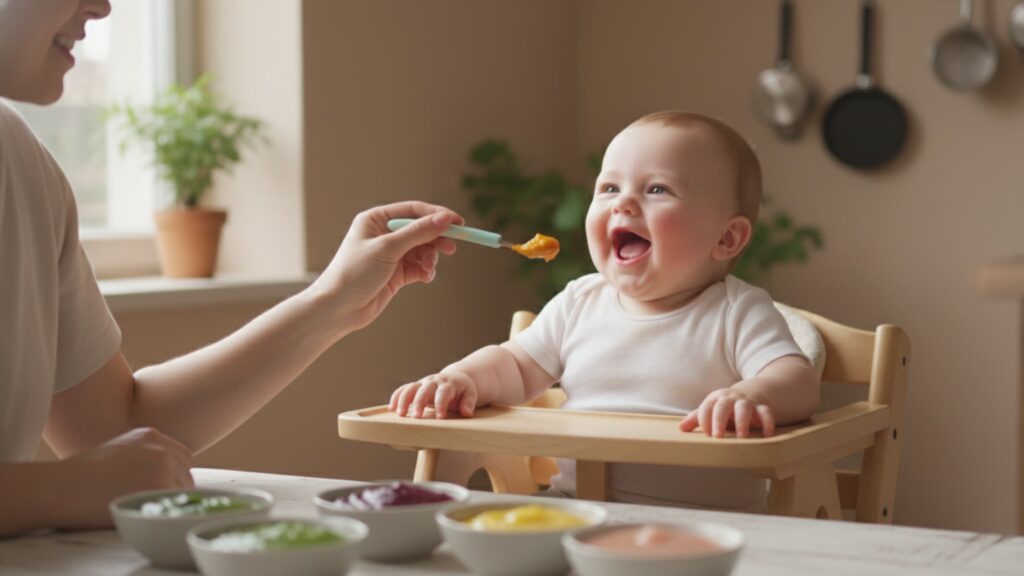
Your baby has been drinking breast milk or formula since day one.
Then comes the moment every parent quietly dreads: starting solid foods. What do you give first? How thick should it be? What does “Stage 1” even mean?
This guide breaks everything down simply. You will learn what each baby food stage means, what types of foods fit each stage, and exactly how to introduce solids safely.
You will also get a clear list of dos and don’ts, foods to avoid, and when to move your baby from purees to table foods.
What Are Baby Food Stages?
Baby food stages are a way to describe how a baby’s diet progresses from milk-only feeding to eating modified family foods.
They are usually labeled Stage 1, Stage 2, and Stage 3, and each stage reflects changes in texture, variety, and feeding skills.
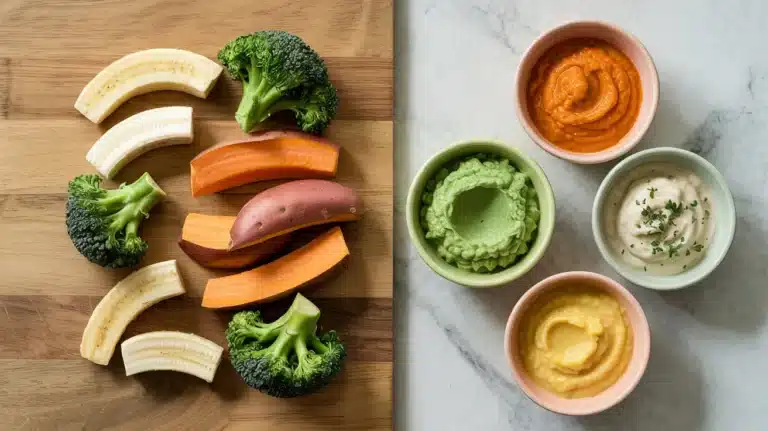
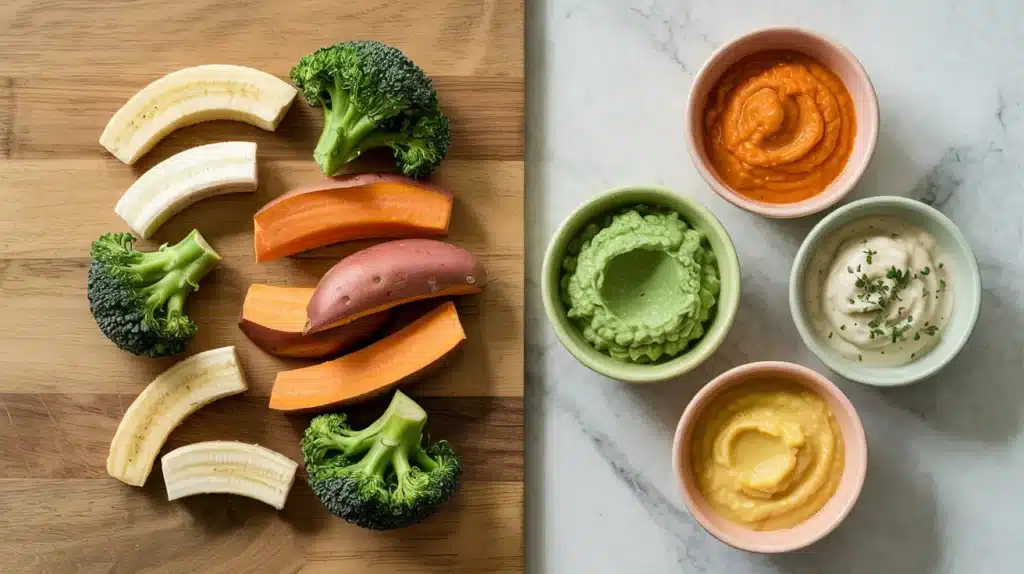
Stage 1 focuses on very smooth, pureed foods for babies just starting solids. Stage 2 introduces thicker purees and mashed foods with more ingredients. Stage 3 includes chunkier textures and soft finger foods that help build chewing and self-feeding skills.
While brands use stage labels, what matters most is your baby’s readiness, swallowing ability, and comfort with different textures.
Is Your Baby Ready for Solid Foods?
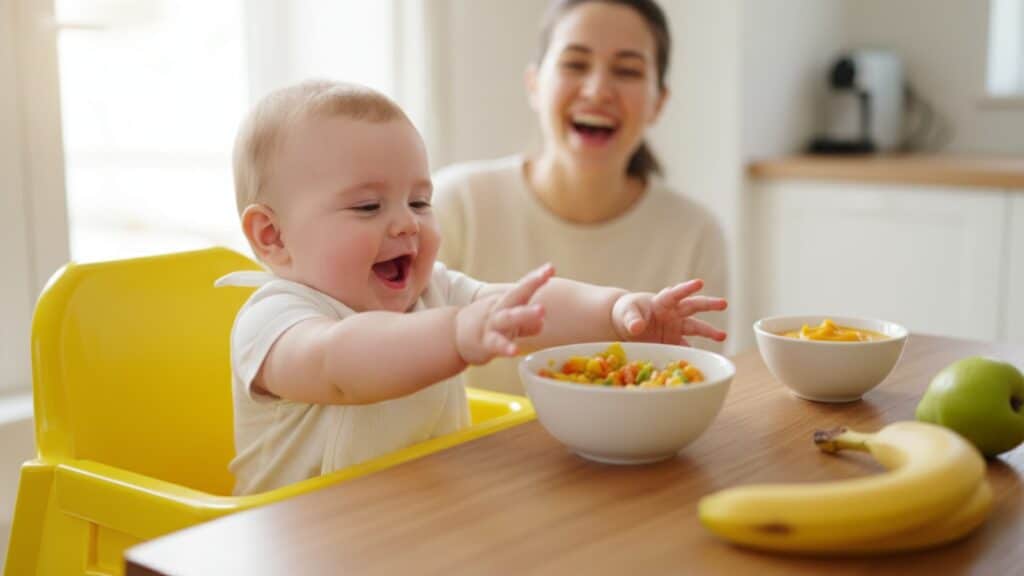
Every parent wonders the same thing: Is my baby ready? Age alone does not give you the full answer. You need to watch for a combination of physical and behavioral signs before you offer that first spoonful.
Here is what to look for:
- Holds their head up steadily: Baby can keep their head upright and sit with support in a high chair.
- Has doubled their birth weight: Usually around 13 pounds or more, typically by 4–6 months.
- Shows interest in food: Baby watches you eat, reaches toward your plate, or opens their mouth when food comes near.
- Has lost the tongue-thrust reflex: Baby no longer automatically pushes food forward out of their mouth with their tongue.
- Can swallow from a spoon: Baby moves food from the front of their mouth to the back and swallows it without choking.
- Sits upright with support: Baby has enough body control to sit safely in a feeding position.
Pro Tip: Look for most of these signs together, not just one or two. If your baby is 4 months old and only showing one sign, check with your pediatrician before starting.
Why you should not start before 4 months:
Before 4 months, breast milk or formula provides all the nutrition a baby needs, and their digestive system is not ready for solids. Starting too early can lead to overfeeding and unhealthy weight gain, and the tongue-thrust reflex often makes babies push food right back out.
Types of Baby Foods: What Goes Into Each Stage
Before you look at the stages themselves, it helps to know what food categories are appropriate for babies, and how each one is prepared. This table gives you a full picture at a glance.
| Food Category | First Introduced | Prep (Quick) | Key Benefit |
|---|---|---|---|
| Fruits | Stage 1 | Wash, peel, steam if needed; puree smooth | Vitamins + fiber |
| Vegetables | Stage 1 | Steam/bake until soft; puree, mash, then soft dice | Vitamins + fiber |
| Grains/Cereal | Stage 1 | Mix iron-fortified cereal with milk/formula/water | Iron support |
| Proteins | Stage 1–2 | Cook fully; blend smooth, mash, then shred/soft dice | Iron + zinc |
| Dairy (yogurt/cheese) | Stage 2 | Plain full-fat yogurt; small amounts | Calcium + fat |
| Combination Foods | Stage 2 | Mix foods already introduced; mild spices only | Flavor variety |
Note: Cow’s milk as a drink is not appropriate until 12 months. Yogurt and cheese are fine from 6 months, they are processed differently and easier to digest.
Baby Food Stages Explained: What to Feed and When
The three baby food stages are not about hitting an exact age. They are about matching the right food texture to your baby’s physical and developmental stage. Here is a complete breakdown of what each stage looks like, what to feed, and how much to give.
Stage 1 Baby Food (4–6 Months)
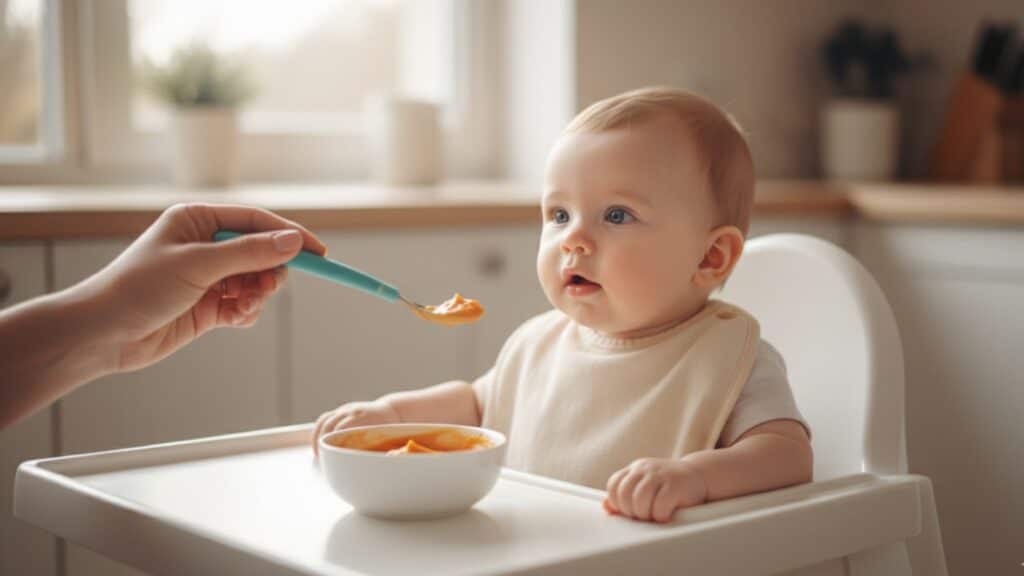
Stage 1 is the starting point for solids. Breast milk or formula is still your baby’s main nutrition source, and solids are mostly for practice. The goal is to help your baby get comfortable eating from a spoon.
Stage 1 foods should be thin, smooth, and made with one ingredient at a time. The texture should be runny and lump-free so it’s easy to swallow and helps you spot any reaction.
Best Stage 1 foods:
- Sweet potato puree
- Pureed carrots
- Pureed peas
- Pureed apple or pear
- Mashed banana
- Mashed avocado
- Pureed chicken or turkey
- Iron-fortified oatmeal, barley, or multigrain baby cereal
How much to feed:
- Start with less than a spoonful
- Slowly build to 1–2 tablespoons, once or twice daily
- Keep breast milk or formula at about 24–32 ounces per day
Stage 2 Baby Food (6–9 Months)
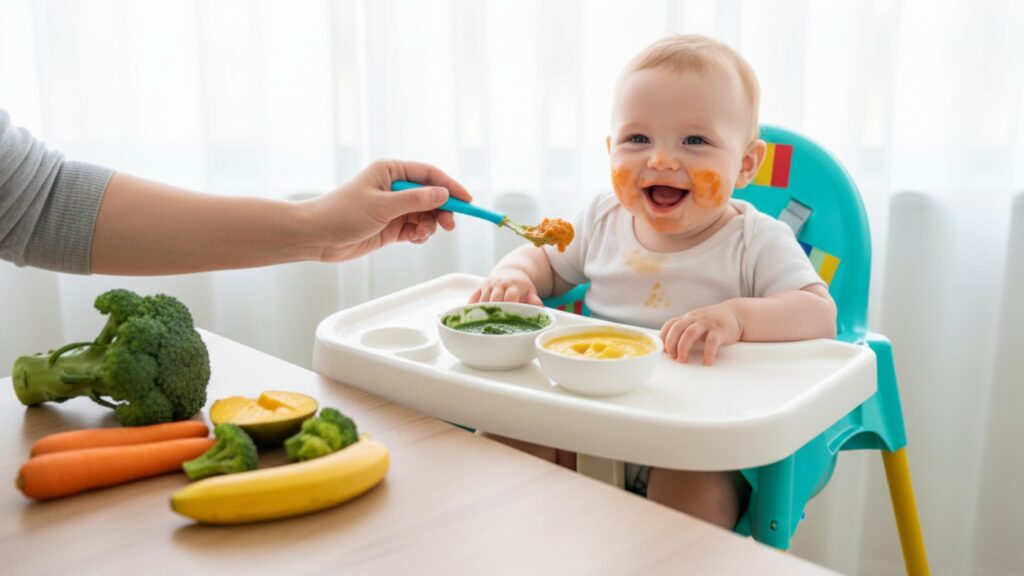
Your baby has found their rhythm with Stage 1. Now it is time to add more texture and flavor.
Stage 2 foods are thicker and often combine two or more ingredients, such as apple-banana puree or carrot-pea blend. There may be small, soft lumps, but nothing that requires real chewing.
This stage is also a key window for building a broad palate. Research shows that babies exposed to a wide variety of flavors in the first year are more willing to eat fruits and vegetables later in life.
Best Stage 2 foods:
- Apple-banana, mango-pear, or peach-blueberry blends
- Carrot-pea or broccoli-sweet potato combos
- Spinach-apple puree
- Mashed lentils or pureed beans
- Blended chicken or turkey with vegetables
- Thicker oatmeal or multigrain porridge
How much to feed:
- About 4 ounces (one small jar) per meal
- Up to 32 ounces of breast milk or formula per day
- Gradually work toward 2–3 solid meals per day
Signs your baby is ready to move to Stage 2:
- Swallows Stage 1 foods easily and consistently for 2–4 weeks
- Opens their mouth eagerly and leans toward the spoon
- No longer pushes food back out with their tongue
Stage 3 Baby Food (8–12 Months)
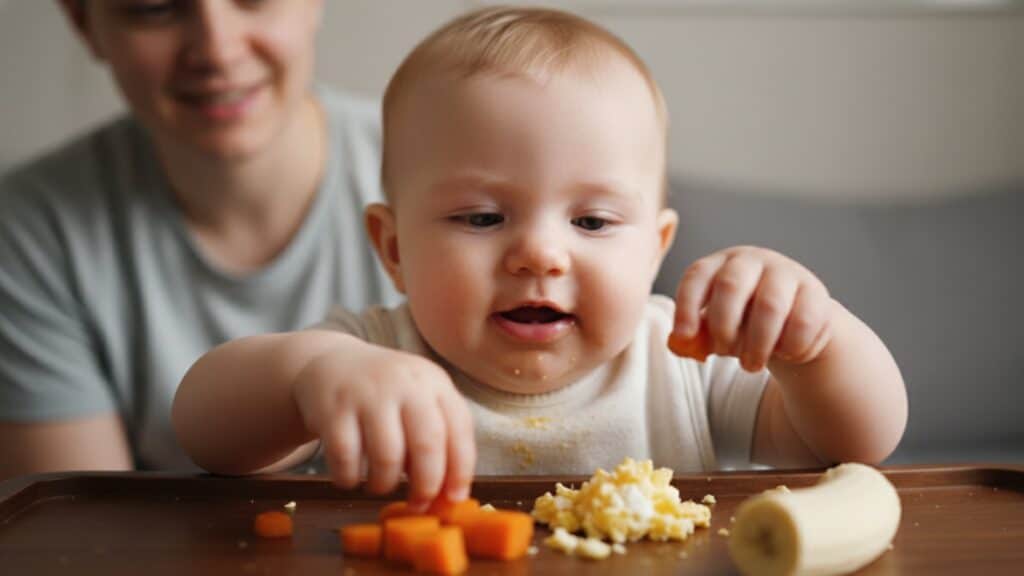
Stage 3 is a big milestone. Your baby is learning to chew, and this skill develops with practice.
Foods are chunkier, with soft pieces that need gentle munching. Many babies also begin picking up food with their fingers at this stage.
Parents often introduce soft finger foods alongside Stage 3 meals to help build independence and strengthen the pincer grasp, the ability to pick up small pieces with the thumb and index finger.
Best Stage 3 foods:
- Soft ripe banana slices or diced cooked pear
- Well-cooked, soft pasta pieces
- Small soft cubes of cooked sweet potato, zucchini, or carrot
- Well-cooked scrambled eggs
- Soft pieces of bread
- Shredded soft-cooked chicken or turkey
- Soft bean pieces or mashed lentils with texture
How much to feed:
- 3–4 small meals per day, plus 1–2 snacks
- Baby eats roughly every 2–3 hours
- Breast milk or formula continues but gradually decreases
Signs your baby is ready for Stage 3:
- Sits upright without support
- Has developed a pincer grasp
- Reaches for food and tries to self-feed
- Handles Stage 2 textures without any difficulty
How to Introduce Solid Foods to Your Baby: Step-By-Step
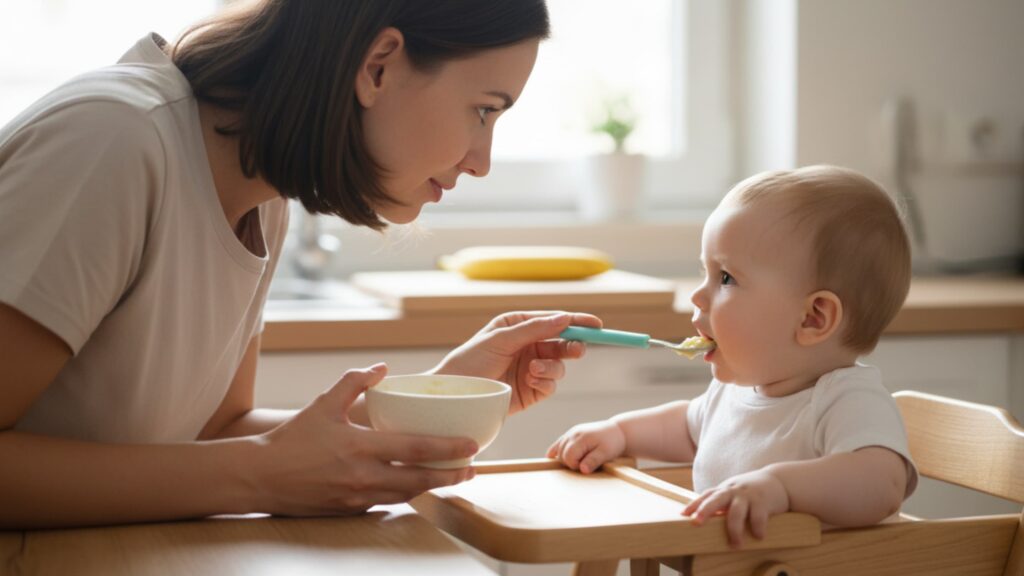
Knowing what to feed is only part of the process. How you introduce solids matters just as much for safety, allergy awareness, and healthy eating habits. Follow these steps in order.
Step 1: Talk to Your Pediatrician First
Before starting solids, check with your baby’s doctor. They can confirm readiness, flag any health concerns, and advise on supplements like vitamin D or iron, especially for premature babies or those with medical conditions.
Step 2: Set Up a Safe Feeding Space
Use a firm high chair that keeps your baby upright at a 90-degree angle. This supports safer swallowing and reduces the risk of choking. Always supervise meals and never leave your baby alone with food.
Step 3: Offer the First Food the Right Way
Feed breast milk or formula first, then offer a small amount of food. Keep it calm and relaxed. If your baby turns away or pushes food out, stop and try again later. Use a soft baby spoon, and never put solids in a bottle.
Step 4: Introduce One New Food at a Time
Offer one new food per sitting, then wait 3–5 days before introducing another. This makes it easier to spot reactions or intolerance. Start with a tiny amount and build slowly. If your baby refuses a food, keep trying; many babies need repeated exposure before accepting it.
Step 5: Introduce Common Allergens Early
The AAP recommends early allergen introduction instead of delaying it. Common allergens include peanuts, tree nuts, eggs, milk, wheat, soy, fish, and shellfish.
Introduce one at a time earlier in the day, and watch for symptoms such as hives, vomiting, swelling, or trouble breathing. Babies with severe eczema or egg allergy should be cleared by a pediatrician before peanuts.
Step 6: Know When to Move to the Next Stage
Stages should be based on skills, not age alone. Move to Stage 2 once your baby handles Stage 1 smoothly for a few weeks.
Move to Stage 3 when thicker textures feel easy, and your baby shows interest in self-feeding. Every baby progresses at their own pace.
Dos and Don’ts of Feeding a Baby
Feeding a baby comes with a short but important list of rules. Getting these right keeps your baby safe and builds healthy habits from the very first meal.
| Do | Don’t |
|---|---|
| Always sit the baby upright in a firm high chair | Don’t start solids before 4 months |
| Offer breast milk or formula before solids | Don’t add salt or sugar to any baby food |
| Introduce one new food every 3–5 days | Don’t put solid food in a bottle |
| Offer a wide variety of foods and flavors early | Don’t force the baby to finish their plate |
| Use a soft baby spoon for every feeding | Don’t give cow’s milk as a drink before 12 months |
| Cook all fruits and vegetables until fork-soft | Don’t give honey in any form before 12 months |
| Stay with your baby during every meal | Don’t give juice to babies under 12 months |
| Let the baby explore food with their hands | Don’t feed only rice cereal; vary the grains |
Foods to Avoid in the First Year
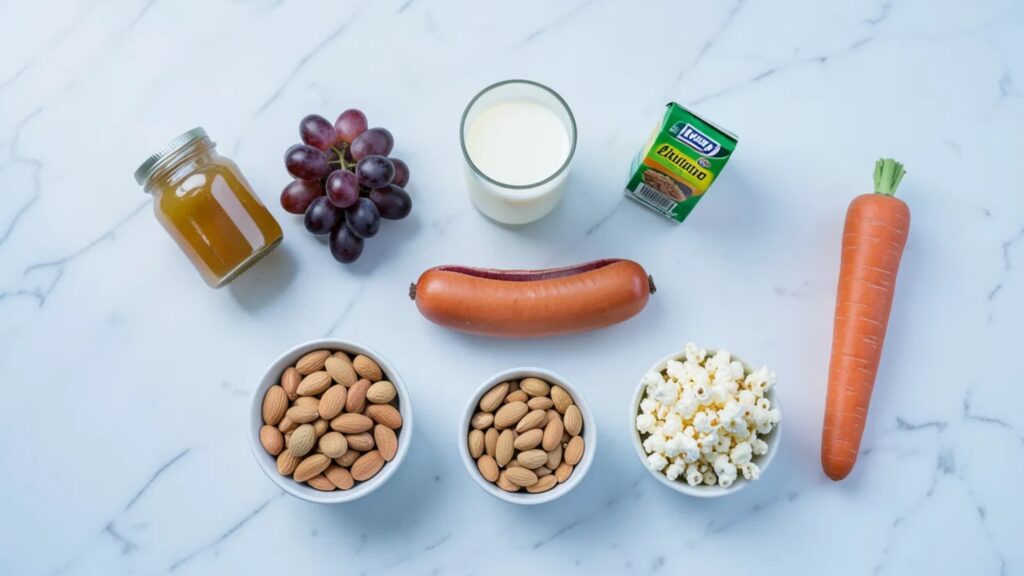
Some foods are completely off the table during the first 12 months, and some stay off the menu until age 3 or 4. Here is a clear list with the reason for each.
- Honey (all forms, raw, baked, or cooked): Risk of infant botulism. Off limits until 12 months.
- Cow’s milk as a drink: Does not provide the right nutrition for babies. Wait until 12 months.
- Fruit juice: No nutritional benefit for babies under 12 months. Linked to diarrhea, tooth decay, and excessive weight gain (AAP).
- Rice cereal as the only grain: Feeding only rice cereal increases the risk of arsenic exposure. Always offer a variety (CDC).
- Whole grapes: A round shape that fits perfectly in a small airway. Must be quartered, at minimum, and even then, wait until developmental readiness at age 3–4.
- Hot dogs and meat sticks: The round, slippery shape makes them a serious choking hazard for young children.
- Whole nuts and seeds: Not safe until age 3–4 due to the risk of choking.
- Popcorn: Pieces can easily get lodged in a baby’s airway. Not safe until age 3–4.
- Hard raw vegetables (carrots, celery): Too firm and difficult to manage. Always steam or cook until very soft.
- Round candies: A choking hazard. Not appropriate for young children.
- Canned adult food: Often high in salt, sugar, and preservatives — not suitable for babies.
After Stage 3: Moving to Family Foods
By 12 months, most babies are ready to move beyond baby food and join family meals. You can now introduce soft table foods cut into small, safe pieces and cow’s milk as a drink.
Honey is safe after the first birthday. Growth slows down around age 1, so a smaller or pickier appetite is completely normal and not a cause for concern.
Work toward stopping bottles by the first birthday, as recommended by the AAP.
From here, focus on offering foods from all food groups at family meals, keeping portions small, textures soft, and always watching for choking risks.
Final Notes
Baby food stages are meant to make starting solids simpler, not stressful.
Stage 1 begins with thin, smooth, single-ingredient purees around 4–6 months. Stage 2 introduces thicker blends and more variety between 6–9 months.
Stage 3 adds soft chunks and encourages self-feeding practice from 8–12 months. After 12 months, most babies can move on to soft table foods.
Offering the right textures at the right time helps your baby develop safe eating skills, accept a wider range of foods, and build healthy habits early on.
The most important reminder is to watch your baby, not just the calendar. Every baby progresses at a different pace.
Follow their cues, move gradually, and check with your pediatrician if you ever feel unsure.