

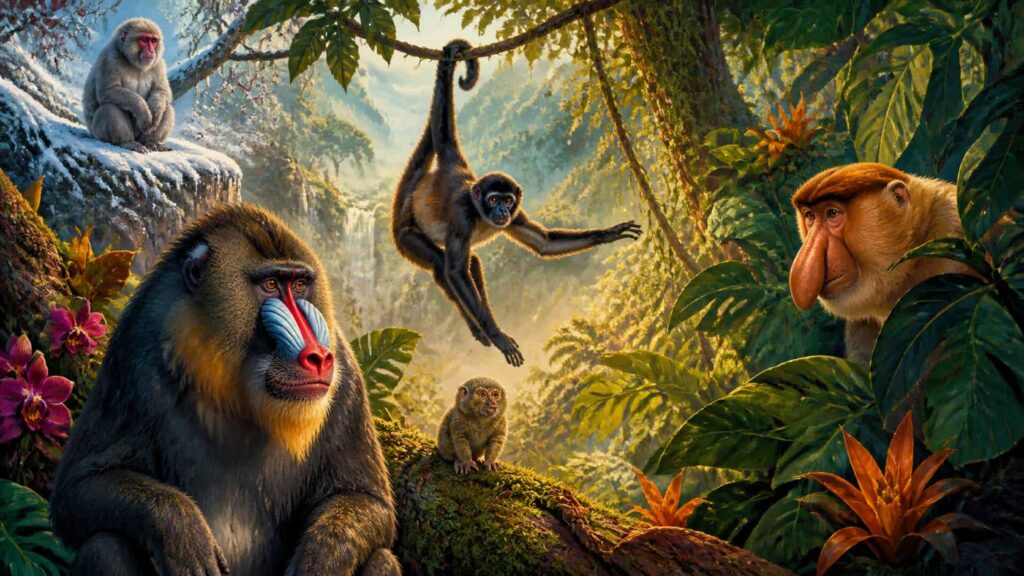
Monkeys are everywhere. In kids’ books, cartoons, zoos, and forests across three continents. But most of what people think they know about monkeys is either a myth or barely scratching the surface.
Did you know a monkey went to space before any human did? Or that some monkeys steal tourists’ phones and hold them for ransom? There are over 300 species of monkeys on Earth, and each one has something odd, clever, or flat-out surprising going on.
This post covers fun facts about monkeys split into five categories: body facts, social life, food and habitat, intelligence, and the most surprising records out there.
Let’s get started.
Body Facts About Monkeys
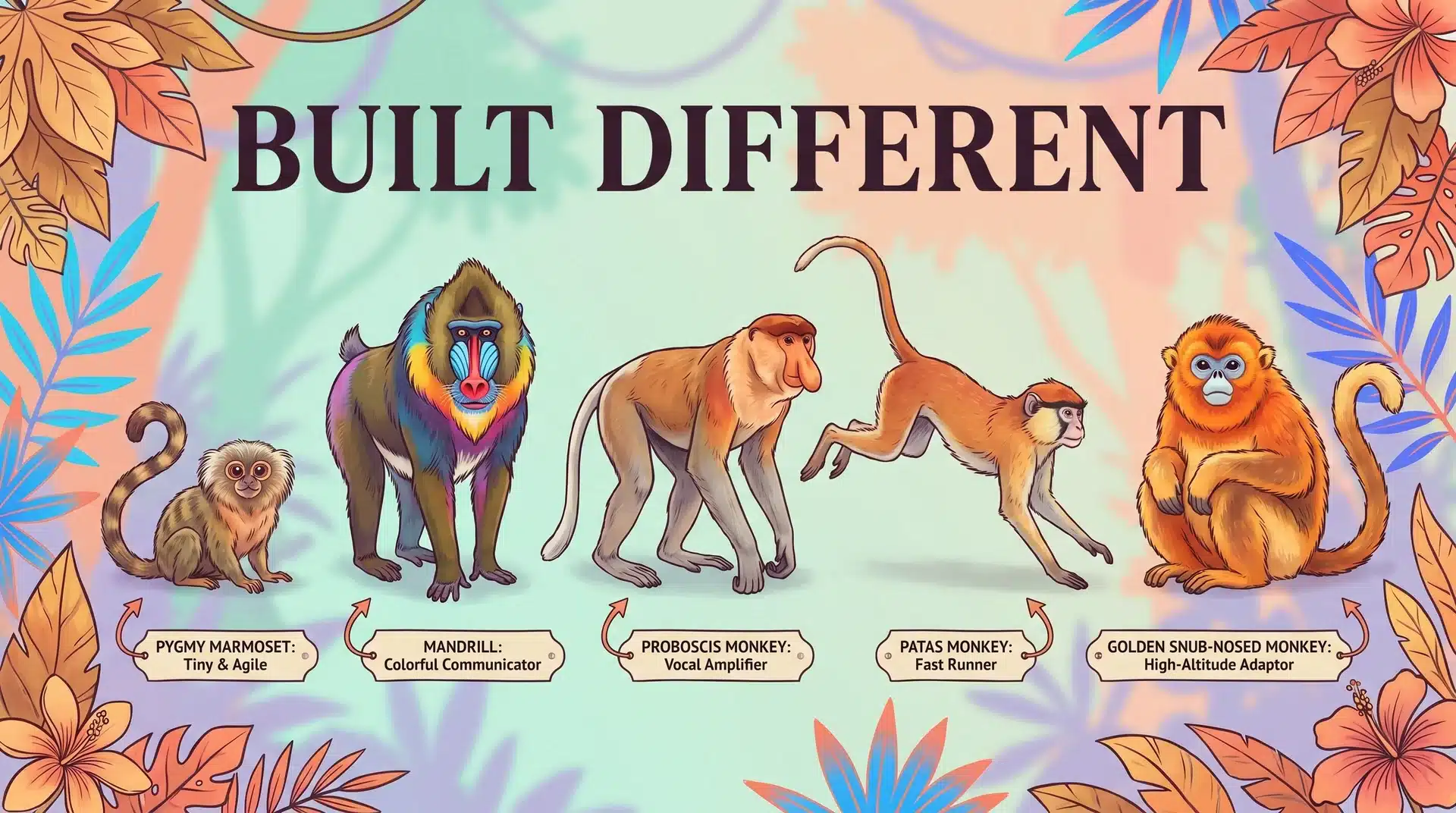
Alt Text: Illustration showing five different monkey species, each labeled with their unique physical trait and a ‘Built Different’ title overhead.
Monkeys come in wildly different shapes, sizes, and colors. From a tiny creature that fits in your palm to a primate with fangs longer than a lion’s, the physical variety across monkey species is genuinely hard to wrap your head around. Here is a closer look at what makes monkey bodies so interesting.
Fact 1. The pygmy marmoset is the smallest monkey in the world. It weighs about as much as an apple and fits in the palm of your hand.
Fact 2. A fully grown pygmy marmoset is no taller than 6.3 inches. Even adults look like babies next to most other animals.
Fact 3. The mandrill is the largest monkey in the world. A male mandrill can weigh over 77 pounds and reach 3.3 feet in length.
Fact 4. Mandrill fangs are longer than a lion’s. Yes, a monkey has bigger teeth than one of the top predators on the planet.
Fact 5. Mandrills have bright blue and red markings on their faces and backsides. The coloring comes from structural coloration in facial collagen fibers, not pigment.
Fact 6. Most monkeys have tails. Apes do not. That is one of the fastest ways to tell the two apart.
Fact 7. New World monkeys, found in Central and South America, have prehensile tails. That means they can grip and hold branches with their tail like an extra hand.
Fact 8. Old World monkeys, found in Africa and Asia, have tails too. But their tails cannot grip anything. They are non-prehensile.
Fact 9. Spider monkeys have a bare patch of skin on the underside of their tail with a unique pattern of grooves. It works like a fingerprint for identification.
Fact 10. Every monkey has a unique fingerprint, just like humans do.
Fact 11. Both Old World and New World monkeys have opposable thumbs. This lets them grip food, tools, and tree branches with precision.
Fact 12. Male proboscis monkeys have noses that can grow up to 3.9 inches long. Scientists think the large nose helps attract females by making calls sound louder.
Fact 13. Proboscis monkeys are the best swimmers among all monkey species. They sometimes land in water with a belly flop.
Fact 14. Howler monkeys have a specially built throat and enlarged hyoid bone. This structure acts as a natural amplifier for their calls.
Fact 15. Patas monkeys are built like runners. Long legs, light body, and a low center of gravity make them the fastest monkeys on Earth.
Fact 16. The Patas monkey can go from a standstill to 33 miles per hour in just three seconds. That is the acceleration of a sports car.
Fact 17. Golden Snub-nosed Monkeys have some of the thickest fur of any primate. They live in snowy mountain forests in China, and their coat keeps them warm in below-freezing temperatures.
Fact 18. Baboons have callus-like pads on their backsides called ischial callosities. These hard patches let them sit comfortably on rocky ground for hours.
Fact 19. Old World monkeys have downward-pointing nostrils. New World monkeys have flat noses with widely spaced nostrils pointing to the sides. Scientists use this to classify them instantly.
Fact 20. The Barbary macaque from North Africa and Gibraltar has only a very short stub of a tail. Some people mistake it for a tail-less monkey, but the stub is there if you look closely.
Social Life and Behavior Facts About Monkeys
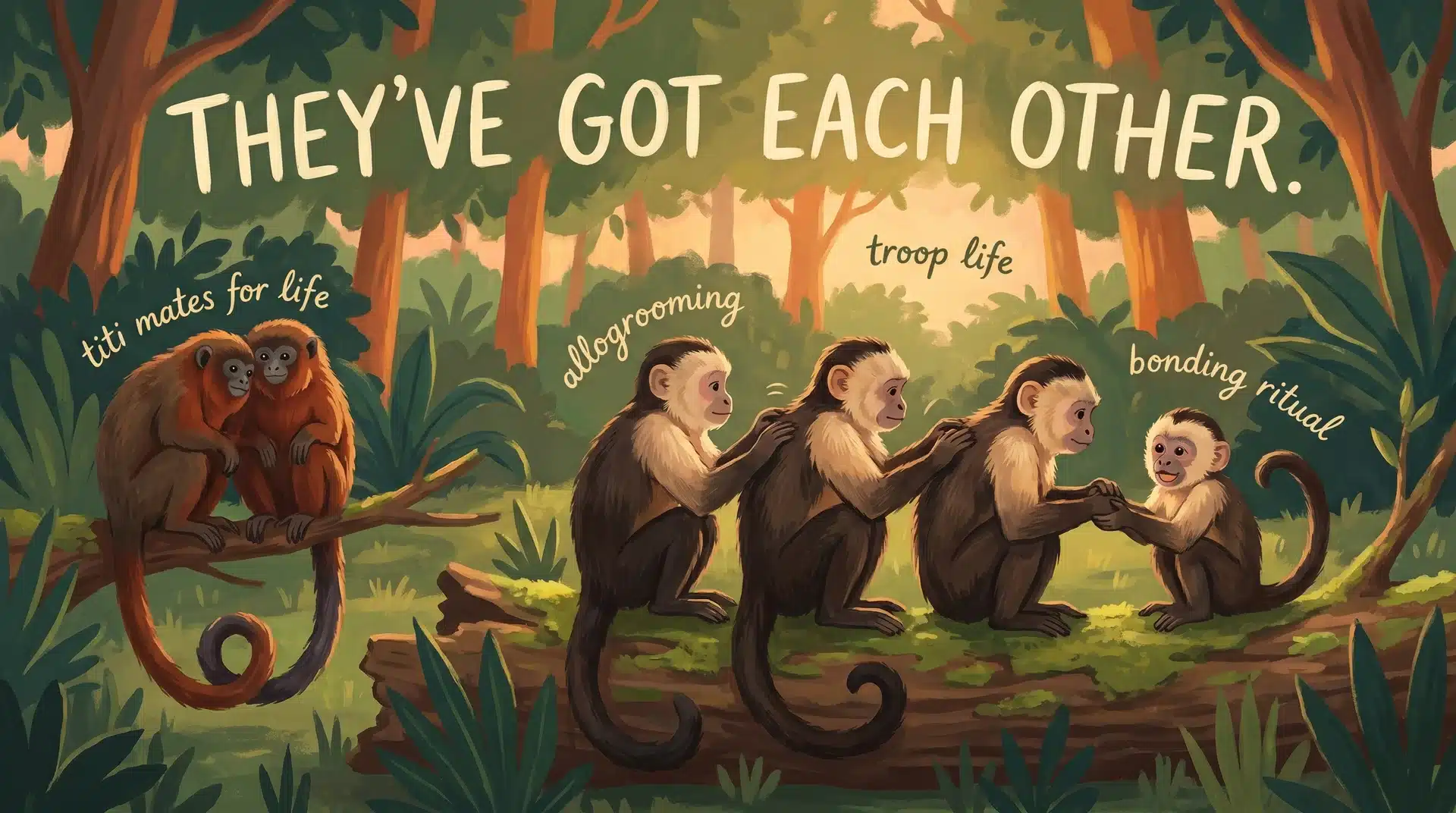
Alt Text: Illustration showing monkeys interacting with labels for titi mates, allogrooming, troop life, and bonding ritual under the title “THEY’VE GOT EACH OTHER.”
Monkeys are not loners. They live, eat, sleep, and travel in groups. But their social lives go much deeper than just hanging out together. Some of their bonding habits are surprisingly human. Others are just plain weird.
Fact 21. A group of monkeys is called a troop. It can also be called a tribe, a barrel, or a cartload, depending on who you ask.
Fact 22. Troops travel together when looking for food. Moving in a group gives individual monkeys protection from predators.
Fact 23. Some baboon troops can have hundreds of members. These large groups have complex social rules and clear rankings.
Fact 24. Monkeys groom each other in a practice called allogrooming. They pick through each other’s fur to remove dirt, bugs, and dead skin.
Fact 25. Grooming is not just about hygiene. It lowers stress, builds trust, and strengthens social bonds within the troop.
Fact 26. Some monkeys form grooming chains where several individuals sit in a row, each grooming the one in front.
Fact 27. Squirrel monkeys use more than 25 different sounds to communicate, including barks, purrs, peeps, and chirps.
Fact 28. Howler monkeys call back and forth with other troops, especially early in the morning and at night. It sounds more like a roar than a monkey call.
Fact 29. Some monkeys have been observed showing their young how to floss their teeth and gums. This is learned behavior passed down through generations.
Fact 30. Monkeys can read and respond to each other’s facial expressions. Research confirms they show empathy when another monkey is in distress.
Fact 31. Titi monkeys mate for life. They spend all their years with one partner and sleep with their tails intertwined.
Fact 32. Male titi monkeys are the main caretakers of babies in the family, not the females. This is rare among primates.
Fact 33. Barbary macaque groups are often led by a strong female. She makes key decisions for the group and keeps order.
Fact 34. White-faced capuchin monkeys have a strange bonding ritual. They pull each other’s hair, force open each other’s jaws, and poke fingers into each other’s nostrils.
Fact 35. Long-tailed macaques in Indonesia steal items from tourists at temples. They appear to understand which items are more valuable.
Fact 36. Those same macaques will hold out for more food when returning a phone or sunglasses compared to a low-value item. Researchers call this bartering behavior.
Fact 37. Squirrel monkeys mark themselves with their own urine. This helps other members of the troop identify them by scent.
Fact 38. Macaques in Japan began washing mud off sweet potatoes in the 1940s. Over time, the whole troop copied the habit, and it spread across generations.
Fact 39. Japanese macaques (Snow Monkeys) soak in volcanic hot springs during winter. Scientists have confirmed this actually lowers their stress hormone levels, similar to what a warm bath does for humans.
Fact 40. Some monkeys deceive others in their troop to get food or avoid conflict. Researchers debate how intentional this deception is, but the behavior has been documented across multiple species.
Food, Habitat, and Survival Facts About Monkeys
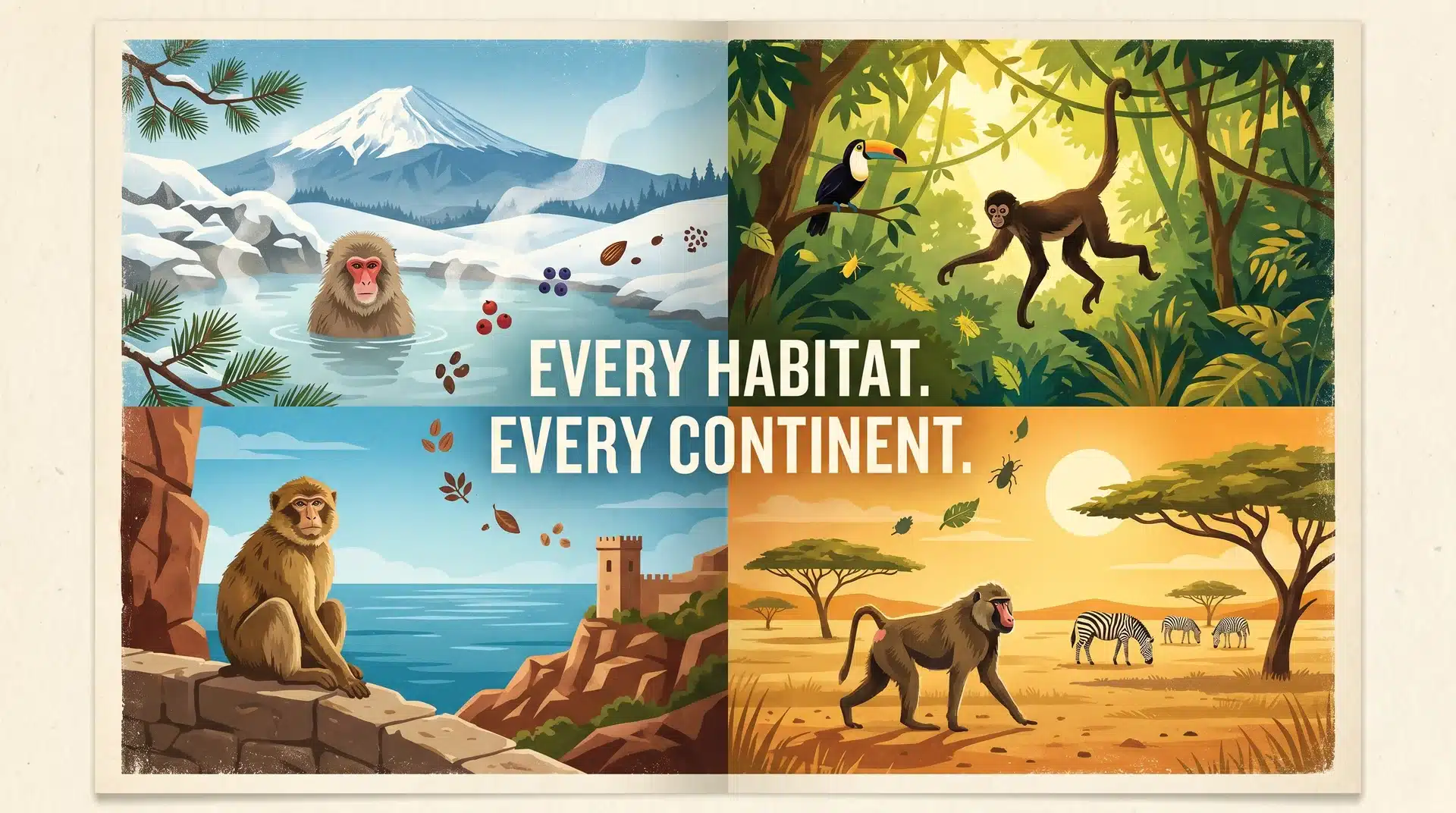
Alt Text: Illustration split into four scenes showing monkeys in snowy, tropical, coastal, and savanna habitats, captioned “EVERY HABITAT. EVERY CONTINENT.”
Monkeys live on nearly every continent and survive in wildly different conditions. From snowy mountains in Japan to dense rainforests in Brazil, they have adapted to more environments than most animals. And their diet is far more varied than most people expect.
Fact 41. Monkeys live on every continent except Antarctica and Australia.
Fact 42. Old World monkeys are found across Africa and Asia. New World monkeys live in Central and South America.
Fact 43. Japanese macaques live farther north than any other non-human primate. They survive in mountain regions that get heavy snowfall every winter.
Fact 44. The only wild monkey population in Europe is a group of Barbary macaques living in Gibraltar. They are the exception, not the rule.
Fact 45. According to legend, Britain will lose control of Gibraltar if the macaque population there ever dies out. Winston Churchill reportedly ordered more macaques be brought from North Africa during World War II to keep the legend alive.
Fact 46. Most monkeys are arboreal, meaning they spend most of their lives in trees. Living in trees keeps them safe from most ground predators.
Fact 47. Baboons are an exception. They live on the ground in Africa and compensate by living in large groups and being highly aggressive when threatened.
Fact 48. Ground-dwelling monkeys tend to be larger or faster than their tree-dwelling relatives. This helps them survive in a more exposed environment.
Fact 49. Monkeys are omnivores. They eat fruits, leaves, insects, eggs, seeds, and sometimes small animals.
Fact 50. The idea that monkeys love bananas is mostly a myth. Bananas are not a natural part of most wild monkeys’ diets. They eat a wide variety of foods depending on what is available.
Fact 51. Capuchin monkeys use stones to crack open hard nuts and dig into soil looking for food. This tool use has been documented in the wild.
Fact 52. Colobus monkeys have a complex, multi-chambered stomach similar to a cow’s. This lets them digest leaves that would be toxic to most other primates.
Fact 53. Monkeys sleep sitting upright in trees. They do not make nests the way apes do.
Fact 54. The three-striped night monkey sleeps up to 17 hours a day. It is one of the sleepiest primates on record.
Fact 55. On average, most monkeys sleep more hours per day than humans do.
Fact 56. Wild monkeys can live between 10 and 50 years depending on the species and conditions.
Fact 57. Baboons have the longest lifespan of wild monkeys, living between 35 and 40 years.
Fact 58. Monkeys are immune to the common cold. The virus that causes colds in humans does not infect monkeys.
Fact 59. Monkeys can pass certain diseases to humans. Some infectious illnesses have crossed from primates to humans through close contact.
Fact 60. Deforestation is one of the biggest threats to wild monkey populations. When forests are cleared, monkeys lose both their food source and shelter.
Intelligence and Skills Facts About Monkeys
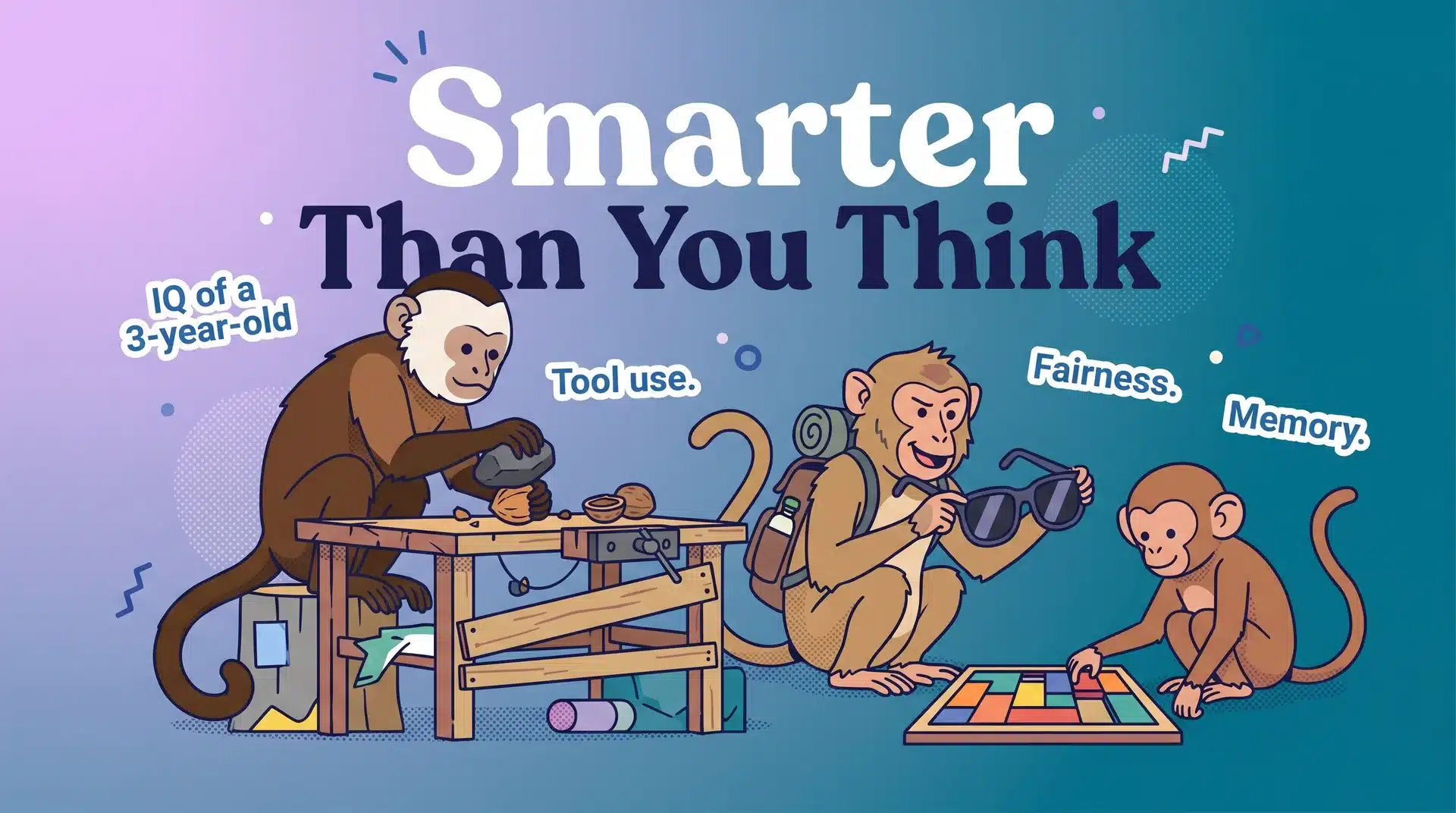
Alt Text: Illustration of monkeys engaging in intelligent behaviors, including tool use and problem-solving, with text floating above that reads ‘Smarter Than You Think’.
Monkeys are not just clever for animals. In certain types of problem-solving and social reasoning, they are on a level that surprises researchers. Here is what the science says about how smart these animals actually are.
Fact 61. Monkeys have large brains relative to their body size. This is a defining trait of primates and is linked to higher intelligence.
Fact 62. The general intelligence of monkeys is roughly equal to that of a 3-year-old human child. They can solve basic puzzles and understand abstract ideas when tested.
Fact 63. Old World monkeys like macaques and baboons performed comparably to great apes in the Primate Cognition Test Battery, a standardized intelligence test for primates. The study found macaques matched apes in most social tasks.
Fact 64. Capuchin monkeys use rocks as tools to crack open nuts. They select the right size stone for the job, which shows planning.
Fact 65. Long-tailed macaques at temple sites in Thailand use stone tools to open shellfish and crack seeds. This behavior has been passed down within local groups for generations.
Fact 66. Monkeys have been observed in the wild trying to copy tools used by humans after watching them in use. This is called observational learning.
Fact 67. Young monkeys learn most of their survival skills by watching adults. Social learning drives much of their development.
Fact 68. In controlled research settings, capuchin monkeys and children were tested on the same touchscreen tasks. The monkeys performed competitively, especially on tasks involving visual patterns and rewards.
Fact 69. Macaques in lab studies rejected unequal rewards even when it meant they got nothing. If one monkey was given grapes and another got a cucumber for the same task, the cucumber monkey refused to cooperate. This reaction to fairness is considered a sign of basic moral reasoning.
Fact 70. Monkeys can be trained to use tools through structured experiments. They show flexibility in switching strategies when one tool does not work.
Fact 71. Research has confirmed that monkeys show empathy. When one monkey is in distress, others nearby show stress responses, including higher heart rates.
Fact 72. Monkeys can distinguish different facial expressions in members of their own species. They react differently to a friendly face versus an aggressive one.
Fact 73. The Indonesian macaques that steal from tourists are not acting randomly. They consistently target high-value items and negotiate for better food rewards. Researchers consider this a form of social intelligence.
Fact 74. Cotton-top tamarins were tested on a tube task originally designed for children. Like small children, the tamarins expected food to fall straight down through a tube even after repeatedly seeing it fall sideways. Researchers called this a “gravity fallacy.”
Fact 75. Some monkeys participate willingly in behavioral tests because they enjoy the problem-solving and the food rewards. Squirrel monkeys and tamarins in research settings will leave their groups to take part in tasks when given the choice.
Fact 76. Capuchin monkeys have been documented choosing to help others in their group get food, even when there is no personal benefit. This prosocial behavior is more common in monkeys that cooperate in raising young.
Fact 77. Monkeys can learn from watching a screen. In studies, some species successfully copied actions shown to them through video, not just from live demonstrations.
Fact 78. Some monkeys have been taught to communicate using symbols on a keyboard in research settings. They reliably selected correct symbols for objects and actions.
Fact 79. Monkeys have working memory similar in function to human working memory. They hold short-term information in mind while solving problems, which is a key building block of reasoning.
Fact 80. Children aged 7 to 10 and capuchin monkeys showed similar tendencies to take mental shortcuts when solving problems in tests. Both groups preferred the faster route even when a more thorough approach would have worked better.
Rare and Surprising Facts About Monkeys
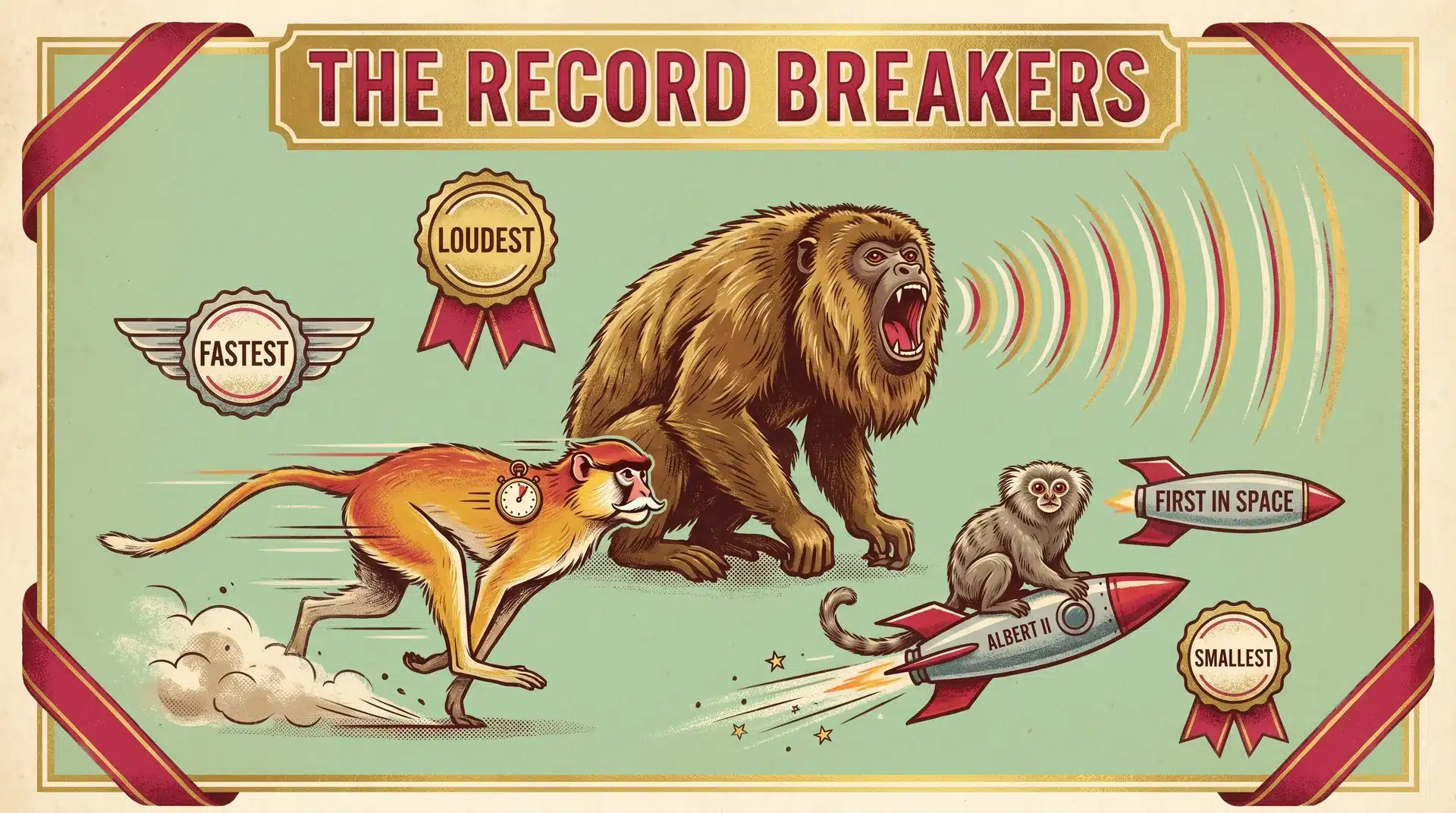
Alt Text: Illustration titled “The Record Breakers” featuring a fast-running monkey, a loud-roaring monkey, and a monkey in a rocket ship labeled “Albert II.”
This is where things get genuinely unexpected. From monkeys in space to a children’s book character who might not even be a monkey, this final category covers the facts that tend to stop people mid-sentence.
Fact 81. The howler monkey is the loudest monkey in the world. Its call can travel up to three miles through dense forest.
Fact 82. The sound a howler monkey makes does not sound like a monkey at all. It comes out as a deep roar or bark.
Fact 83. Howler monkey groups call back and forth with neighboring troops as a way of marking territory without fighting.
Fact 84. The Patas monkey is the fastest primate on Earth. It runs at up to 35 miles per hour, about as fast as a racehorse.
Fact 85. A Patas monkey can go from a complete stop to 33 miles per hour in just three seconds. That kind of acceleration from a primate is hard to believe.
Fact 86. Albert II was the first monkey to go to space. He was launched into space on June 4, 1949, more than a decade before any human made the same trip.
Fact 87. Monkeys used to live in North America. Fossil records show they roamed the continent roughly 56 million years ago before dying out.
Fact 88. The word “monkey” is thought to come from a Germanic root word meaning “to mimic.” Given how well monkeys copy human behavior, that tracks.
Fact 89. Ancient Egyptians painted monkeys on their walls and kept them as sacred animals. Monkeys have fascinated humans for thousands of years.
Fact 90. New monkey species are still being found. The Lesula monkey was found in the Democratic Republic of Congo as recently as 2007.
Fact 91. There are currently over 300 known monkey species, and researchers believe more may still be out there.
Fact 92. Curious George, the famous children’s book character, has no tail. Since almost all monkeys have tails, some biologists argue he is more likely an ape, possibly a young chimpanzee, not a monkey at all.
Fact 93. Titi monkeys sleep with their tails intertwined with their partner’s. Researchers use this tail-twining behavior as a sign of pair bonding.
Fact 94. The three-striped night monkey is the only owl monkey species that neither carries nor suffers from malaria, a disease common across many primate species.
Fact 95. The Golden Lion Tamarin from Brazil is one of the most at-risk monkey species in the world. Conservation programs have helped bring its population back from near extinction.
Fact 96. In the 2023 to 2025 IUCN report, fifteen monkey species were listed as critically threatened. These include the Golden-bellied Mangabey from Congo and the Cat Ba Langur from Vietnam.
Fact 97. Monkeys play an important role in keeping forests healthy. They spread seeds through their droppings across large areas, helping forests regenerate.
Fact 98. Illegal wildlife trade is one of the top threats to monkeys. Pygmy marmosets, sometimes called “finger monkeys,” are frequently sold as exotic pets, which is harmful and often illegal.
Fact 99. Monkeys kept as pets rarely thrive. Their social, physical, and mental needs cannot be met in a home environment. Most end up isolated, stressed, and unwell.
Fact 100. Thousands of monkeys are still kept as pets in the United States, despite expert consensus that they should remain in the wild.
Fact 101. Every monkey species, from the tiny pygmy marmoset to the large mandrill, plays a specific role in its ecosystem. Losing one species affects the whole system around it.
P.S. If you enjoyed learning about these incredible creatures, you might also get a kick out of these monkey-themed puns, just a little extra bit of primate humor to brighten your day.
Final Notes
Monkeys are far more than the playful, banana-grabbing animals most people grew up seeing in cartoons. They build complex social networks, solve problems, feel emotions, and adapt to environments from snowy Japanese mountains to tropical rainforests in Brazil.
These fun facts about monkeys show just how much is going on beneath the surface. The smallest weighs less than an apple. The loudest can be heard three miles away. One went to space in 1949.
Understanding these animals better also reminds us why protecting them matters. Fifteen species are already critically threatened by habitat loss and the illegal pet trade.
Which monkey fact surprised you the most? Drop it in the comments below.
Frequently Asked Questions
What Is the 3 Monkey Rule?
The “three wise monkeys” rule refers to “see no evil, hear no evil, speak no evil,” a Japanese maxim often shown through three monkeys each covering their eyes, ears, or mouth.
What Smells Do Monkeys Hate?
Monkeys strongly dislike the smell of citrus, chili, and certain strong herbs like mint and eucalyptus, which is why these are sometimes used to keep them away from crops.
What Are Some Other Facts About Monkeys?
Monkeys are the only primates besides humans known to show a concept of fairness, and some species, like the capuchin, will refuse a reward they consider unfair.
Do Monkeys Engage in Homosexuality?
Yes, same-sex behavior has been documented in several monkey species, including Japanese macaques and bonobos, and researchers consider it a normal part of primate social behavior.
What Does the Bible Say About Monkeys?
The Bible mentions monkeys in 1 Kings 10:22 and 2 Chronicles 9:21, referring to them as rare goods brought by ships to King Solomon’s court.
Do Monkeys Kiss Each Other?
Some monkeys do press their lips together in a gesture that resembles a kiss. In species like chimps and capuchins, this is used as a greeting or a way to ease social tension.