


Most parents have been there. Your child is crying, you are exhausted, and every parenting book says something different. You want to stay calm. You want to connect. But you also want your child to listen.
That is where gentle parenting comes in.
Gentle parenting is not a passing trend. It is a research-backed approach that has been growing steadily over the past decade. It focuses on raising children through empathy, respect, and clear limits, rather than fear or punishment.
But what exactly is the definition of gentle parenting? What does it look like on a real Tuesday morning when everything goes wrong?
This blog breaks it all down, from the core principles to real-life examples, so you can decide what works best for your family.
What Is the Gentle Parenting Definition?
Gentle parenting is a style of raising children built on empathy, respect, understanding, and clear boundaries.
Instead of using punishment or control to manage behavior, parents guide children by acknowledging their feelings and teaching them why certain actions are not acceptable.
The goal is not just good behavior in the moment. It is to raise children who grow into emotionally aware, responsible, and confident adults.
The Four Core Principles of Gentle Parenting

Gentle parenting does not work on rules alone. It is held together by four principles that support and build on each other.
- Empathy: Parents try to see the situation through the child’s eyes before reacting.
- Respect: Children are treated as individuals with their own feelings and point of view.
- Understanding: Parents learn about child development to set fair, age-appropriate expectations.
- Clear Boundaries: Limits are firm, consistent, and explained calmly, not enforced through punishment.
Where Did Gentle Parenting Come From?
British author Sarah Ockwell-Smith widely popularized the term through her book “The Gentle Parenting Book,” drawing on decades of research in child psychology and attachment theory.
The approach grew as a direct response to authority-heavy parenting rooted in control and obedience. Over the last decade, social media brought the conversation into everyday homes.
A 2023 Pew Research Center report found that nearly half of all parents want to raise their children differently than how they were raised, seeking more affection, open communication, and less yelling.
Gentle Parenting vs. Other Parenting Styles
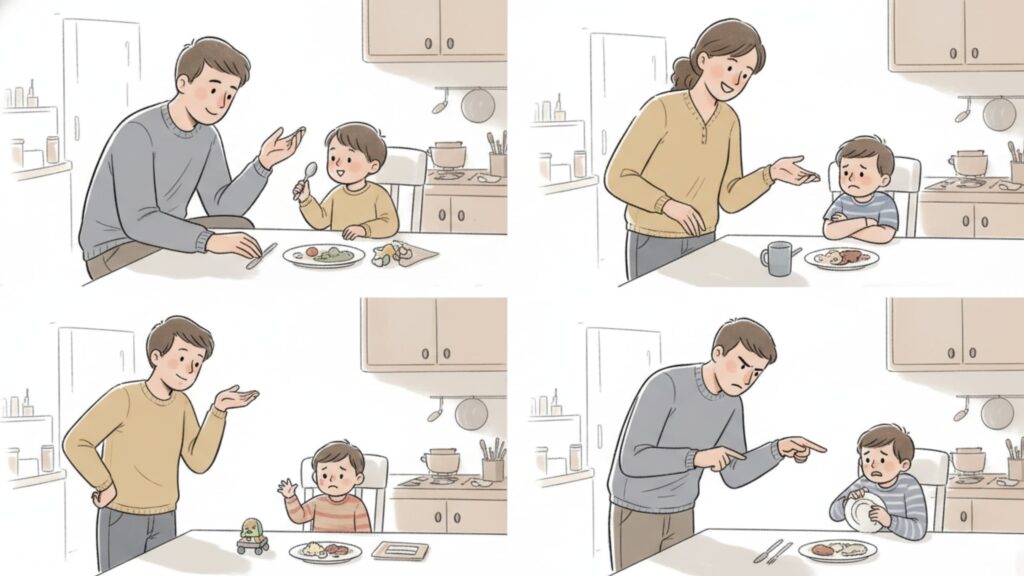
Gentle parenting is often confused with other styles, and the differences matter. Here is a clear side-by-side comparison of each one.
| Parenting Style | Key Focus | Uses Punishment? | Sets Boundaries? | Emotional Warmth |
|---|---|---|---|---|
| Gentle | Empathy, teaching, connection | No | Yes, with a calm explanation | High |
| Authoritative | Warmth with firm rules | Sometimes | Yes | High |
| Permissive | Avoiding conflict | No | Rarely | High |
| Authoritarian | Control and obedience | Yes | Yes, strictly | Low |
What Does Gentle Parenting Look Like in Real Life?
Reading about principles is helpful, but seeing them in everyday situations is what makes gentle parenting click. Here are three common scenarios and how a gentle parent handles each one.
1. Handling a Tantrum
When a child melts down, the first step is to stay calm and get to their eye level. Avoid jumping straight into correction.
Children cannot process reasoning when they are overwhelmed, so the priority is helping them feel safe first. Once they settle, then you address the behavior.
“I can see you are really upset right now. Take a breath. I am right here.”
2. Setting Bedtime Limits
Transitions are hard for young children, especially when they are asked to stop something fun.
A gentle parent gives a heads-up before the change and acknowledges the frustration when it comes. The limit does not move, but the delivery stays warm and consistent.
“I know you want to keep playing. Bedtime still happens. Let us pick two books and then lights out.”
3. Responding to Hitting
Hitting is never ignored, but the response stays calm and deliberate.
A gentle parent states the limit clearly and immediately, then looks at what emotion or unmet need caused the behavior in the first place. That second step is what makes the lesson actually stick.
“Hitting is not okay. You seem really frustrated. Let us talk about what happened.”
Common Myths About Gentle Parenting
Gentle parenting is one of the most misunderstood approaches in modern parenting. Here is what people most often get wrong.
- Myth: It means no rules. Gentle parenting has clear rules. They are just communicated calmly and consistently.
- Myth: It produces spoiled children. Research shows children raised with empathy and firm limits develop stronger self-control, not weaker.
- Myth: You can never say no. Saying no is absolutely fine. The difference is in how it is explained and delivered.
- Myth: It only works for easy-going children. It is especially effective for strong-willed children because it addresses the root cause of behavior rather than just the surface.
- Myth: It is too hard to keep up in real life. No parent does it perfectly. Small, consistent steps count far more than flawless execution.
Pros and Cons of Gentle Parenting
Like any parenting approach, gentle parenting comes with real strengths and honest challenges. Here is a straightforward look at both sides.
| Pros | Cons | |
|---|---|---|
| For the Child | Stronger emotional regulation and better social skills | Takes time to see results; needs consistency to work |
| For the Parent | Fewer power struggles and a closer relationship over time | Emotionally draining in the early stages |
| For the Family | Backed by child psychology research | Social media versions set unrealistic standards |
| Overall | Builds long-term trust and open communication | Does not always guide what to do when calm responses do not work immediately |
Gentle Parenting and Discipline: How Does It Work?

Many parents assume gentle parenting means skipping discipline altogether. It does not. The difference is in what discipline actually means here.
1. Teaching, Not Punishing
In gentle parenting, discipline is a tool for teaching, not a consequence meant to cause discomfort. When a child misbehaves, the focus is on helping them understand what went wrong and why, not on making them feel bad.
2. Natural Consequences Over Imposed Punishments
Gentle parenting leans on natural consequences wherever possible. If a child throws their cup, it is put away calmly. The consequence is a direct result of the behavior, which makes it easier for a child to understand and remember.
3. Consistency Is the Real Key
Gentle discipline only works when limits are held every single time. Stating the limit the same way, calmly and clearly, every time is what builds real trust and structure over time.
4. What About Serious Misbehavior?
Parents remove the child from the situation, state the limit firmly, and follow through with a calm, logical consequence. The conversation about what happened comes after the child has settled, not in the middle of the moment.
Tips to Start Practicing Gentle Parenting
You do not need to change everything at once. These small, consistent steps are where most parents start seeing a real shift.
- Start with yourself: Work on staying calm before you respond to your child’s behavior.
- Name the feeling: Replace “stop it” with “I can see you are feeling…”
- Give choices within limits: “Do you want shoes first or your jacket first?”
- Stay consistent: Children feel safe when they know what to expect every time.
- Repair when you slip: If you lose patience, say sorry. Modeling accountability teaches it better than any rule.
- Ignore the social media highlight reel: Real gentle parenting is imperfect, and that is completely normal.
Is Gentle Parenting Right for Every Family?
Gentle parenting is not a perfect fit for every child or every home.
Some children need more structure, and some parents find it genuinely difficult to stay regulated during intense moments, especially while managing their own stress.
Psychology Today notes that while gentle parenting offers a strong first response, it does not always guide parents on what to do when the child’s behavior persists.
The honest answer is: take what works, leave what does not. The goal is not to follow a method flawlessly. It is to build a relationship where your child feels safe, heard, and guided.
Final Thoughts
The gentle parenting definition comes down to one simple idea: guide your child, do not control them.
It is built on empathy, respect, understanding, and clear limits. It is not about being soft. It is not about giving children whatever they want. It is about helping them understand the world and their own feelings, so they can handle both well.
No parent gets it right every single day. That is not the point. The point is to keep showing up, stay connected, and choose teaching over punishment as often as you can.
If one thing from this blog stayed with you, start there. Try it tomorrow morning. Small steps, done consistently, are what actually change things over time.
Which tip are you going to try first? Let us know in the comments below.