

There’s a particular kind of gift panic that hits before a big family milestone. A first Mother’s Day is coming, or a tenth anniversary, or you’ve just brought a baby home and want to mark it with something that outlasts the flowers and the onesies.
You want it to mean something. You also don’t want to spend a month’s grocery budget on a piece that ends up living in a drawer.
Jewelry is the classic answer for a reason: it’s small, it’s personal, and unlike most milestone gifts, it can genuinely last for decades. But “buy her a necklace” is where a lot of well-meaning parents get stuck.
What kind? How much is reasonable? And how do you avoid the trap of spending real money on something she quietly never wears?
After years of watching friends and family navigate this and making a few misfires myself I’ve landed on a simple filter I call the keepsake test. Here’s how it works.
Start With The Moment, Not The Metal
The best milestone pieces are tied to a specific memory, not just a generic “nice thing.” Before you look at a single product page, get clear on what you’re actually commemorating.
A baby’s arrival? A decade of marriage? Surviving the year everyone had the flu at once and you still made it to the school play?
That answer shapes everything. A birthstone pendant for a new baby carries the birth month. An anniversary piece might nod to the number of years a diamond for each, or a single stone chosen for its longevity as a symbol.
When the object points back to a moment, it stops being jewelry and starts being a marker. That’s the difference between something worn daily and something regifted.
A quick gut-check: if you can imagine explaining the piece to your kid in fifteen years (“this was for the day you were born”), you’re on the right track. If the only story is “I saw it and it was on sale,” keep looking.
Match The Piece To How She Actually Lives
This is where good intentions most often go sideways. A stunning statement piece is wasted on someone whose days are spent wrangling toddlers, and a delicate everyday chain can feel underwhelming for a milestone that deserves weight.
Be honest about lifestyle:
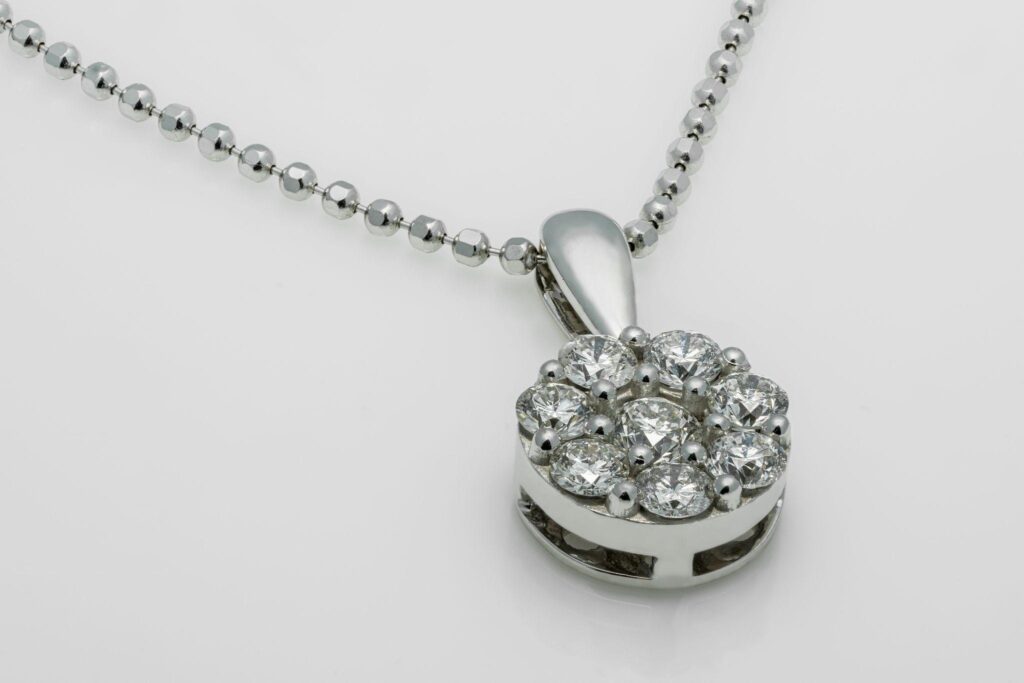
- For hands-on parents of little kids, pendants and necklaces tend to win. They sit out of reach of grabby hands, survive daily wear, and don’t get in the way of the twelve things she’s carrying. A simple pendant on a sturdy chain is the workhorse of milestone jewelry.
- For a big anniversary, you have room to go a little bolder a larger center stone, or a piece that photographs well for the occasion.
- For someone who genuinely doesn’t wear much jewelry, smaller and finer beats bigger and flashier every time. Studs or a minimalist pendant respect her taste instead of overriding it.
The goal isn’t to impress the room. It’s to give her something she reaches for on a Tuesday.
Understand What You’re Paying For
Here’s the part most gift guides skip. When you buy a diamond piece, you’re paying for two very different things bundled together: the stone, and everything around it the setting, the brand, the showroom, the markup.
The stone itself is the part where your money does the most work, and it’s also where the market has quietly changed. Lab-grown diamonds are now a mainstream choice, and it’s worth understanding why.
They’re not imitations or “fake” diamonds they’re physically and chemically identical to mined stones, and they’re graded by the same independent labs (GIA, IGI, and GCAL) using the same criteria.
The difference is origin, not substance. Because they skip the mining supply chain, they typically cost a fraction of a mined equivalent, which means you can choose a larger or cleaner stone for the same budget.
For a keepsake pendant, that math matters. A pendant is one stone doing all the emotional work, so putting your budget into the stone rather than a brand name is exactly where it belongs.
This is one reason many parents shopping for lab grown diamond pendants start by looking at loose-stone economics first, then choose a setting rather than the other way around.
To show what that looks like in practice, here’s a like-for-like comparison across several lab-grown diamond sellers. I’ve used pear-shaped stones (a soft, flattering shape that reads beautifully in a pendant) at matched specs, so the only thing changing row to row is the price:
Pear-shaped lab-grown diamond prices, matched specs
|
Size (ct) |
Color |
Clarity |
Loose Grown Diamond |
Dreamstone |
Brilliance |
Adiamor |
Rare Carat |
Ruby Harper |
|---|---|---|---|---|---|---|---|---|
|
1 |
D |
VS1 |
$197 |
|||||
|
1.5 |
E |
VS2 |
$292 |
|||||
|
2 |
F |
VVS2 |
$382 |
|||||
|
2.6 |
D |
VS1 |
$628 |
|||||
|
3 |
E |
VS1 |
$602 |
|||||
|
3.5 |
F |
VS1 |
$657 |
|||||
|
4 |
D |
VVS2 |
$1,452 |
|||||
|
4.6 |
E |
VS1 |
$970 |
|||||
|
5 |
F |
VS1 |
$859 |
Note: Prices shown reflect pear-shaped lab-grown diamonds with the specified characteristics, benchmarked against the lowest available prices for equivalent diamonds across leading competing brands as of Q2 2026. Prices change frequently and vary by availability.
A few honest takeaways from that table. First, the spread is enormous. The same essential stone can cost three or four times as much depending on where you shop, mostly because of overhead and brand markup rather than the diamond itself.
Second, no single seller wins every row: Ruby Harper actually lists the lowest price on the smaller pear stones, so if the raw per-stone cost is your only concern, it’s worth a look.
Where Loose Grown Diamond earns its place is the combination around the stone it’s a direct manufacturer rather than a reseller, with a 5/5 Trustpilot rating across more than 3,000 verified reviews, free insured worldwide shipping, and free 3D CAD design renderings with unlimited revisions before you pay anything.
For a milestone piece you’re designing to last, that pre-purchase design step and the certification paper trail often matter more than a $30 difference on the loose stone.
The practical lesson isn’t “buy from one specific place.” It’s this: compare the stone separately from the setting. Once you can see what a diamond actually costs, you stop overpaying for the name stamped on the box.
Give Yourself A Decision, Not A Rabbit Hole
Milestone shopping goes wrong when it becomes a research project. Set three constraints up front a budget, a piece type (pendant, studs, a simple chain), and a stone size range and let those cut the options down to something manageable. Perfect is the enemy of the given.
And remember the keepsake test at every step: does this point back to the moment? Will she actually wear it? If both answers are yes, you’ve found it. The rest is just packaging.
Milestones deserve to be marked. A well-chosen piece tied to a memory, matched to a real life, and paid for wisely does exactly that, quietly, for years. That’s a gift worth getting right.