
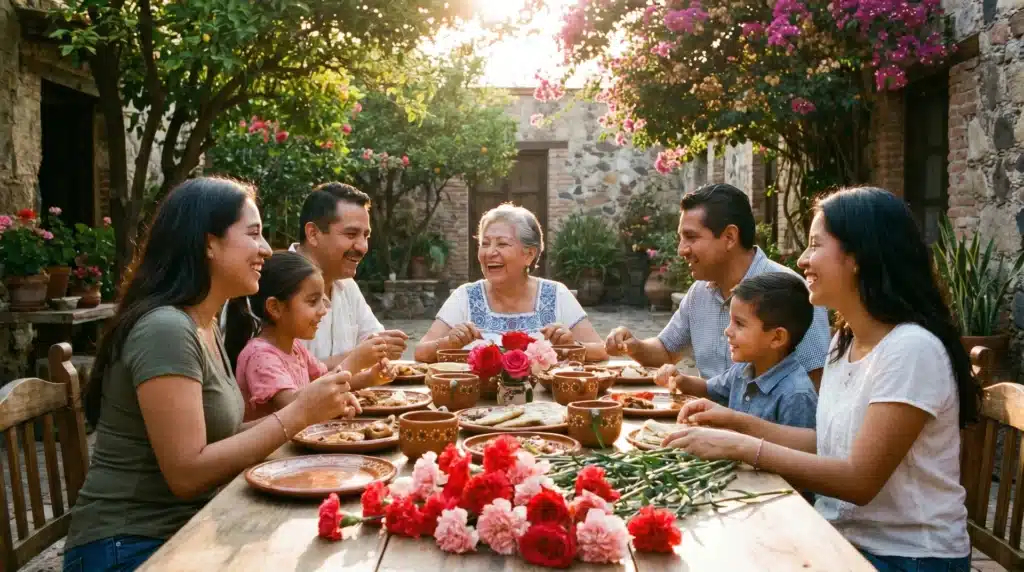
Mexico does not follow the same Mother’s Day calendar as the United States, which surprises many people.
While American families celebrate on the second Sunday of May, Mexicans mark the day on May 10 every single year, no matter what day of the week it falls on.
This is not just a date on a calendar. It is one of the most emotionally charged days in Mexican culture, filled with music, food, and family gathered around the women who hold everything together.
Here is everything you need to know about when Mother’s Day is in Mexico, why the date was chosen, and how the country comes alive to celebrate it.
When Is Mother’s Day in Mexico?
Mother’s Day in Mexico, known as Día de las Madres, falls on May 10 every year without exception.
Unlike the United States, where the date shifts to the second Sunday of May each year, Mexico’s celebration is always on May 10, regardless of the day of the week. In 2026, that date lands on a Sunday.
How Mother’s Day in Mexico Began
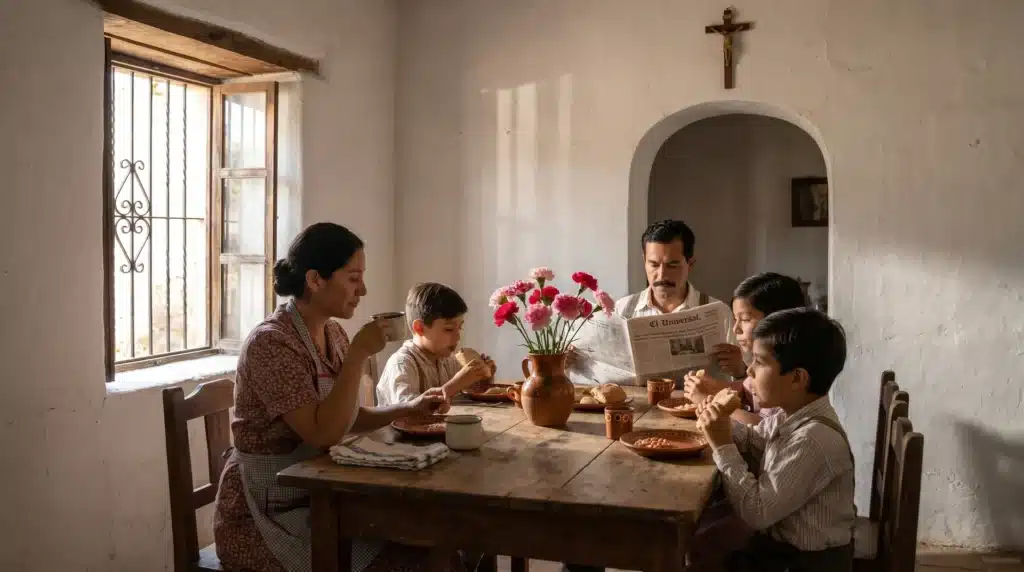
In 1922, journalist Rafael Alducin, founder of the newspaper Excélsior, launched a national campaign to establish a dedicated Mother’s Day in Mexico, inspired by similar movements in the United States but determined to create something uniquely Mexican.
Key facts at a glance:
- Who started it: Rafael Alducin, a Mexico City newspaper editor, wrote and published an editorial that affirmed the deep ties between motherhood and Mexico’s traditional values.
- Why May 10: At the time, Mexican paydays fell on the 10th of each month, so people had money to spend on their mothers. May also carried religious significance as a month tied to the Virgin Mary in Catholic tradition.
- Who backed it: A widespread media campaign and strong support from the Catholic Church helped bring the observance into full effect across the country.
- When it became official: In 1940, the wife of President Manuel Avila Camacho, Soledad Orozco Garcia, declared May 10 a holiday, making it a state-sponsored celebration.
- Mexico’s place in Latin America: According to the Mexican government, Mexico was the first country in Latin America to commemorate Mother’s Day.
Alducin chose May 10 deliberately. The date was close to the feast of the Virgin Mary and fell in a season already associated with flowers, renewal, and family in Mexican culture. His campaign resonated with the people, and within a year, the date had taken on a life of its own.
What Makes Mother’s Day in Mexico Different From the US
The biggest difference is the date itself. The US observes Mother’s Day on the second Sunday of May, which changes every year, while Mexico has always celebrated on a fixed May 10.
Although it is not an official public holiday, schools close on May 10, and on May 9, children at many schools invite their mothers to plays, dances, and recitals in their honor.
Beyond the calendar, the tone of the celebration in Mexico is deeply communal.
It spills out of homes and into churches, restaurants, school stages, and public plazas, making it feel less like a personal gesture and more like a national expression of gratitude.
How Families Celebrate Mother’s Day in Mexico
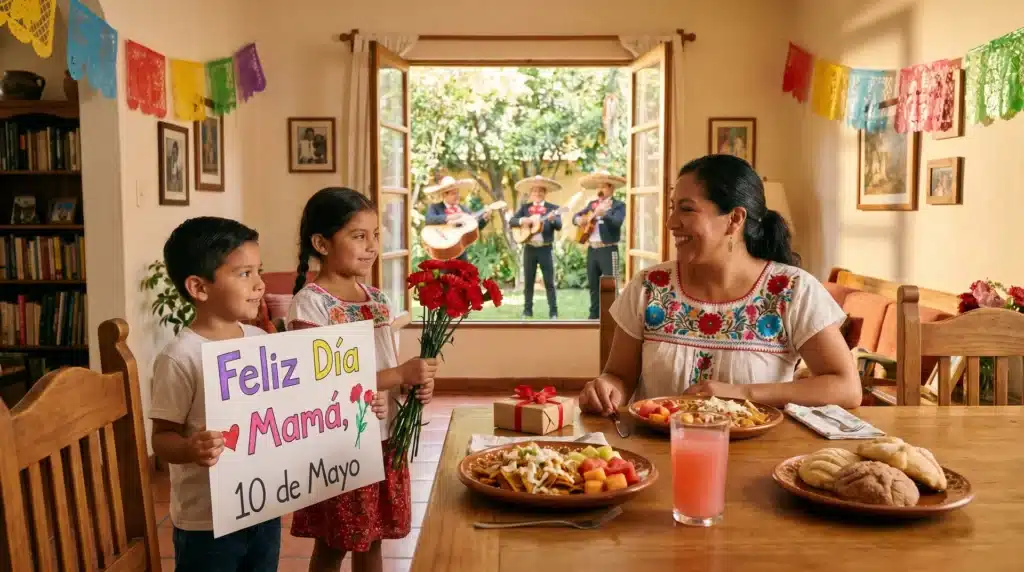
Families across Mexico spend the entire day honoring not just mothers but also grandmothers, aunts, and godmothers. The celebration starts before sunrise and continues until late in the evening.
1, The Morning Serenade: Las Mañanitas
On the morning of May 10, homes throughout Mexico come alive with music as families serenade their mothers, grandmothers, aunts, and all female family members who are mothers, singing Las Mañanitas outside their homes.
Mother’s Day is one of the busiest days of the year for mariachi bands across the country.
2. Church Services and Masses
Many families begin the day with a special church service for mothers, giving them a chance to express gratitude and seek blessings, blending family devotion with religious faith.
Lady of Guadalupe, often seen as Mexico’s spiritual mother, is invoked at a special Mass on this day.
3. The Big Family Meal
Across Mexico, kitchens fill with the aromas of traditional dishes prepared by extended family members to honor the matriarch of the home. Multi-generational meals are the norm, with grandmothers receiving as much attention and warmth as first-time mothers.
4. Gifts That Actually Mean Something
Gift-giving on this day is less about extravagance and more about thought and appreciation. Carnations and roses are the traditional flowers, and white carnations are often placed at the gravesites of mothers who have passed on.
In rural communities, wildflowers and handmade items carry just as much weight as anything bought from a store.
5. School Celebrations the Day Before
It is common for schools to put on productions that allow students to showcase their talents and express their appreciation for the moms in the audience. May 9 is often just as emotional as May 10 itself for many families.
Traditional Foods Served on Mother’s Day in Mexico
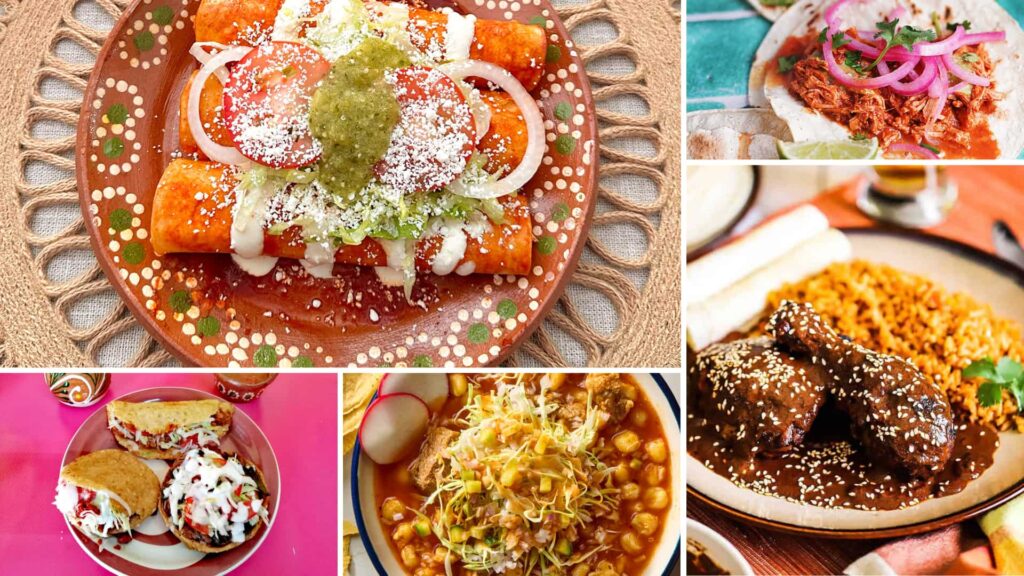
Food sits at the center of every Mother’s Day celebration in Mexico. Families cook for hours, or they book a table at a restaurant weeks in advance, because May 10 is one of the busiest days of the year for restaurants across Mexico.
Here is what typically shows up on the table:
- Mole: A rich, slow-cooked sauce made from dried chiles, chocolate, and spices, usually served over chicken or turkey. It takes hours to prepare, making it a dish reserved for special occasions.
- Pozole: A hearty hominy soup, pozole is one of the traditional favorites on Mother’s Day in Mexico. It is filling, festive, and almost always made in large batches for the whole family.
- Enchiladas: A crowd favorite across all generations, typically layered with cheese, salsa, and sometimes chicken or beef.
- Sopes and Quesadillas: Handheld, easy to share, and loved by everyone at the table.
- Cochinita Pibil: On the Yucatán Peninsula, cochinita pibil, a traditional slow-roasted pork, is a regional favorite on this day. If you are in that part of Mexico on May 10, you will find it on almost every table.
Mexico vs. Other Latin American Countries
Not every country in Latin America follows the same date. Mexico, Guatemala, El Salvador, and Belize celebrate Mother’s Day on May 10 each year, a date known as El Día de las Madres. The rest of the region has its own calendar.
| Country | Mother’s Day Date |
|---|---|
| Mexico | May 10 (fixed every year) |
| Guatemala | May 10 (fixed every year) |
| El Salvador | May 10 (fixed every year) |
| Belize | May 10 (fixed every year) |
| USA, Colombia, Ecuador, Peru, Chile, Brazil, Honduras | Second Sunday of May |
| Paraguay | May 15 |
| Costa Rica | August 15 |
| Argentina | Third Sunday of October |
| Panama | December 8 |
Mexican-American Families: Celebrating Mother’s Day Twice
For Mexican-American families living in the United States, the question of which date to celebrate rarely arises, as many simply celebrate both.
Some Latin Americans in the US, especially those with Mexican heritage, celebrate Mother’s Day twice: once on May 10 to honor their cultural roots, and once on the second Sunday of May for the American tradition.
Here is what that often looks like in practice:
- May 10 feels more personal. For families with deep ties to Mexico, this is the date that carries real emotional weight. It is the one their grandmothers celebrated, and their mothers before them.
- The second Sunday covers the American side. School events, work schedules, and American traditions tend to center around the floating Sunday date. Families participate in both without it feeling like a conflict.
- Flowers on both days. For Mexican mothers who live in the US, getting flowers on both Mother’s Days is something many families simply do as a matter of habit, even when a mother has passed away.
- It reflects a real cultural identity. Celebrating twice is not about being indecisive. It reflects the genuine experience of living between two cultures and wanting to honor both without dropping either.
How to Celebrate Mother’s Day in Mexico If You’re Visiting
If you happen to be in Mexico on May 10, expect the entire country to feel different that day.
Restaurants fill up fast, mariachi music carries through neighborhoods from early morning, and the warmth between families is hard to miss.
Book your restaurant table at least two to three weeks in advance, attend a morning church service if you want to see the spiritual side of the celebration, and stop by a local market for flowers rather than a chain store.
If you are visiting the Yucatán region, do not skip cochinita pibil, and if the mom you are celebrating enjoys a cold drink, the Mexican craft beer scene has grown considerably and pairs well with a long celebratory afternoon.
Summing It Up
Mother’s Day in Mexico on May 10 is a fixed, deeply felt celebration that has stayed on the same date since 1922.
It started with a newspaper editorial, grew with support from the Catholic Church, and, over a century later, brings families together across the entire country every year without fail.
The food, the music, the church services, and the flowers all point to one thing: in Mexico, mothers are not just celebrated; they are genuinely honored.
If you are curious about when Mother’s Day is in Mexico for any upcoming year, the answer is always the same. May 10. Every time.
Do you celebrate on May 10, the second Sunday, or both? Share your tradition in the comments below.
Frequently Asked Questions
Why Is Mother’s Day Different in Mexico?
Mexico celebrates Mother’s Day on a fixed date, May 10, every year, while the US observes it on the second Sunday of May, which shifts annually. The Mexican date was set in 1922 and has not changed since.
When Did Mexican Mother’s Day Start?
Mexican Mother’s Day was officially established on May 10, 1922, after newspaper editor Rafael Alducin published an editorial calling for a national day to honor mothers.
Is May 10 Mother’s Day in Mexico?
Yes. Mother’s Day in Mexico always falls on May 10, regardless of the day of the week it lands on that year.
What Does “A La Madre” Mean?
“A la madre” is a Mexican slang phrase with a flexible meaning depending on tone. It can express shock, surprise, or frustration, roughly translating to “oh wow,” “damn,” or “what the heck” in different contexts.