
Have you ever spotted a bright streak in the night sky and felt genuinely curious? That was most likely a comet. These icy space objects have fascinated people for thousands of years, and for good reason.
From ancient Chinese astronomers keeping careful records to NASA missions landing a spacecraft right on one, our relationship with comets runs deep.
This post covers facts about comets that go well beyond the basics. You will also learn where comets come from, what they are made of, how they get their glowing tails, and which famous comets have made history.
Let’s get into it.
Where Do Comets Come From?
Most comets start their lives in one of two places: the Kuiper Belt, a wide disk of icy objects just beyond Neptune, or the Oort Cloud, a vast sphere of frozen material at the very outer edge of our solar system.
Short-period comets, the ones that return every 200 years or less, usually come from the Kuiper Belt.
Long-period comets, some of which take thousands or even millions of years to complete a single orbit, are pushed inward from the Oort Cloud when the gravity of a passing star or large planet nudges them out of their resting place.
30 Facts About Comets
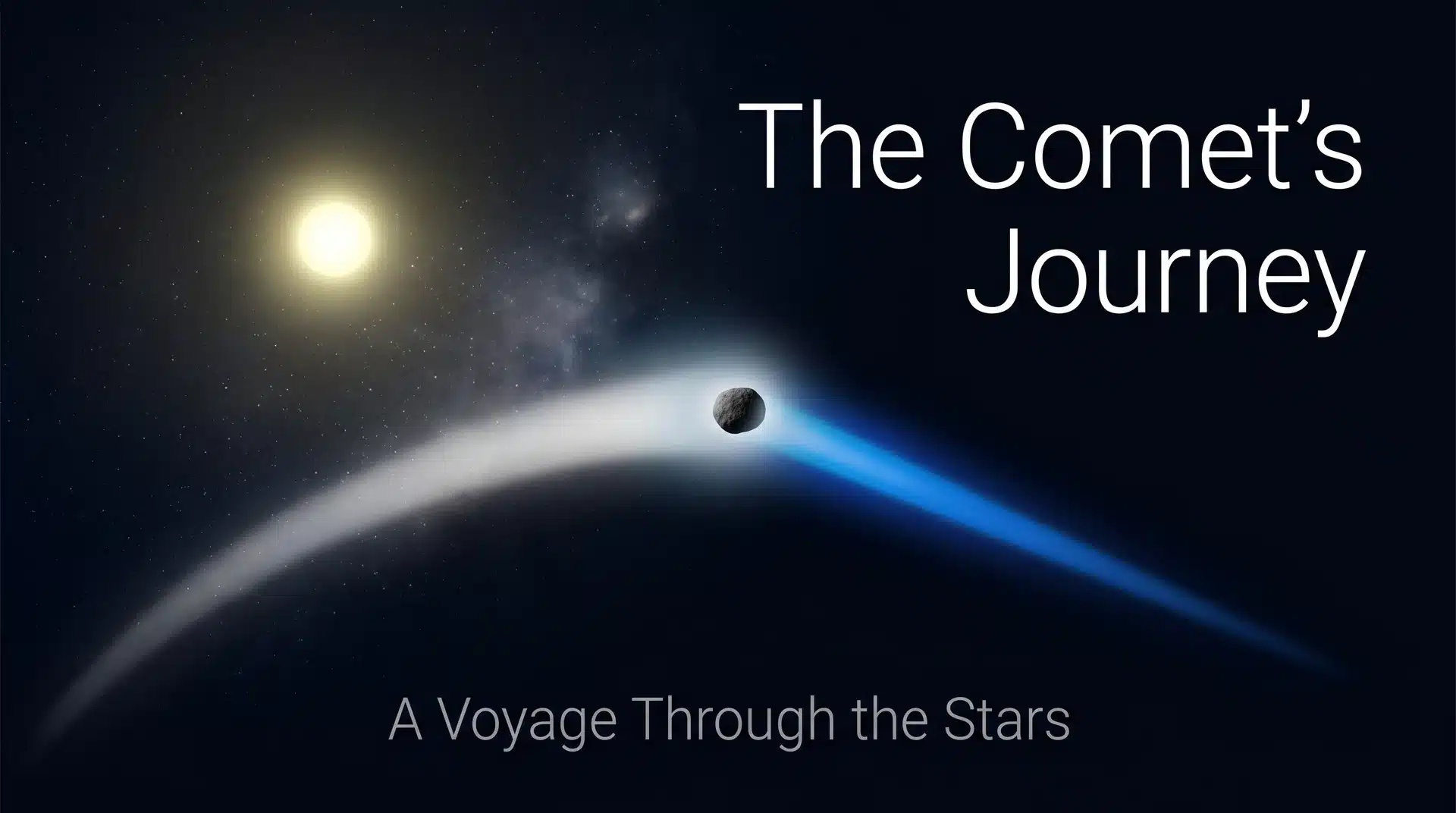
Alt Text: A comet traveling through space with the text “The Comet’s Journey: A Voyage Through the Stars” overlaid on the dark, starry background.
Here are facts about comets backed by NASA, ESA, Britannica, and peer-reviewed research. Some of these will genuinely surprise you.
- Comets formed around 4.6 billion years ago, at the same time as the Sun and planets.
- Scientists call them “dirty snowballs,” a nickname introduced by astronomer Fred Whipple in 1950.
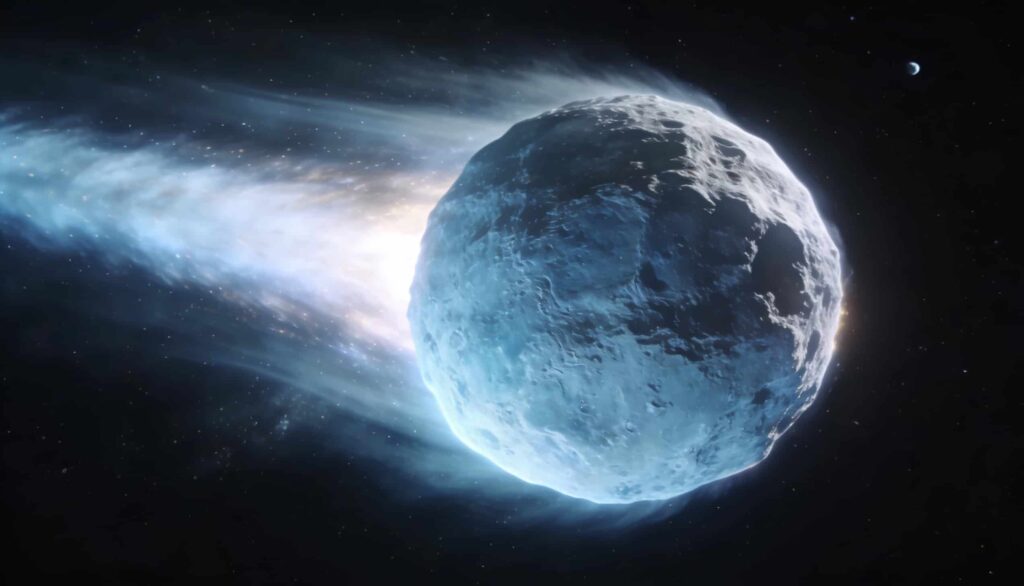
- Every comet has four main parts: the nucleus, the coma, the dust tail, and the ion tail.
- A comet’s nucleus is usually only a few miles wide, roughly the size of a small town.
- The nucleus reflects only about 4% of sunlight, making it one of the darkest objects in the solar system.
- When a comet gets close to the Sun, its ice turns directly into gas through a process called sublimation. There is no liquid stage.
- The glowing atmosphere around the nucleus is called the coma. It can grow over 60,000 miles wide.
- In 2007, Comet Holmes developed a coma wider than the sun itself.
- Comets have two tails, not one: a white dust tail and a blue ion tail.
- Both tails always point away from the Sun, even when the comet is heading outward.
- A comet’s tail can stretch over 100 million miles through space.
- The ion tail appears blue because it contains electrically charged gas molecules blown by the solar wind.
- The dust tail has a gentle curve along the comet’s orbit path; the ion tail points straight away from the Sun.
- Halley’s Comet travels at over 157,000 mph when closest to the Sun. That is about 60 times faster than a bullet.
- Short-period comets take less than 200 years to orbit the Sun. Long-period comets can take thousands of years.
- Comet Encke holds the record for the shortest known orbit: just 3.3 years.
- Comet Hale-Bopp was visible to the naked eye for a record-breaking 18 months after its discovery in 1995.
- Comet Shoemaker-Levy 9 crashed into Jupiter in 1994, leaving impact scars larger than Earth.
- In 2009, NASA confirmed the amino acid glycine in samples from Comet Wild 2. Glycine is a building block of proteins.
- Scientists think comets may have delivered water and organic compounds to early Earth billions of years ago.
- The water found inside certain comets has a chemical composition very close to Earth’s ocean water.
- Halley’s Comet produces two meteor showers every year: the Eta Aquarids in May and the Orionids in October.
- Chinese astronomers were recording comet sightings as far back as 240 BC.
- The first telescopic observation of a comet was made in 1618 by Swiss astronomer Johann Cysat.
- Only about 4,000 comets have been catalogued so far, but scientists estimate there could be hundreds of millions more.
- Some comets, called sungrazers, fly directly into the Sun or break apart under its heat.
- The word “comet” comes from the Greek word “kometes,” meaning “long-haired,” referring to its glowing tail.
- In October 2024, Comet Tsuchinshan-ATLAS became the brightest comet in 27 years and was visible to the naked eye.
- ESA’s Rosetta spacecraft made history in 2014 when it landed a probe called Philae on Comet 67P, the first soft landing on a comet nucleus.
- Rosetta found 16 organic compounds on Comet 67P, four of which had never been detected on a comet before.
How Are Comets Named?
Comets are generally named after the person or spacecraft that first spotted them, following guidelines set by the International Astronomical Union (IAU). The IAU allows a maximum of two discoverer names per comet. There are also letter codes at the start of each name that tell you what kind of comet it is.
- C/ means it is a long-period comet with an orbit greater than 200 years.
- P/ means it is a periodic comet that returns on a regular schedule.
- Halley and Encke are exceptions. Both are named after the scientists who calculated their orbits, not the people who first spotted them.
- Tsuchinshan-ATLAS got its double name because two separate observatories discovered it independently around the same time: the Purple Mountain Observatory in China and the ATLAS system in Hawaii.
- Shoemaker-Levy 9 carries two surnames because it was the ninth comet found by the Shoemaker-Levy team, made up of Eugene Shoemaker, Carolyn Shoemaker, and David Levy.
Famous Comets in History
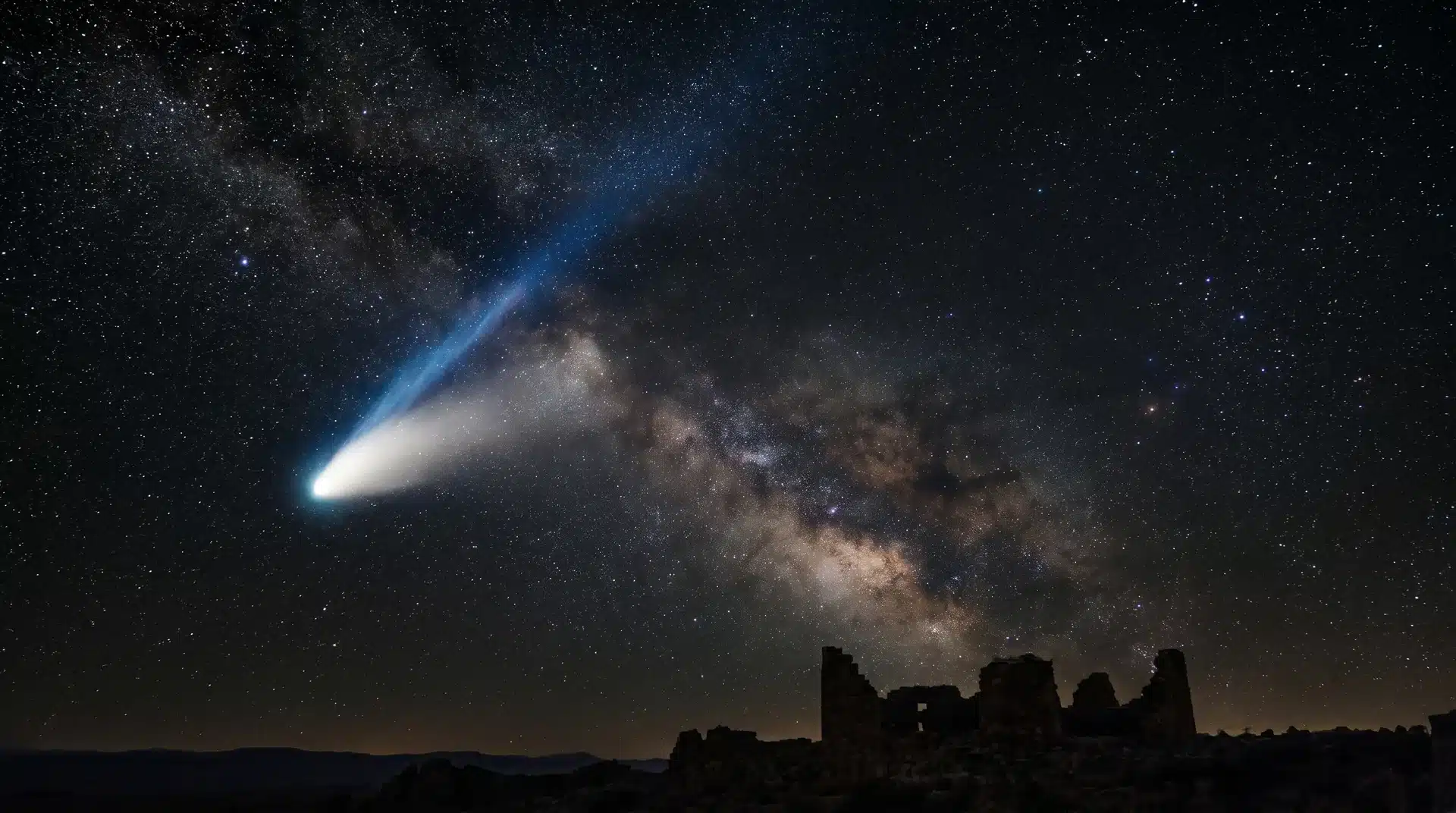
Alt Text: A vibrant comet with a bright glowing head and a long, streaking tail glowing against a dark, star-filled night sky above a landscape.
A handful of comets have left a real mark on science, history, and public memory.
Halley’s Comet is the most well-known of all, with recorded observations going back to 240 BC and a confirmed orbit that comes around every 75 to 76 years.
Its appearance in 1066 was even stitched into the Bayeux Tapestry, and in 1705, astronomer Edmond Halley correctly predicted it would return, making it the first comet whose reappearance was calculated in advance.
Comet Hale-Bopp grabbed global attention in 1997 when it lit up the sky for over a year, bright enough to see from cities. Comet Shoemaker-Levy 9 made science history in 1994 when it broke into pieces and slammed into Jupiter, giving researchers their first live look at a major solar system collision. More recently,
Comet Tsuchinshan-ATLAS became the talk of backyard astronomy in October 2024, visible to millions with no equipment at all.
Final Notes
Comets are among the oldest objects in our solar system, and every fact about comets we learn brings us closer to understanding how everything around us came to be.
They are not just pretty lights in the sky. They carry organic molecules, possibly helped seed Earth with water, and have shaped how we think about the origins of life.
The next time a meteor shower lights up October or May, remember those streaks are pieces of Halley’s Comet burning up overhead.
If you found this post useful, share it with someone who loves space, or drop a question in the comments below. There is always more to learn.
Frequently Asked Questions
How Often Do Comets Appear?
A comet bright enough to see without a telescope appears roughly once every 10 years, though smaller or dimmer ones pass through the inner solar system far more often.
Is a Comet Cold or Hot?
In the outer solar system, comets are extremely cold, but as they get close to the Sun, the surface temperature can climb to several hundred degrees Fahrenheit.
How Long Do Comets Last?
Short-period comets lose material with every pass near the Sun and can fade or break apart over thousands of orbits, while long-period comets may survive much longer because they visit the inner solar system so rarely.
Do Comets Run Out of Ice?
Yes, over time they do. Each pass near the Sun burns off a layer of ice and gas, and eventually a comet either loses too much material to produce a tail, breaks apart, or turns into a dark, inactive rocky body.
What Comet Is Seen Every 76 Years?
That is Halley’s Comet. It last appeared in 1986 and is expected to return in 2061.