
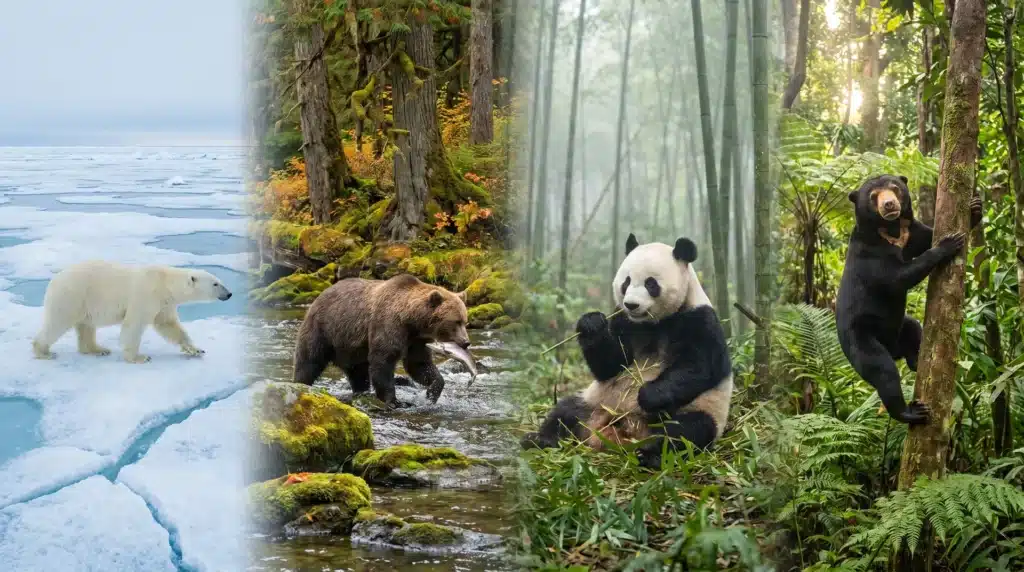
Most people think of bears as big, slow, sleepy animals that eat fish and hibernate all winter. That picture is mostly wrong.
Bears are fast, sharp-minded, and full of traits that most wildlife blogs never cover. A grizzly bear can outrun a horse over a short distance.
A polar bear’s nose is roughly 2,000 times more sensitive than a human’s. One female polar bear once traveled over 7,000 km in under two years.
This blog covers fun facts about bears across all species and why these animals are worth learning more about.
Types of Bears
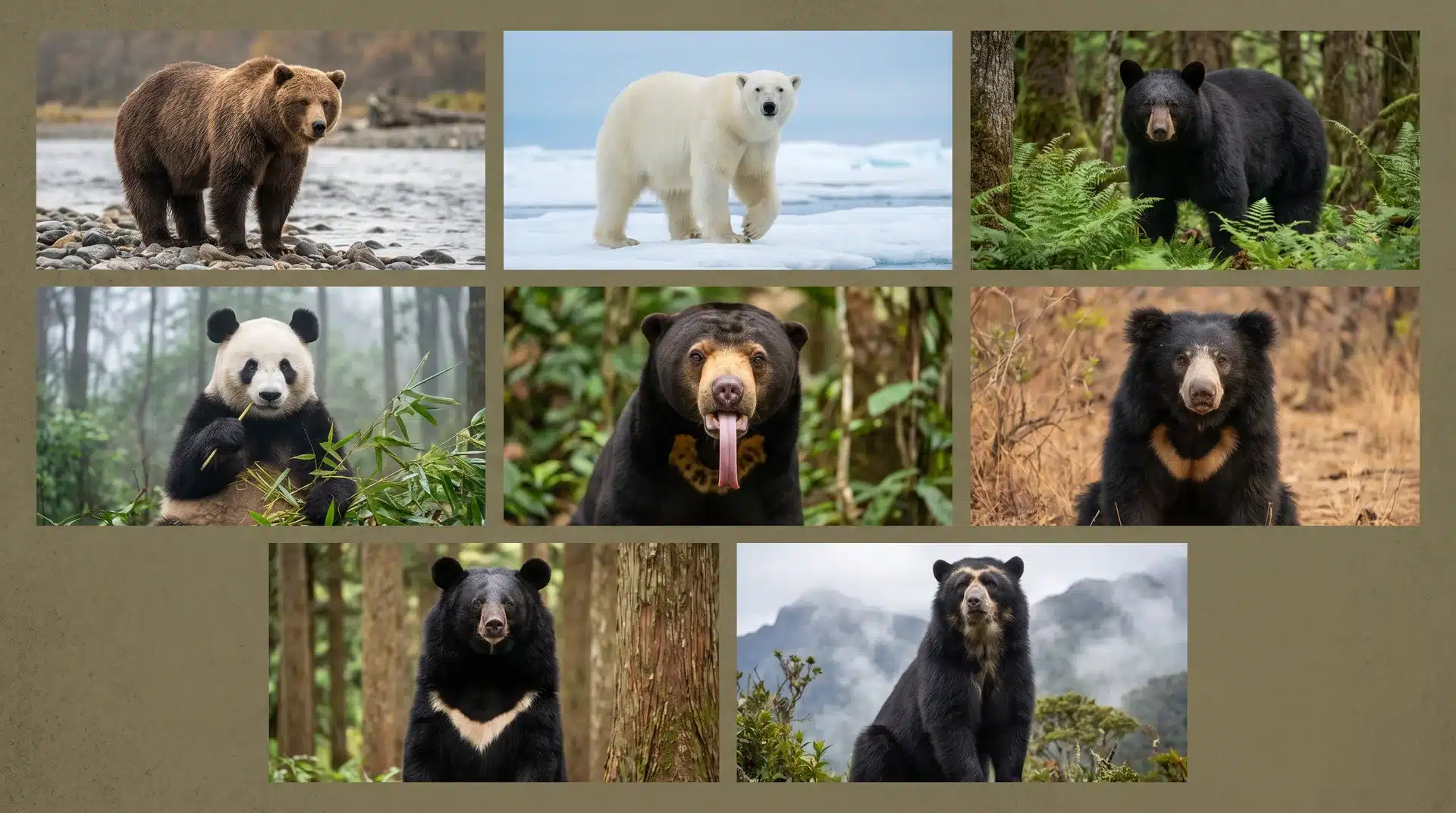
There are eight living bear species on Earth. Each one lives in a different part of the world and has its own set of traits that make it stand out.
| Bear Species | Native Region | Quick Trait |
|---|---|---|
| Brown Bear | North America, Asia, Europe | Most widespread species; grizzly is a subspecies |
| Polar Bear | Arctic | Only a bear is classified as a marine mammal |
| American Black Bear | North America | Comes in more colors than any other North American mammal |
| Giant Panda | South-central China | Has a false thumb-like wrist bone to grip bamboo |
| Sun Bear | Southeast Asia | The smallest bear has the longest tongue of any bear species |
| Sloth Bear | India and Sri Lanka | Sucks insects out of mounds using lips like a tube |
| Asiatic Black Bear | Southern Asia | Known as the moon bear for its white crescent chest marking |
| Spectacled Bear | Andes, South America | The only bear species in South America is an excellent tree climber |
Each of these species has developed specific physical features and habits tied to where it lives. The sun bear, for example, weighs as little as 60 pounds and uses its long tongue to pull honey out of beehives.
The polar bear, on the other hand, can weigh up to 1,500 pounds and spends most of its life on sea ice hunting seals. Knowing which species is which makes the facts list below much easier to follow and more interesting.
51 Fun Facts About Bears
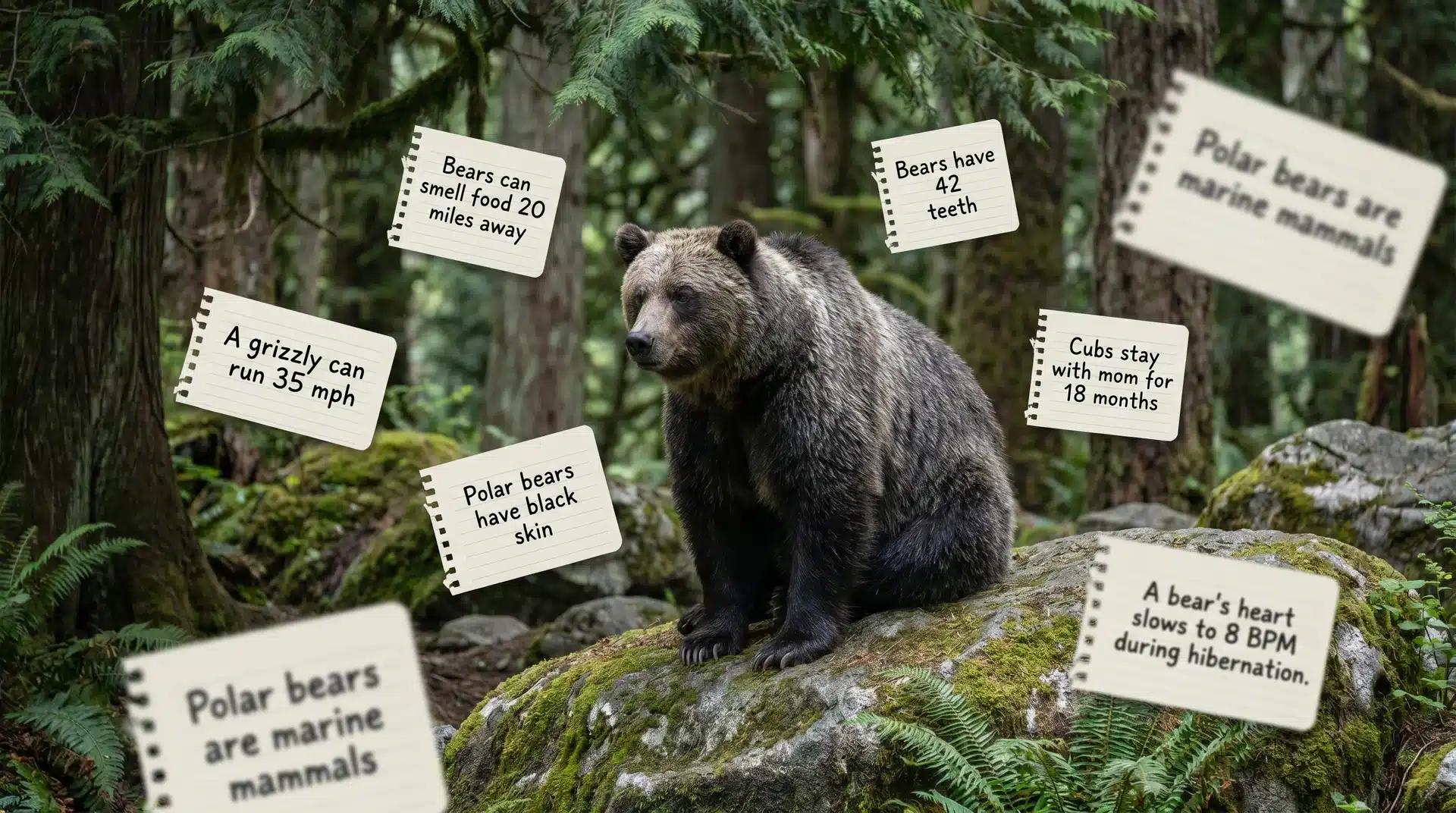
Alt Text: A black bear walking through a forest with floating text bubbles highlighting facts about bear anatomy, speed, and hibernation habits.
Here are bare fun facts drawn from wildlife research, conservation organizations, and zoological studies. No filler, no repeats.
- Bears have been on Earth for roughly 38 million years, dating back to the late Eocene Epoch.
- There are exactly eight living bear species in the world today.
- A bear’s sense of smell is roughly 2,000 times stronger than a human’s.
- Polar bears can detect a seal hiding under one meter of ice from several kilometers away.
- Some bears can smell food from over 20 miles away, which is better than most dogs.
- A grizzly bear can run at speeds up to 35 miles per hour despite weighing up to 800 pounds.
- Adult grizzly bears can run at roughly the same pace as a greyhound.
- Polar bears are classified as marine mammals, the same category as whales and seals.
- Polar bear paws can be up to 30 cm wide, which helps spread their weight across snow and ice like natural snowshoes.
- Polar bear fur contains microscopic pockets of air that hold in body heat.
- Beneath their white fur, polar bears have black skin that absorbs sunlight’s heat.
- A female polar bear can go up to eight months without food while denning and raising her cubs.
- One tracked polar bear traveled 7,162 km in 576 days, moving from Alaska all the way to northern Greenland.
- Scientists cannot use GPS collars to track male polar bears because their necks are wider than their skulls, so the collars slip right off.
- Polar bears live across five countries: Canada, the United States, Norway, Russia, and Denmark.
- As of 2026, there are between 22,000 and 31,000 polar bears remaining in the wild.
- During hibernation, a black bear’s heart rate drops from around 55 beats per minute to just 8 beats per minute.
- Bears do not eat, drink, urinate, or defecate during hibernation, yet lose almost no muscle or bone mass.
- NASA studies bear hibernation to understand muscle loss in astronauts during long space missions.
- Female black bears use delayed implantation: they mate in summer, but embryos only begin developing once hibernation begins.
- Black bear cubs are born in January or February while the mother is still in her den.
- Bear cubs live with their mothers for about 18 months before going off on their own.
- The more bear cubs play, the more likely they are to survive to adulthood, according to wildlife researchers.
- Not all bears fully hibernate. Asiatic black bears in warmer climates can stay active year-round if food is available.
- Polar bears do not hibernate, but pregnant females den during winter in a process similar to hibernation.
- Wildlife biologists classify bears as one of the smartest land animals in North America.
- Brown bears have the largest brain-to-body weight ratio of any carnivore.
- Bears have been observed using tools in the wild to complete complex foraging tasks.
- Bears can recognize individual humans and other bears even years after their last meeting.
- After his sister died, a captive male brown bear slept only a third as much as before and spent far more time inactive, pointing to a genuine bond between the two.
- Grizzly bears can have home ranges covering up to 2,000 square miles.
- Bears that are regularly hunted shift their activity patterns to stay out of sight and reduce their exposure to hunters.
- American black bears are not always black. They can also be brown, cinnamon, blonde, blue-grey, or white.
- Black bears have more color variations than any other North American mammal.
- Adult bears have about 42 teeth, about 10 more than adult humans.
- A grizzly bear’s bite is strong enough to crush a bowling ball.
- Pandas spend between 10 and 16 hours a day eating, and bamboo makes up the bulk of their diet.
- Giant pandas have a wrist bone that extends like a false thumb to help them grip bamboo stalks.
- As of 2025, only between 1,800 and 2,000 giant pandas remain in the wild.
- Sun bears are the smallest of all eight species, with many weighing between 60 and 80 pounds.
- Sun bears have the longest tongues of any bear species, which they use to extract honey from beehives.
- Sloth bears can close their nostrils and use their flexible lips like a tube to suck insects out of mounds.
- Spectacled bears have markings around their eyes that resemble false eyespots, which may confuse predators.
- Spectacled bears can climb up to 14,000 feet in the Andes Mountains and spend much of the day resting in trees.
- Asiatic black bears, also called moon bears, have a white crescent-shaped marking on their chests.
- Brown bears are the most widely spread bear species on Earth, living across North America, Europe, and Asia.
- About a third of all living bear species are found in North America, including black, brown, and polar bears.
- Bears spread seeds across wide distances by eating fruit and either excreting the seeds or carrying them on their fur.
- After a grizzly finishes a salmon, the leftover carcass breaks down near trees and helps fertilize them.
- Arctic foxes often follow polar bears, hoping to scavenge from their kills, though polar bears sometimes eat the foxes instead.
- Bears walk with both legs on one side of their body, moving at the same time, giving them their distinctive shuffling gait.
Are Bears Dangerous to Humans?
Most bears actively avoid humans and only become aggressive when they feel threatened or when protecting their cubs.
You cannot outrun a bear, since grizzlies can reach over 35 mph. The right move if you see one is to stay calm, speak in a low, steady voice, and back away slowly without making direct eye contact or sudden movements.
Bear attacks are rare, and the vast majority of people who hike or camp in bear country each year never have a serious encounter.
Conclusion
Bears are not the slow, simple creatures most people picture. They are fast, sharp, and deeply rooted in the environments they live in. A polar bear tracks seals through a meter of ice.
A grizzly outruns most animals on land. A brown bear’s brain-to-body ratio beats every other carnivore. These bear fun facts barely scratch the surface of what makes these animals worth paying attention to.
If one thing stands out from this list, it is that bears deserve far more respect than pop culture usually gives them. Which fact caught you off guard? Drop it in the comments below.
Frequently Asked Questions
What Is the 3-Bear Rule?
The 3-bear rule is a wildlife guideline that says to stay at least 300 feet (about 100 yards) from any bear you spot in the wild.
What Are Bear Facts for Kids?
Bears can stand on two legs, baby bears are called cubs, pandas eat for up to 16 hours a day, and polar bears have black skin under their white fur.
What Smell Do Bears Hate?
Bears strongly dislike the smell of certain strong scents like pine-based cleaners, ammonia, and properly used bear spray, which contains concentrated capsaicin.
What Is a Bear’s Worst Enemy?
Adult bears have very few natural predators. Their biggest threats are humans through hunting and habitat loss, and occasionally, other large bears competing for territory.
How Far Can a Bear Smell Blood?
Bears can detect blood from over 20 miles away under the right wind conditions, thanks to a sense of smell roughly 2,000 times stronger than a human’s.