

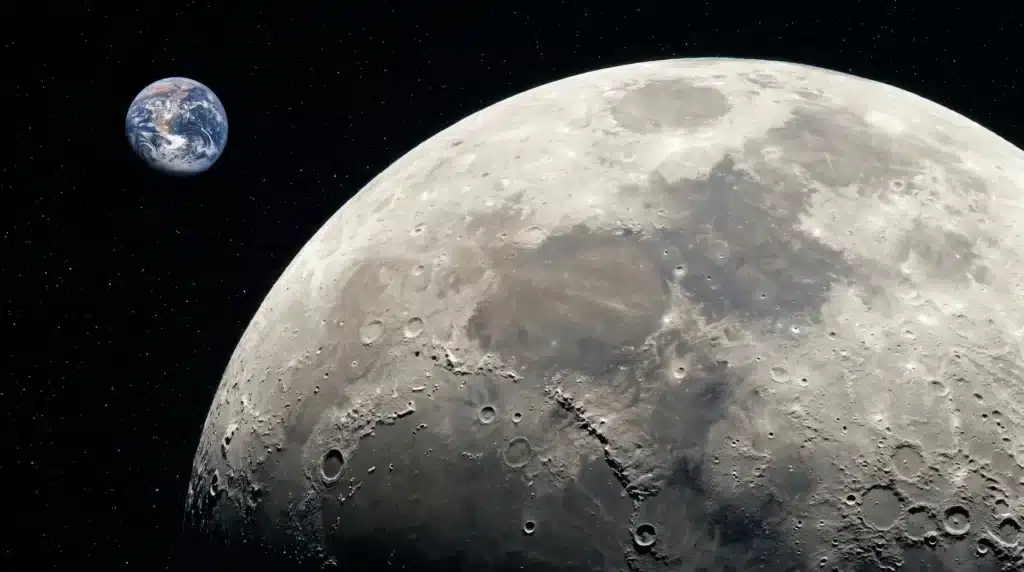
You have looked at the moon your whole life. It hangs there, big and bright, and feels familiar.
But how much do you actually know about it? Most of you know Neil Armstrong walked on it and that it controls the tides. That is about where it stops.
The moon is far stranger and more interesting than many people realize. It has quakes, trash, frozen water, and footprints that will outlast every human civilization.
These fun facts about the moon go well beyond the basics, covering moon interesting facts that even space fans rarely know.
Some will genuinely catch you off guard. Read on. You will look up tonight differently.
What Are the Types of Moons?
Before getting into the fun facts, it helps to know that not all moons behave the same way. Scientists group moons into four main types based on how they formed and what they look like.
| Moon Category | Description | Key Examples |
| Regular Moons | Formed with their planet from the same gas and dust; have stable, circular orbits. | Earth’s Moon, Ganymede (Jupiter) |
| Irregular Moons | Captured asteroids or Kuiper Belt objects; feature eccentric or retrograde orbits. | Phobos & Deimos (Mars) |
| Ocean Worlds | Icy bodies with massive subsurface liquid water oceans heated by tidal forces. | Europa (Jupiter), Enceladus (Saturn) |
| Volcanic Moons | Geologically violent worlds with intense surface volcanism driven by tidal heating. | Io (Jupiter) |
| Atmospheric Moons | Rare moons possessing thick, complex atmospheres capable of supporting weather. | Titan (Saturn) |
| Shepherd Moons | Small moons that orbit near ring systems to confine and sharpen ring particles. | Pan & Daphnis (Saturn) |
Earth’s moon is a rocky moon. It formed about 4.5 billion years ago when a Mars-sized object slammed into early Earth, sending debris flying into orbit. That debris slowly came together over time and became the moon we see today.
40 Fun Facts About the Moon
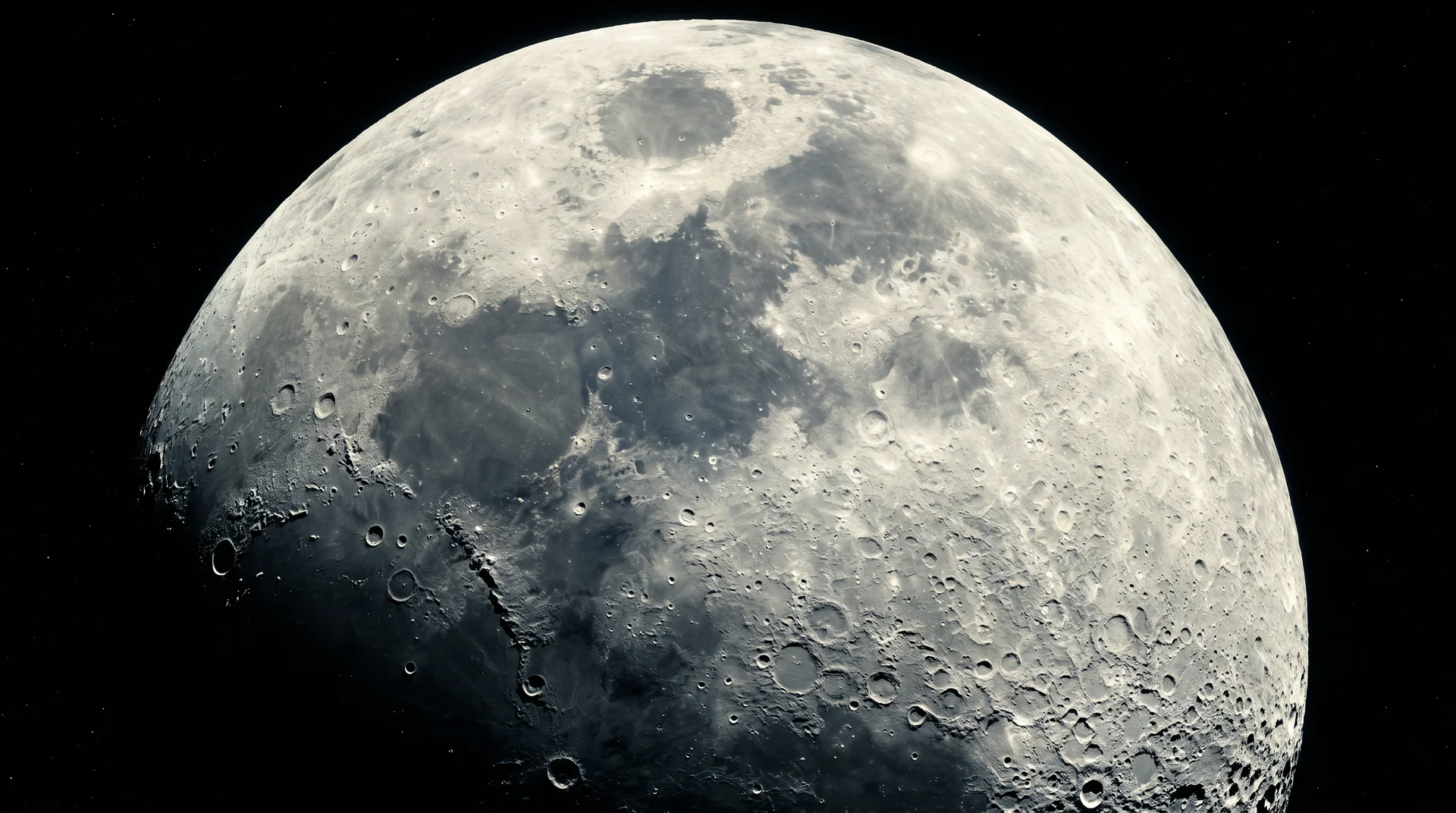
Alt Text: A high-contrast close-up of the Moon showing its detailed lunar surface, craters, and shadows against the vast blackness of deep space.
These fun facts about the moon cover everything from its size and surface to the trash left behind by astronauts and what it will look like in 500 million years. Each one is backed by real science.
Fact 1. The moon is Earth’s only natural satellite. No other object orbits our planet the way the moon does.
Fact 2. It formed about 4.5 billion years ago. Scientists call the event that created it the Giant Impact Hypothesis, a Mars-sized body hit early Earth, and the debris became the moon.
Fact 3. The moon’s diameter is3,474 km, making it roughly one-quarter the size of Earth.
Fact 4. Only 12 humans have ever walked on the moon. All of them were American astronauts during NASA’s Apollo missions between 1969 and 1972.
Fact 5. Neil Armstrong and Buzz Aldrin were first. They landed on July 20, 1969, as part of Apollo 11. Gene Cernan, who stepped off the moon last in 1972, remains the most recent person to have stood on its surface.
Fact 6. The moon is slowly moving away from Earth at a rate of3.8 centimeters per year. This happens because tidal forces transfer rotational energy from Earth to the moon’s orbit.
Fact 7. Astronaut footprints on the moon can lastmillions of years. There is no wind or weather to wear them away.
Fact 8. The moon reflects only 12% of the sunlight that hits it. Its surface is actually darker than weathered asphalt. The full moon only looks bright because the surrounding sky is so dark.
Fact 9. The moon takes 27.3 days to complete one full orbit around Earth. This is called the sidereal month.
Fact 10. A full lunar cycle, from new moon to new moon, takes 29.5 days. The difference exists because Earth is also moving around the Sun during that time.
Fact 11. We always see the same side of the moon. The moon rotates on its axis at exactly the same rate it orbits Earth, a process called tidal locking or synchronous rotation.
Fact 12. The “dark side” of the moon is a common misunderstanding. Both sides receive equal sunlight. We simply never see the far side from Earth.
Fact 13. The moon’s surface temperature swings wildly. During the day it can reach 127°C (260°F). At night it drops to-173°C (-280°F). There is no atmosphere to hold in heat.
Fact 14. The moon has no global magnetic field. It has small, localized magnetic patches in its crust, but nothing like Earth’s protective magnetic shield.
Fact 15. Moonquakes do happen. They are caused by tidal stress from Earth’s gravity, meteorite impacts, and the expansion and contraction of the moon’s crust as temperatures shift.
Fact 16. There is confirmed water ice on the moon. It sits inside permanently shadowed craters near the lunar poles, where sunlight never reaches.
Fact 17. The moon’s gravity isone-sixth of Earth’s. A person who weighs 150 pounds on Earth would weigh about 25 pounds on the moon.
Fact 18. The dark patches visible on the moon are called maria, which is Latin for “seas.” They are not seas at all. They are ancient lava plains that filled massive craters billions of years ago.
Fact 19. The moon’s surface is covered in regolith, a fine, powdery dust made from billions of years of meteorite impacts. This dust is extremely sharp because there is no wind or water to smooth it down. It clings to everything.
Fact 20. There are about 200 tons of trash on the moon. This includes spent rocket parts, cameras, backpacks, boots, and at least two golf balls left by astronaut Alan Shepard during Apollo 14.
Fact 21. The ashes of planetary scientist Eugene Shoemaker were sent to the moon in 1998 by NASA. He is the only person whose remains are on another world.
Fact 22. The far side of the moon was first seen in 1959 when the Soviet spacecraft Luna 3 photographed it. No human had ever seen it before that mission.
Fact 23. The word “lunatic” comes from the Latin word “luna,” meaning moon. People in ancient times believed the full moon caused madness, seizures, and erratic behavior.
Fact 24. The moon’s surface area is about 38 million square kilometers, which is roughly the size of the Asian continent.
Fact 25. Light from Earth takes about 1.3 seconds to reach the moon. That is why radio communications with Apollo astronauts had a short but noticeable delay.
Fact 26. The moon travels through space at an average speed of 1.02 kilometers per second as it orbits Earth.
Fact 27. The moon is thefifth-largest natural satellite in the entire solar system. Four others are larger: Ganymede, Titan, Callisto, and Io. But relative to its host planet, the moon is the largest satellite of any planet.
Fact 28. Of the9,113 officially named features on the moon, only 421 are not craters. That is just 4.6% of all named features.
Fact 29. The moon’s core makes up roughly20% of its radius. Scientists believe it consists of iron with a partially molten outer layer, similar to Earth’s inner structure.
Fact 30. Ancient lava tubes exist beneath the moon’s surface. These underground tunnels could be large enough to shelter future human bases from radiation and extreme temperatures.
Fact 31. The moon was volcanically active until about 1.2 billion years ago. The dark maria regions are the result of that ancient volcanic activity, where lava flooded and filled large basins.
Fact 32. During a supermoon, the moon appears up to 14% larger and 30% brighter than normal because it is at the closest point in its orbit to Earth.
Fact 33. The moon’s mass is about 1/81 of Earth’s mass. Despite being much smaller, its gravitational pull still affects everything from ocean tides to Earth’s rotational speed.
Fact 34. The moon helps stabilize Earth’s axial tilt at around 23.5 degrees. Without it, Earth’s tilt could shift dramatically over thousands of years, causing extreme changes in climate.
Fact 35. At its farthest point from Earth (apogee), the moon is about 405,500 km away. At its closest point (perigee), it is around 363,300 km away. That is a noticeable difference in apparent size from our view.
Fact 36. If you walked at an average human pace without stopping, it would take about9 years to walk the distance from Earth to the moon.
Fact 37. The moon has no atmosphere to burn up incoming space rocks. Every impact leaves a permanent mark. The biggest known crater, the South Pole-Aitken Basin, is about 2,500 km wide and 8 km deep.
Fact 38. The study of the moon’s surface and physical features is called selenography. The word comes from Selene, the ancient Greek goddess of the moon.
Fact 39. In about500 million years, the moon will be 14,600 miles farther away from Earth than it is today. At that point, total solar eclipses will no longer be possible because the moon will appear too small to fully cover the Sun.
Fact 40. The moon is the only world beyond Earth that humans have physically visited. Every other planet and moon in the solar system has only been seen by robotic spacecraft.
How the Moon Affects Your Everyday Life?
The moon shapes more of daily life than most people realize. Tides are the obvious one.
The moon’s gravitational pull lifts the oceans, creating the regular rhythm of high and low tides that fishing communities, sailors, and coastal planners have depended on for thousands of years.
The word “month” comes from the word “moon,” because early human calendars were built around the lunar cycle. Even agriculture has deep roots in moon-based timing.
Some research also suggests that the full moon can disrupt human sleep, though scientists are still studying just how strong that effect really is.
Conclusion
The moon is not just a light in the night sky. It steadies Earth’s tilt, drives our tides, gave us our calendar, and holds the footprints of 12 humans who stepped onto another world.
These fun facts about the moon show that our closest neighbor is full of real surprises, from moonquakes and underground lava tubes to water ice that could one day fuel rockets.
Whether you are a space fan or just someone who looks up on a clear night, knowing these moon interesting facts makes each glance at the sky feel genuinely different.
Which of these facts surprised you most? Drop your answer in the comments below.
Frequently Asked Questions
What Is the Moon’s Full Name?
The moon’s official scientific name is Luna, from the Latin word for moon. In everyday English, it is simply called “the Moon.”
Which Planet Has 0 Moons?
Mercury and Venus both have zero moons, making them the only planets in our solar system with no natural satellites.
What Are the Phases of the Moon?
The eight moon phases are: New Moon, Waxing Crescent, First Quarter, Waxing Gibbous, Full Moon, Waning Gibbous, Third Quarter, and Waning Crescent.
Why Is It Called a Blood Moon?
A blood moon occurs during a total lunar eclipse when Earth’s atmosphere scatters blue light and lets red and orange wavelengths pass through, giving the moon a deep red color.
Why Is It Called a Pink Moon?
The Pink Moon is simply the traditional name for the full moon in April, used by Native American tribes to mark the blooming of pink wildflowers called creeping phlox. The moon itself does not turn pink.