
One minute your child is totally fine. The next, they’re on the floor because their sandwich was cut the wrong way. And you’re standing there, genuinely unsure whether to laugh, cry, or just sit down next to them.
Big feelings in kids are real. They’re not dramatic. They’re just untrained. And that’s the part most parents don’t realize, emotional regulation isn’t something children figure out on their own. It’s a skill that has to be shown, practiced, and repeated.
You don’t need a therapy degree to help. These emotional regulation activities for kids are simple, research-backed, and easy to start at home.
What Is Emotional Regulation in Kids?
Emotional regulation is a child’s ability to recognize what they’re feeling and respond to it in a way that fits the situation.
A child who gets disappointed about a canceled plan but doesn’t spiral into a two-hour meltdown, that’s regulation at work. It doesn’t mean kids never feel upset.
It means they have some tools to work through it. And since the part of the brain that controls impulses and reactions (the prefrontal cortex) is still developing well into adulthood, kids genuinely need adults to help them build this skill over time.
Difference Between Self-Regulation and Emotional Regulation?
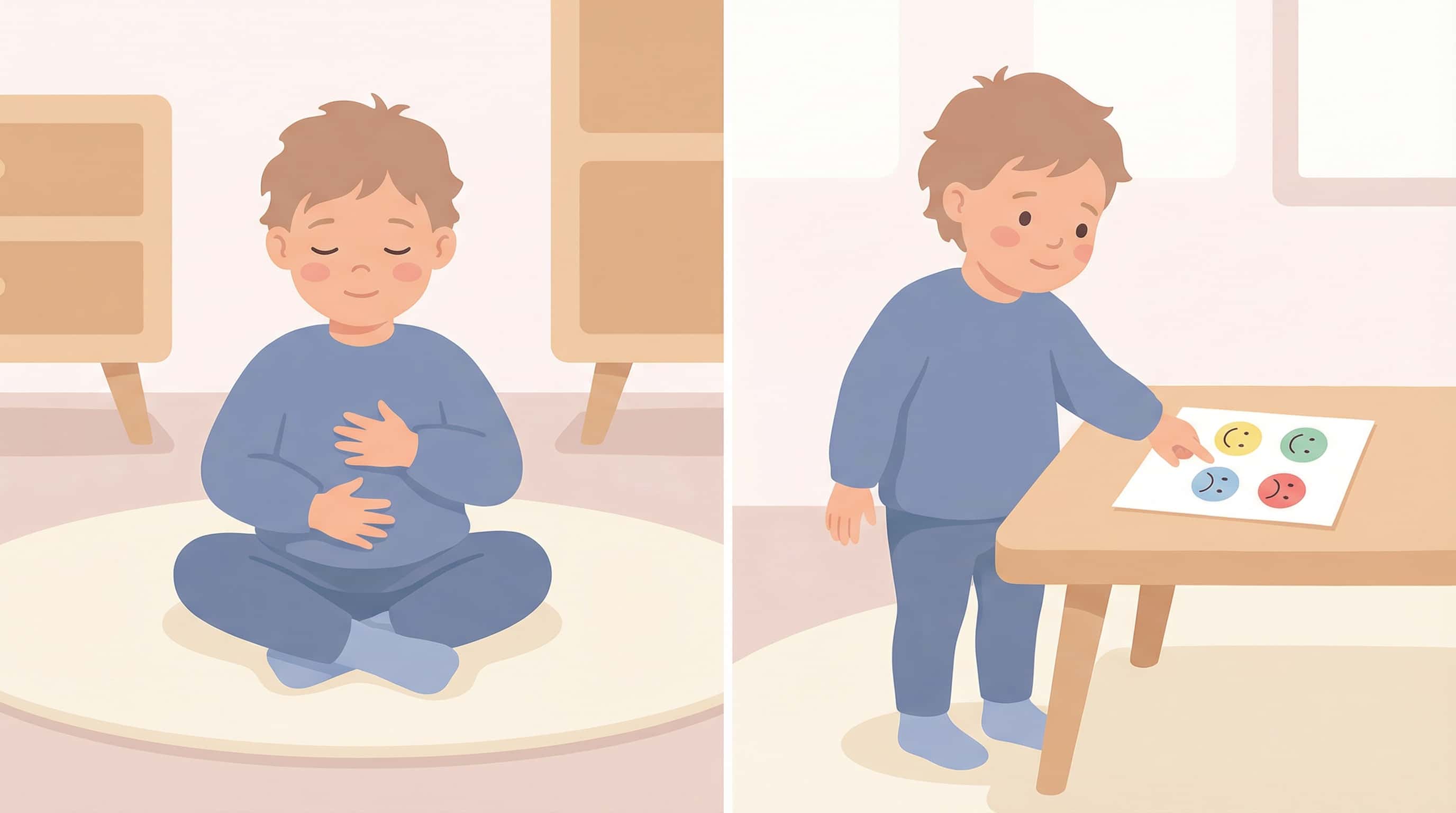
Alt Text: Illustration showing a child calming themselves by holding their stomach and another child identifying emotions using a chart with different facial expressions
These two terms get used interchangeably all the time, but they’re actually two separate steps in the same process. Think of self-regulation as the first floor and emotional regulation as the second, one has to come before the other.
| Differences | Self-Regulation | Emotional Regulation |
|---|---|---|
| What it is | Managing your body’s energy and physical state | Understanding, processing, and responding to emotions |
| What it looks like | Taking a breath, doing a movement break, slowing down | Naming the feeling, thinking through a response |
| When it happens | First, calming the body | Second, after the body is calm |
| Example | A child takes three deep breaths when angry | The same child says “I was angry because I felt left out” |
| Goal | Reduce physical arousal | Build emotional awareness and healthy responses |
| Taught how | Through calming techniques and physical tools | Through conversations, journaling, and modeling |
Signs Your Child May Be Struggling with Emotional Regulation
Most kids have big feelings sometimes. But there’s a difference between the occasional meltdown and a pattern that’s getting in the way of daily life. Here are specific signs to watch for, some obvious, some easy to miss.
Outward Signs
- Tantrums or outbursts that are still happening frequently past age 5
- Reactions that seem too big for the situation (screaming over something small)
- Trouble calming down even after a long time has passed
- Physical behavior during emotions, hitting, throwing objects, slamming doors
- Low frustration tolerance, gives up quickly when things don’t go as expected
Less Obvious Signs
- Pulling away from friends or activities they used to enjoy
- Refusing comfort from you during or after an upset
- Intense negative feelings that last for hours, not minutes
- Difficulty moving from one activity to another
- Sleep disruptions or changes in appetite during stressful periods
How Emotional Regulation Develops by Age
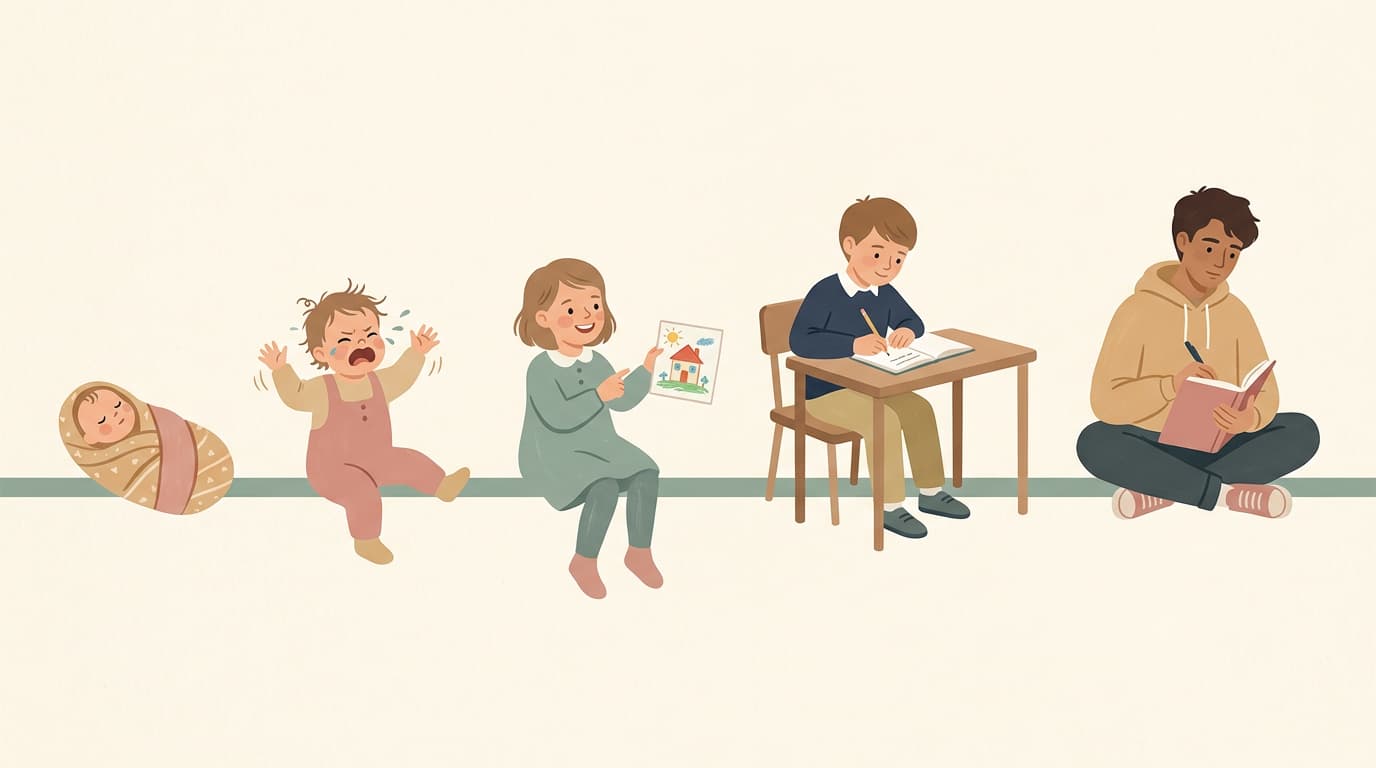
Alt Text: Illustration showing stages of child development from infancy to adolescence, including crying toddler, drawing child, studying student, and reading teenager
Kids don’t go from tantrums to total self-control overnight. The process is gradual and tied directly to how the brain matures. Here’s what to expect at each stage, and what actually helps.
Newborns to 12 Months
At this stage, babies run entirely on instinct. They cry when something feels wrong and calm down when a need is met. They self-soothe through sucking and respond to a caregiver’s calm voice or touch.
There’s no “teaching” regulation here, just responding with warmth and consistency.
Ages 1 to 2 (Toddlers)
Toddlers start linking emotions to situations. Fear of strangers kicks in around 12 months. By age 2, tantrums are common and completely normal, the brain simply doesn’t have the tools yet to manage frustration. The most helpful thing at this age is distraction and keeping upsetting situations short.
Ages 3 to 5 (Preschool)
Children at this age can start using simple words, “sad,” “mad,” “scared.” They still act on impulse, but they’re beginning to understand that feelings have names.
Labeling emotions out loud as they happen (“You look really frustrated right now”) builds vocabulary that kids use later on their own.
Ages 6 to 10 (School Age)
By around age 5 or 6, children should begin managing emotions with some success. This is when breathing techniques, movement breaks, and journaling start to stick.
They can also begin to understand how their actions affect others, which is a big shift from pure impulse.
Ages 11 and Up (Tweens and Teens)
Hormonal changes and social pressures make this stage particularly hard. Teens need more advanced tools — problem-solving skills, peer support, and consistent routines.
At this age, the goal shifts from “help them calm down” to “help them understand why they felt that way.”
What Causes Poor Emotional Regulation in Kids?
There’s rarely one single reason a child struggles to manage emotions. Most of the time, it’s a mix of factors working together. Here’s a clear breakdown.
| Cause | What It Means |
|---|---|
| Temperament | Some children are naturally more sensitive or reactive from birth, this is biology, not bad parenting |
| Brain development | The prefrontal cortex (the brain’s control center) isn’t fully developed until the mid-20s, so younger kids have less control by design |
| Home environment | Ongoing stress, major routine changes, or exposure to conflict at home affects a child’s ability to regulate |
| Parental modeling | Research shows children absorb emotional habits from caregivers, both the healthy and unhealthy ones |
| ADHD or anxiety | These conditions make impulse control and emotional processing significantly harder |
| Invalidating responses | When a child’s feelings are dismissed or punished (“stop crying, it’s not a big deal”), they don’t learn to process emotions, they learn to hide them |
| Trauma or loss | Major life events disrupt a child’s sense of safety, which directly affects their ability to regulate |
8 Emotional Regulation Activities for Kids
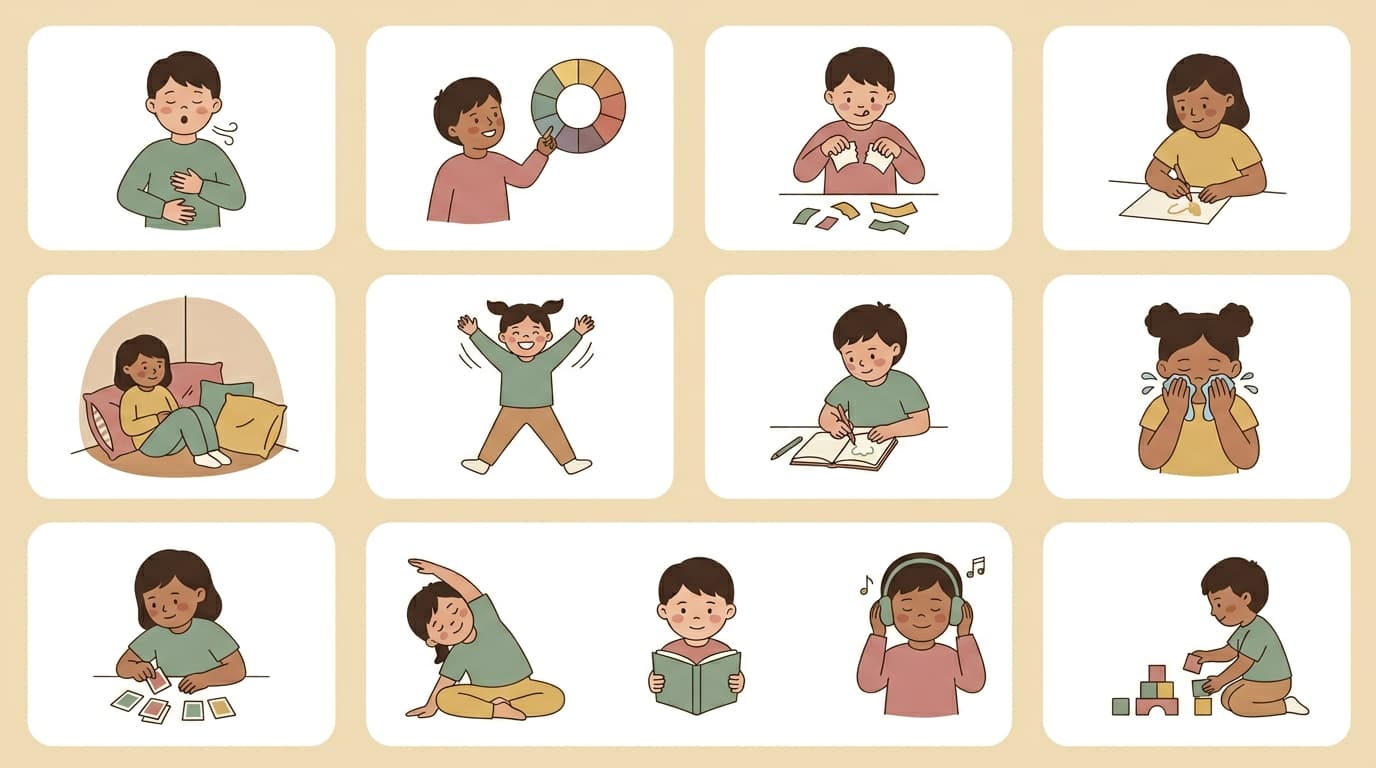
Alt Text: Illustration grid of children practicing emotional regulation activities like breathing, drawing, stretching, reading, listening to music, and playing with toys
Before anything else, and this matters, don’t try to teach these tools in the middle of a meltdown. A child’s brain in full emotional overdrive cannot absorb new information. Practice when things are calm. That’s when it actually builds.
1. Daily Feelings Check-In
A short, daily moment where your child names or draws how they’re feeling. Works best at the same time each day, morning or bedtime.
- Ask: “What’s one feeling you had today?”
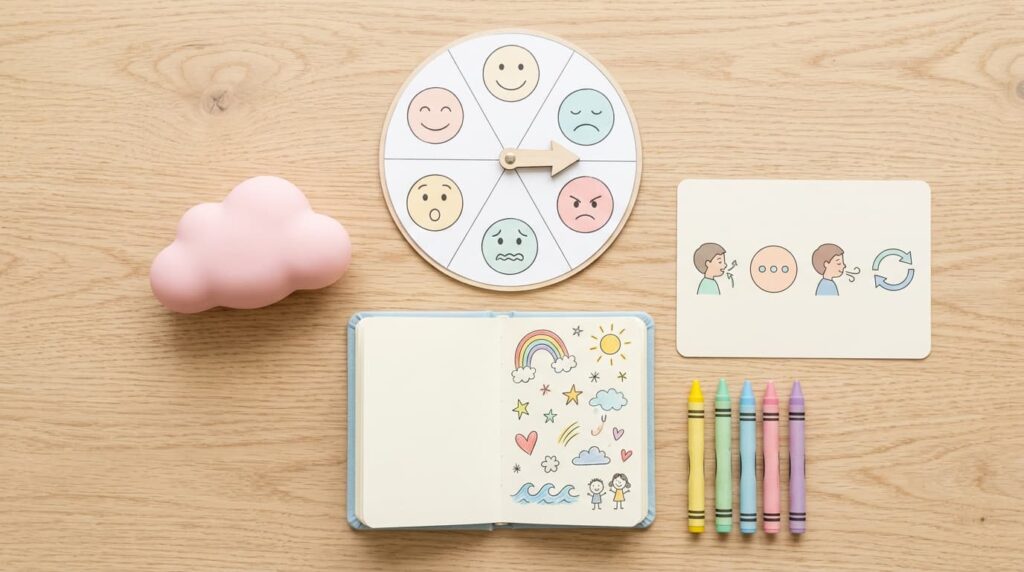
- For younger kids, use a feelings chart with illustrated faces
- For older kids, a simple journal entry works
This builds the habit of paying attention to emotions before they get overwhelming.
2. The Emotion Wheel
A color-coded wheel where each segment represents a different feeling — red for anger, blue for sadness, yellow for happy, green for calm.
- Create one together or print a free version online
- When your child is feeling something, ask them to point to the color
- Over time, add more specific feelings to each section
Kids who struggle to put words to feelings often find pointing to a color much easier.
3. Belly Breathing
One hand on the belly, one on the chest. Breathe in slowly through the nose and feel the belly rise. Hold for a moment. Breathe out slowly.
- The belly should move more than the chest
- Practice for 3 to 5 breaths
- Do it together, it works better when a parent models it
This directly activates the body’s natural calming response.
4. Balloon Breathing
Ask your child to close their eyes and picture a balloon in their belly.
- Breathe in to fill the balloon, make it big
- Hold for a few seconds
- Breathe out to slowly deflate it
Younger kids especially respond to this because the visual makes the breathing feel like a game rather than a task.
5. The 1-2-3 Breathe Method
Breathe in for 3 counts. Hold for 3. Breathe out for 3.
- Count out loud together at first
- Once your child knows the pattern, they can do it independently
- Works well in school settings too, kids can use it quietly at their desk
The counting gives the mind something to focus on, which interrupts the escalating emotion.
6. Emotion Sorting Cards
Create or buy cards with different emotions written or drawn on them. Ask your child to sort them into categories, happy, scared, sad, angry, surprised.
- For young kids, use simple words and clear faces
- For older kids, add more nuanced feelings like “embarrassed” or “frustrated”
- Talk about each one: “When did you last feel this way?”
Sorting is a low-pressure way to build emotional vocabulary without feeling like a lesson.
7. The Feelings Journal
Ask your child to write or draw about one emotion, what caused it, where they felt it in their body, and how they handled it.
- Younger kids can draw a face or a scene instead of writing
- Keep it short, one page or even one sentence is enough
- No judgment on the content, it’s for them, not you
Writing or drawing helps kids process feelings after the fact, not just in the moment.
8. Movement Breaks
When emotions are running high, the body needs an outlet. Build short movement breaks into the day.
- Jumping jacks, animal walks, or a quick run around the yard
- Stretching or yoga poses like Child’s Pose or Starfish Stretch
- Even just shaking out hands and arms helps
Physical movement uses up the adrenaline that builds during emotional moments.
How to Help Your Child Build Emotional Regulation at Home
The single most effective thing you can do is model it yourself. When you say out loud, “I’m feeling frustrated right now, so I’m going to take a few breaths before I respond,” your child files that away.
They see what handling a hard feeling actually looks like in real life. Beyond that, the work happens in the quiet moments, talking about feelings at dinner, reading books where characters have big emotions, naming what you notice in your child without jumping straight to fixing it.
Consistency across caregivers matters too. When parents, grandparents, and teachers respond the same way, children get a clear, stable message about what to do with their feelings.
Wrapping It Up
Teaching a child to manage their emotions isn’t a one-time conversation. It’s a hundred small moments, a deep breath you take together, a feeling they finally find a word for, a meltdown that ends a little faster than the one before.
That’s how emotional regulation activities for kids actually work. Not through a single perfect intervention, but through repetition, patience, and showing up the same way each time.
Start with one activity this week. See what your child responds to. Every child is different, and some tools click faster than others.
Which activity are you planning to try first? Drop it in the comments below, it might help another parent too.