
The Stegosaurus was already gone for 80 million years before the T. rex ever walked the Earth. That single fact puts the whole Jurassic Park franchise in a new light.
Dinosaurs ruled this planet for over 165 million years, and most of what people think they know about them comes from movies, not science.
Real dinosaurs were stranger, more varied, and honestly more interesting than any film version. Some were the size of a chicken. Some had feathers. Some raised their babies.
These fun facts about dinosaurs are split into five clear categories, so you can read straight through or jump to the ones that interest you most.
Dinosaurs at a Glance
These numbers set the stage before we get into all the random dinosaur facts. Keep this as a quick reference while reading through each category below.
| Feature | Detail |
|---|---|
| Time on Earth | About 165 to 245 million years |
| Mass extinction | Roughly 66 million years ago |
| Known species | Over 700 have been named so far |
| Largest by weight | Argentinosaurus, about 77 tons |
| Smallest known adult | Lesothosaurus, about the size of a chicken |
| The first dinosaur named | Megalosaurus, in 1824 |
| Longest dinosaur name | Micropachycephalosaurus, 23 letters |
| Living relatives | Modern birds |
| Fossils found on | All 7 continents, including Antarctica |
| Who studies them | Paleontologists |
Dinosaurs were not just a single type of creature. They included many different types of dinosaurs, each with its own unique characteristics, spread across millions of years, every continent, and almost every environment you can think of.
Size, Weight, and Records of Dinosaurs
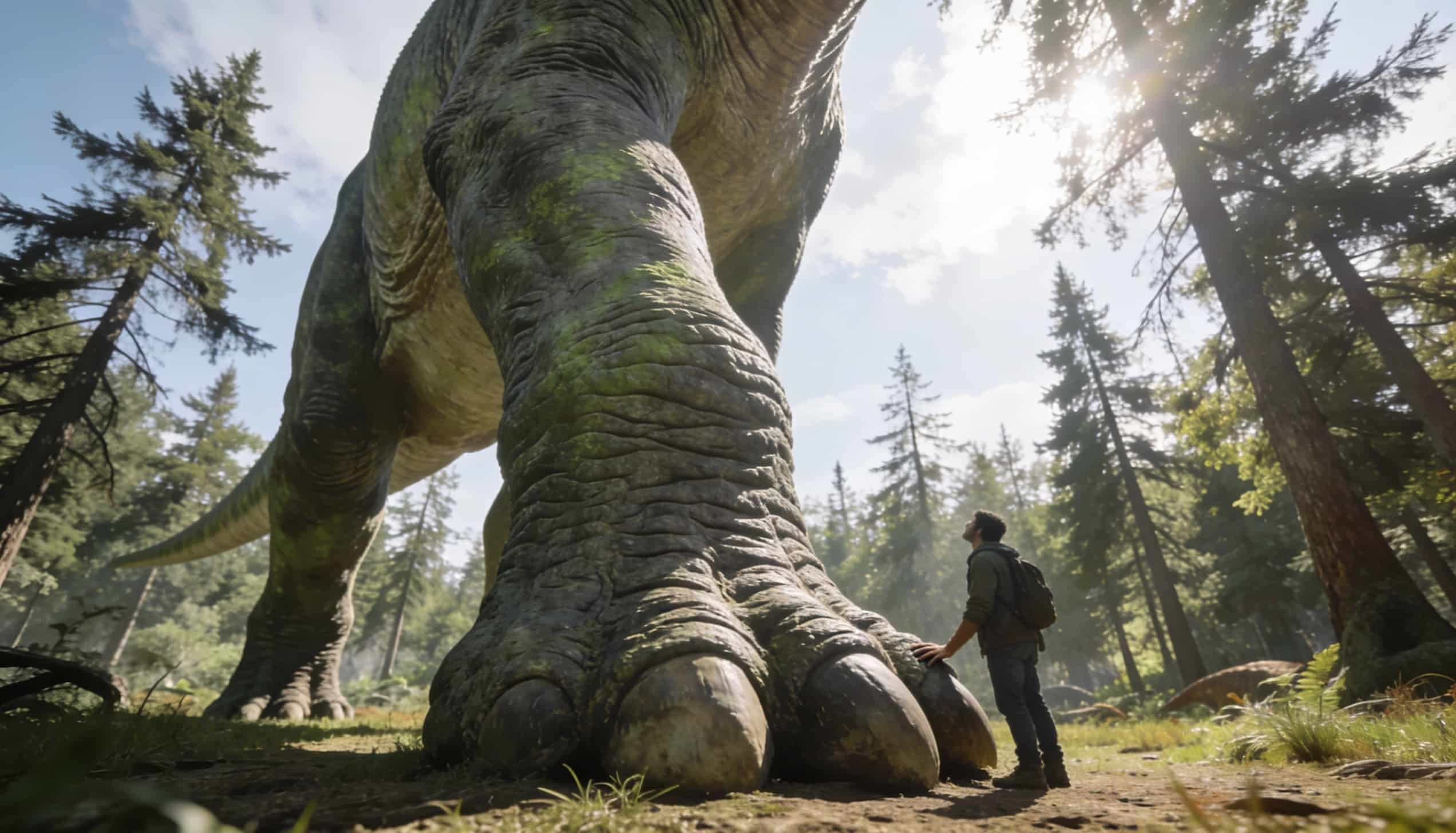
Alt Text: A massive, detailed dinosaur foot stands in a lush forest beside a person, highlighting the immense scale of the prehistoric creature.
These fun facts about dinosaurs’ size will change how you think about what “big” really means.
1. The Argentinosaurus was the heaviest dinosaur ever found. It weighed around 77 tons. That is equal to 17 African elephants standing side by side.
2. The Argentinosaurus also stretched about 40 meters from head to tail. For comparison, a blue whale averages just 25 to 30 meters long.
3. The single biggest dinosaur bone ever found is an Argentinosaurus backbone. It measured 5 by 5 feet and weighed over one ton.
4. Spinosaurus was the largest meat-eating dinosaur ever known. It could grow over 46 feet long and spent much of its time in water, similar to alligatorsand crocodiles.
5. The Brachiosaurus had front legs that were longer than its back legs. This gave it a giraffe-like posture, allowing it to reach branches 30 feet off the ground.
6. Not all dinosaurs were giants. The Lesothosaurus was fully grown at roughly the size of a chicken. It was a plant-eater and weighed less than 10 pounds.
7. The Microraptor was even smaller. It had four feathered limbs and was roughly the size of a crow. Fully grown, it weighed less than a pound.
8. The average dinosaur, across all known species, was roughly the size of a small car. Most people picture giants, but the numbers tell a different story.
9. The Compsognathus was one of the smallest dinosaurs ever found. It was about the size of a turkey and weighed around 6 pounds.
10. The Seismosaurus was roughly 150 feet long from head to tail, making it one of the longest animals ever to live on land.
11. The largest dinosaur eggs ever found belonged to the Segnosaurus. They measured about 19 inches long and were found in China.
12. The smallest dinosaur eggs ever recorded measured just 0.7 inches. These were found in northeastern Thailand in 2002 and 2003.
13. Some scientists believe large dinosaurs like the Apatosaurus may have lived up to 300 years, based on their bone structure and body size.
14. Most meat-eating dinosaurs lived to around 30 years. Larger plant-eaters are estimated to have lived between 70 and 80 years.
15. Baby dinosaurs grew very fast. Many reached their full adult size in just 7 to 8 years after hatching.
16. The T. rex had a skull about 5 feet long. Its jaw could open wide enough to swallow very large prey whole.
17. The Triceratops skull, including its frill, could be up to 10 feet long. It is one of the largest skulls of any land animal ever recorded.
18. Many large dinosaur skulls had big holes in them called fenestrae. These openings made the skull lighter without significantly reducing its strength.
19. The heaviest and longest complete skeleton on public display is a Diplodocus cast. The original bones are too heavy to mount safely without damage.
20. Some sauropod dinosaurs had necks longer than a school bus. The Mamenchisaurus had a neck that stretched over 35 feet on its own.
Diet, Teeth, and Eating Habits of Dinosaurs
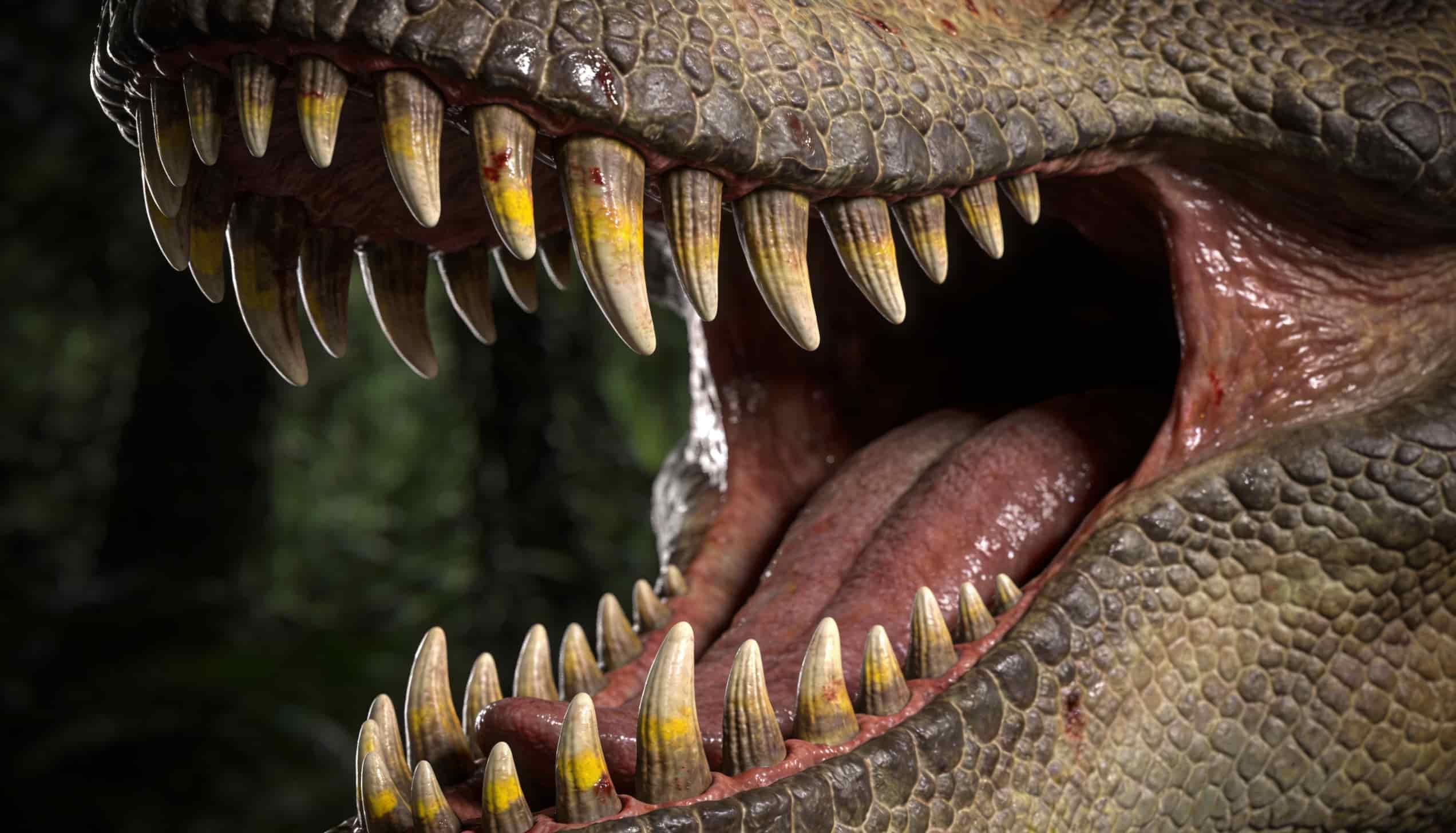
Alt Text: A close-up view of a Tyrannosaurus rex with its mouth open, showcasing large, sharp, serrated teeth designed for tearing and eating.
These random dinosaur facts about food and feeding might be the most surprising category in the whole list.
21. The biggest dinosaurs were not meat-eaters. The Brachiosaurus, Apatosaurus, and Argentinosaurus were all plant-eaters. Size and diet were not connected the way most people assume.
22. The Triceratops had hundreds of teeth arranged into a solid wall with sharp ridges. These were used to chop through very tough plant material.
23. Diplodocus had long, pencil-like teeth used to rake leaves off branches. It did not chew. It swallowed food whole.
24. Anatotitan had wide, flat teeth built for grinding. Scientists can tell a great deal about what dinosaurs ate just by looking at the shape of a single tooth.
25. Some plant-eating dinosaurs had no grinding teeth at all. So they swallowed rocks. These stomach stones, called gastroliths, helped break down tough plant food inside the gut.
26. Gastroliths have been found alongside many dinosaur fossils. Modern birds like chickens and parakeets still use a similar method today with small pieces of grit.
27. The Velociraptor was much smaller than the movies show. It was about the size of a turkey and likely hunted small prey like lizards and small mammals.
28. Spinosaurus ate fish. Its skull was shaped like a crocodile’s, and its teeth were straight rather than serrated. This is a clear sign of a fish-eating diet.
29. T. rex had banana-sized teeth with serrated edges built for tearing through bone. Its bite force is estimated to have been the strongest of any land animal in history.
30. Some scientists believe the T. rex may have also scavenged dead animals rather than always hunting live prey. The debate is still open among paleontologists.
31. Plant-eating dinosaurs generally had flat, rounded teeth. Meat-eaters had sharp, curved, or serrated teeth. A single tooth can often identify the diet of a whole species.
32. Long-necked sauropods like the Brachiosaurus could eat from treetops that other animals could not reach. Their height gave them exclusive access to food sources.
33. Low-to-the-ground dinosaurs like the Ankylosaurus likely fed on shrubs, ferns, and fruit. Their body build made reaching anything tall physically impossible.
34. Some dinosaurs called ornithomimosaurs are thought to have been omnivores. They ate both plants and small animals, much like modern ostriches.
35. The Iguanodon had a beak-like mouth at the front for cropping plants and teeth further back for grinding. It could eat a wide range of vegetation.
36. Some carnivorous dinosaurs, like the Oviraptor, were once mistakenly thought to steal eggs. Later fossil evidence showed they were actually sitting on their own nests, protecting them.
37. Fossilized dung from dinosaurs, called coprolites, has given paleontologists direct evidence of what various species actually ate rather than what scientists guessed.
38. Hadrosaurs, also called duck-billed dinosaurs, had up to 1,000 teeth packed into their jaws at once. New teeth grew in to replace worn ones continuously.
39. The Parasaurolophus is believed to have eaten pine needles, seeds, and leaves. Its teeth and jaw structure were well-suited to processing tough, fibrous plant matter.
40. Some evidence suggests that a few dinosaur species ate others of the same kind. Bite marks found on bones of the same species have led scientists to this conclusion.
Behavior, Social Life, and Parenting in Dinosaurs
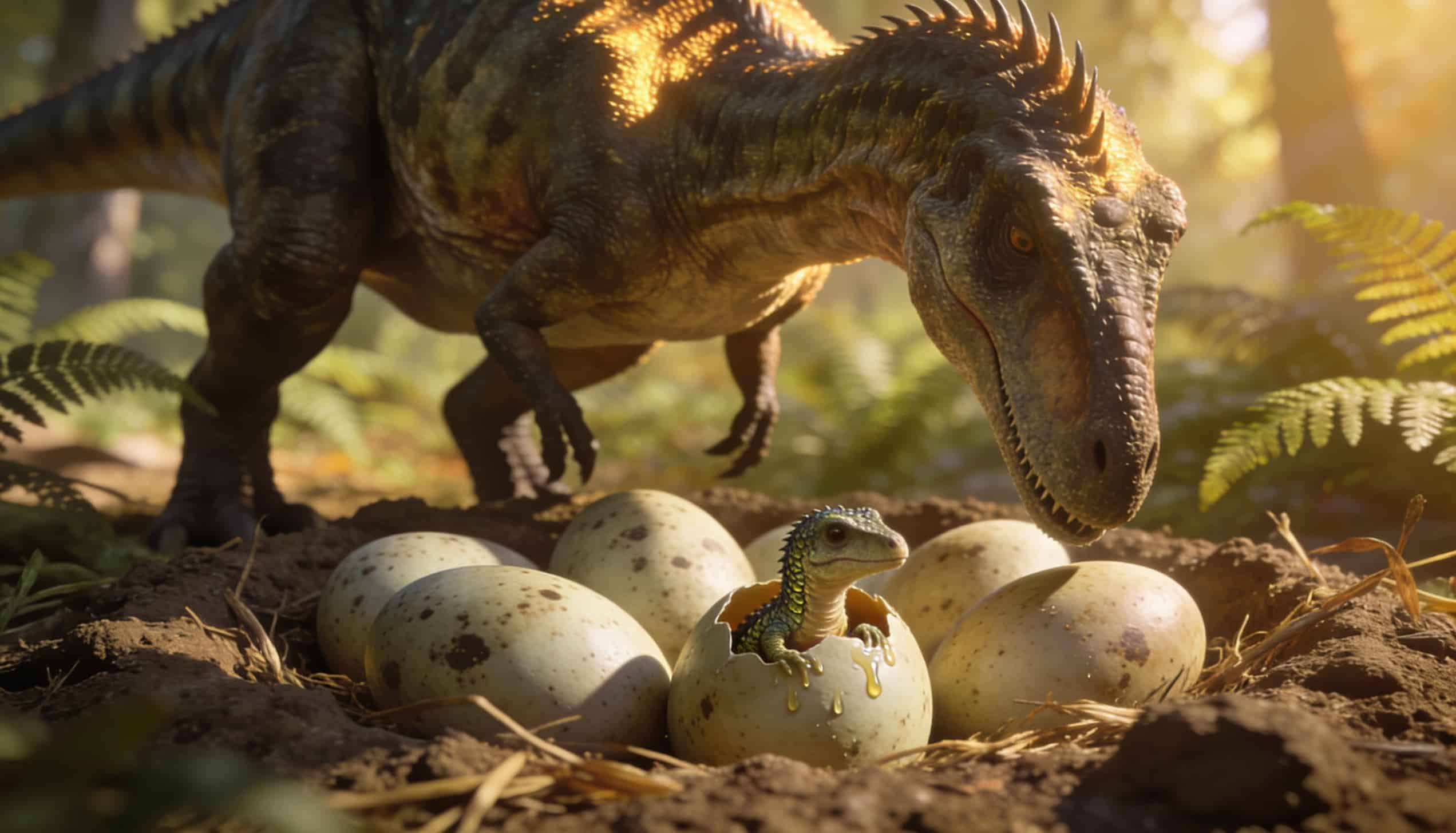
Alt Text: An adult dinosaur guarding its nest of eggs in a lush, prehistoric landscape, illustrating parental care and social behavior.
Dinosaurs were not the lone killing machines most people picture. Some of these facts sound more like a nature documentary about wolves or elephants.
41. The Maiasaura, whose name means “good mother reptile,” built large nesting colonies. Fossils show adult bones grouped near young, which is strong evidence of parental care.
42. Baby Maiasaura hatchlings had underdeveloped legs when they first came out of the egg. This means the parents had to bring food to the nest rather than leaving the young alone.
43. Triceratops and Styracosaurus likely traveled in large herds. Scientists know this because thousands of their bones have been found together in the same fossil beds.
44. A Centrosaurus bonebed in Alberta, Canada, contains the fossils of thousands of individual dinosaurs. This is one of the strongest signs of mass herd behavior in the fossil record.
45. Hypacrosaurus fossils from Montana and Alberta show that young dinosaurs around 4 years old appear to have joined multigenerational herds. Younger ones stayed in groups with other juveniles first.
46. Pachyrhinosaurus migrated in massive groups. Fossil sites suggest thousands moved together at once, similar to modern caribou migrations across North America.
47. Some dinosaurs communicated through sound. Lambeosaurs had hollow, tube-like crests on their skulls that functioned like a musical instrument to produce calls and signals.
48. Scientists have found fossilized footprints showing multiple dinosaurs walking side by side in the same direction. This strongly suggests coordinated group movement.
49. Velociraptor adults have been found near nests with young nearby. This points to some level of parental involvement after hatching, not just egg-laying and leaving.
50. Some large dinosaurs, like the Brachiosaurus, may have left their eggs soon after laying them. No adult Brachiosaurus fossils have ever been found directly beside a nest.
51. Evidence from the Hell Creek Formation in North America shows that several different small dinosaur species lived in the same habitat at the same time as T. rex.
52. Some carnivorous dinosaurs may have hunted in groups. In Patagonia, the bones of six large meat-eaters were found together, suggesting they died at the same spot as a pack.
53. Fossilized tracks from ornithomimid dinosaurs show they could move at least 25 miles per hour in short bursts. This is fast enough to outrun most large predators.
54. Some dinosaurs likely used physical features, like the plates of the Stegosaurus or the crest of the Parasaurolophus, for display and recognition within their own species.
55. Dinosaur nesting sites have been found on every continent. This tells scientists that parental behavior was not limited to one region or one time period.
56. The Iguanodon had a long, spiky thumb. For 40 years, scientists thought it was a nose horn. It was not until more complete skeletons were found that its true location became clear.
57. Some fossil sites show young and old dinosaurs of the same species buried together. This is taken as strong evidence of tight family or herd structures.
58. Stegosaurus had a brain roughly the size of a walnut. But brain size alone does not determine survival. Its armored back plates and spiked tail made it highly effective at defense.
59. T. rex had forward-facing eyes, much like modern predators such as owls and eagles. This gave it depth perception, useful when judging distance during a chase.
60. Many smaller theropod dinosaurs are believed to have been warm-blooded, or at least able to regulate body temperature better than modern cold-blooded reptiles.
Fossils, Names, and the Science Behind Dinosaurs
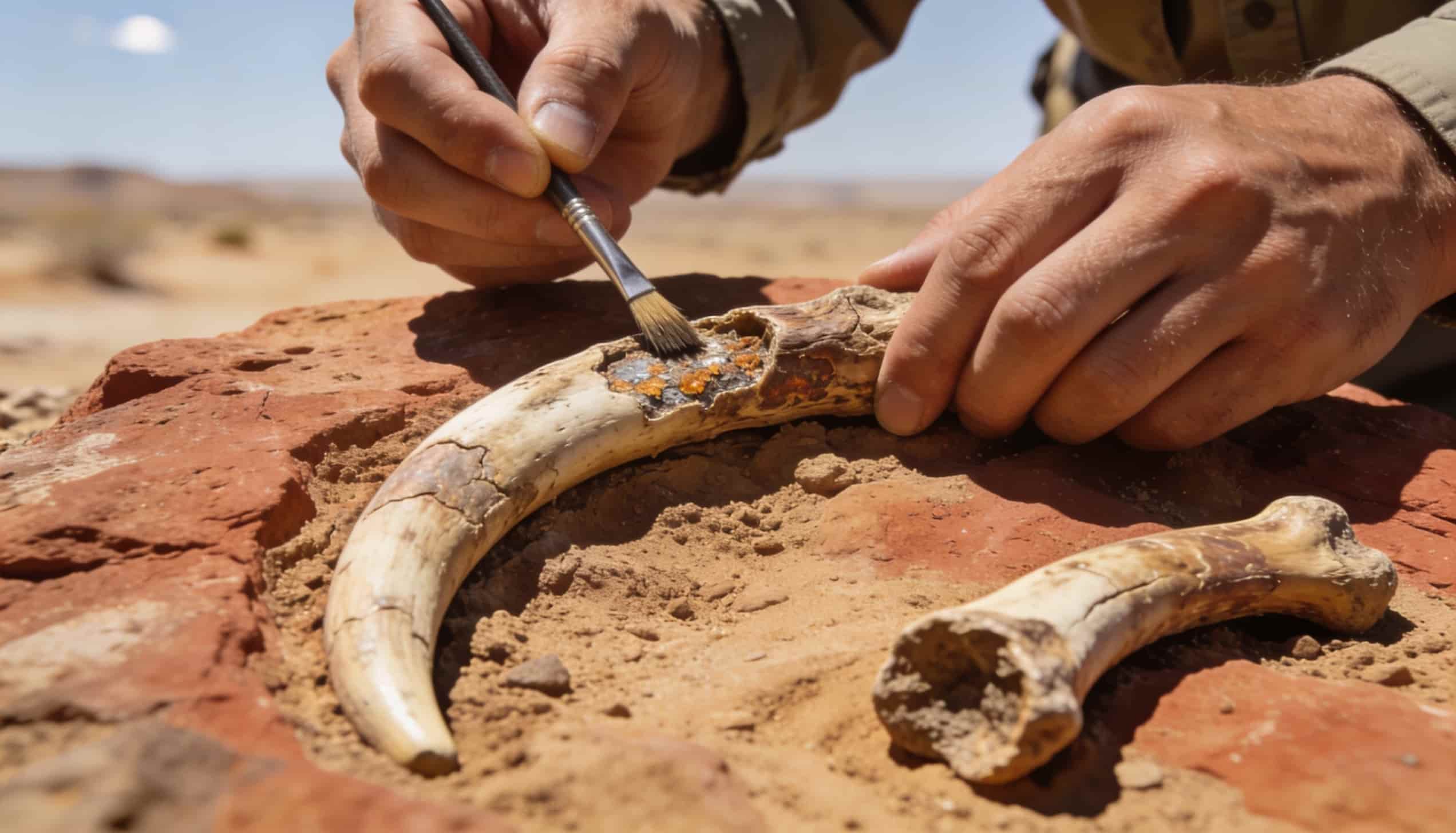
Alt Text: A paleontologist carefully uses a small brush to clean dirt and debris from a large, fossilized dinosaur bone embedded in rocky ground.
These facts cover how scientists figured all of this out, and some of the surprises they found along the way.
61. The first scientific account of a dinosaur fossil was published in 1677. It described a large thighbone belonging to a Megalosaurus, though scientists at the time had no idea what they were looking at.
62. The Megalosaurus was the first dinosaur to be officially named. Reverend William Buckland gave it that name in 1824.
63. The term “Dinosauria” was created by English scientist Sir Richard Owen in 1842. It comes from two Greek words meaning “fearfully great” and “lizard.”
64. Sir Richard Owen intended the word “terrible” to mean impressively large, not frightening. He was describing their scale, not their personality.
65. Dinosaur fossils have been found on all seven continents. This includes Antarctica, where conditions have preserved some fossils for millions of years.
66. The countries with the most dinosaur fossil discoveries are the United States, Canada, China, and Argentina. These regions have the right type of rock from the right time period.
67. The dinosaur with the longest name is the Micropachycephalosaurus. Its name has 23 letters and means “tiny thick-headed lizard.” It was named by Chinese paleontologist Dong Zhiming in 1978.
68. Paleontologists can estimate the height of a dinosaur from a single footprint. Multiplying the print length by four gives a rough estimate of the animal’s leg length.
69. In 2025, fossilized Diplodocus skin provided evidence that these dinosaurs may have been colorful, according to research published in Royal Society Open Science.
70. Fossilized dung, called coprolites, can tell scientists not just what a dinosaur ate but how it digested food and what its gut bacteria may have looked like.
71. Dinosaur fossils include more than bones. Paleontologists study teeth, eggs, footprints, skin impressions, and even preserved blood vessels to learn how these animals lived.
72. The oldest fossil classified as a true dinosaur dates back about 245 million years. It was found in what is now Tanzania and Argentina.
73. Before true dinosaurs appeared, Earth was dominated by other reptiles called archosaurs and therapsids. Dinosaurs evolved from earlier reptile groups, not out of nowhere.
74. The first T. rex fossil was discovered by Barnum Brown, who worked at the American Museum of Natural History from 1897. Several of his T. rex finds are still on display there today.
75. In 2024, researchers confirmed a new species called Tyrannosaurus mcraeensis. Analysis of a partial skull showed it lived 5 to 7 million years before the T. rex we know today.
76. In 2024, paleontologists in South Korea found fossilized tracks from small dinosaurs that appeared to be flapping their arms, offering a rare look at behaviors that came before full flight.
77. A new burrowing dinosaur from Utah was published in the journal Anatomical Record in 2024. It is one of the very few known dinosaurs adapted to living underground.
78. Research in 2024 confirmed that young Hypacrosaurus dinosaurs formed their own juvenile herds before joining larger mixed-age groups around age 4, mirroring behavior seen in some modern herd animals.
79. There are currently around 700 named dinosaur species. Many scientists believe that the number could more than double as new fossil sites are found and studied around the world.
80. Some fossils show healed injuries, meaning the animal survived an attack and recovered. This suggests that some dinosaurs had immune systems and healing abilities closer to those of modern birds than to those of cold-blooded reptiles.
Dinosaurs and Their Connection to the Modern World
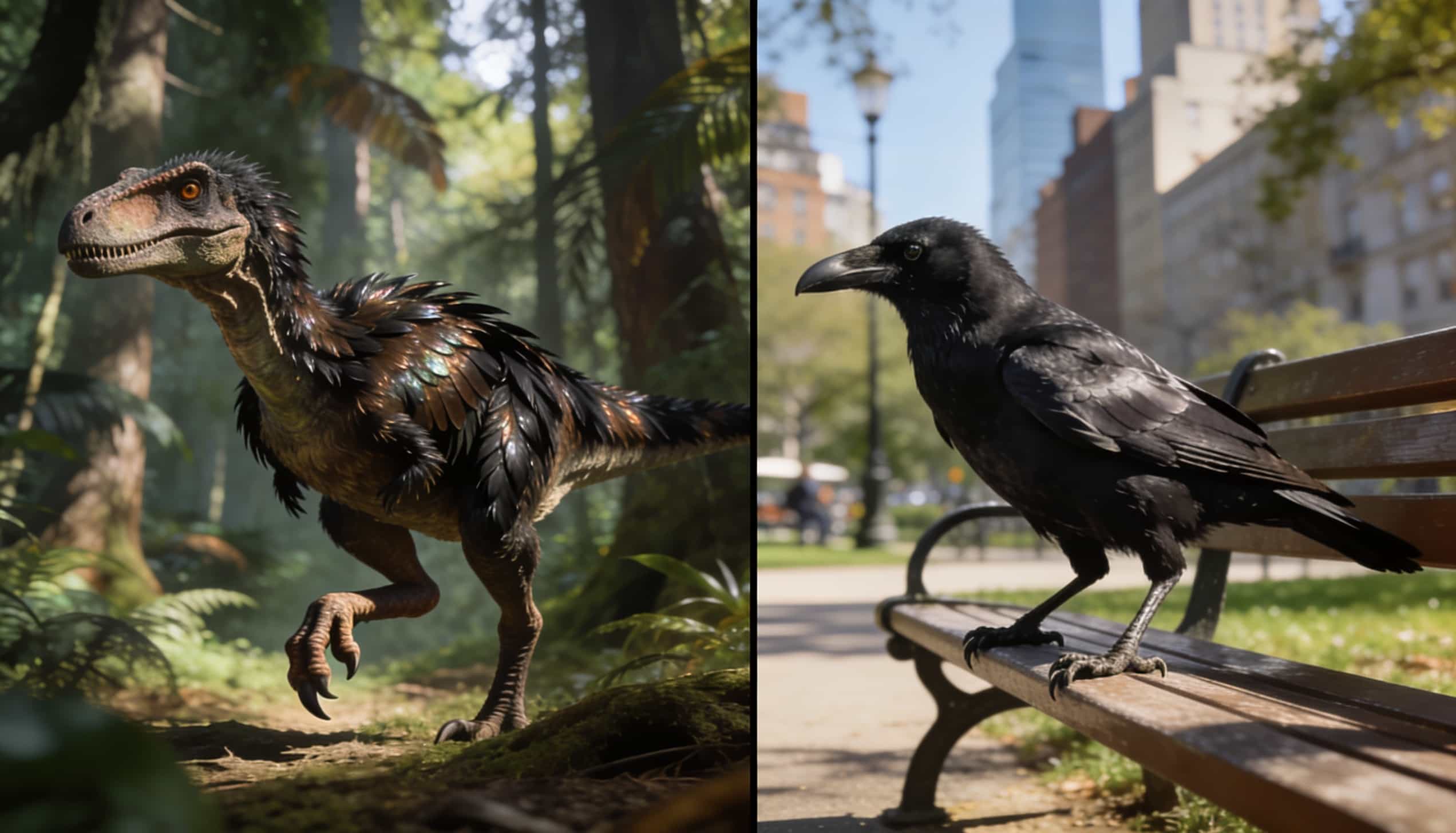
Alt Text: A split-screen comparison showing a feathered theropod dinosaur on the left and a modern crow perched on a park bench on the right.
This last set of fun facts about dinosaurs connects prehistoric life to the world you can see right now, including the birds outside your window.
81. Every bird alive today is a dinosaur. Not just a descendant. An actual dinosaur. Birds evolved from a group of two-legged meat-eaters called theropods and sit within the dinosaur family tree.
82. The connection between birds and dinosaurs is not just theoretical. Birds share hollow bones, scales on their feet, and nesting behaviors with their non-avian ancestors.
83. The pigeon on your street is more closely related to the T. rex than any lizard or crocodile is. Crocodiles are cousins of dinosaurs. Birds are dinosaurs.
84. Pterodactyls were not dinosaurs. They were pterosaurs, a related but completely separate group of flying reptiles. This is one of the most common mix-ups in popular dinosaur coverage.
85. Plesiosaurs and other large marine reptiles were also not dinosaurs. They lived at the same time but belonged to entirely separate animal groups.
86. The Yutyrannus Huali was a feathered dinosaur and a cousin of the T. rex. It was roughly 30 feet long, making it the largest known feathered animal that ever lived.
87. Feathers were not only for birds or for flight. Many non-bird dinosaurs had feathers believed to help with warmth, display, or camouflage. The Velociraptor almost certainly had them.
88. Recent fossil evidence suggests that some dinosaurs may have slept like modern birds, tucking their heads under a wing or resting in a curled position.
89. The mass extinction that ended the age of non-avian dinosaurs happened about 66 million years ago. The main cause was a large asteroid impact, likely combined with massive volcanic activity.
90. The asteroid that ended the dinosaurs hit what is now the Yucatan Peninsula in Mexico. The resulting crater, called the Chicxulub crater, is still visible today through satellite imaging.
91. The impact sent debris into the atmosphere, blocked sunlight, and caused temperatures to drop worldwide. Most large animals could not survive the years that followed.
92. Small, feathered theropods survived the extinction event because they could eat seeds, insects, and stored food when other food sources disappeared entirely.
93. Birds are the only dinosaur lineage to survive the extinction. Every other group, including T. rex, Triceratops, and all sauropods, is gone.
94. Chickens share a number of physical traits with the T. rex, including the way their legs are built and the structure of certain leg and foot bones.
95. Dinosaurs are still being found. New species are named multiple times a year. Scientists estimate that most dinosaur species that ever existed have yet to be discovered.
96. Modern birds use gastroliths just like their ancestors did. You can see this in farm chickens. They actively seek out small stones to help with digestion.
97. Some modern bird behaviors, like building nests and guarding eggs, can be traced directly back to behaviors seen in fossilized evidence from theropod dinosaurs.
98. The Stegosaurus and the T. rex did not exist at the same time. The Stegosaurus died out about 150 million years ago. T. rex appeared around 68 million years ago. The gap between them is greater than the gap between T. rex and today.
99. Birds have three-toed feet with the same bone layout as theropod dinosaurs. The similarity is so close that some early bird fossils were first classified as small dinosaurs.
100. In 2025, researchers found preserved blood vessels in dinosaur fossils. This opened the possibility of learning more about dinosaur biology at a cellular level, something previously thought impossible.
101. Dinosaurs lived on Earth longer than the time that has passed since they went extinct. They had 165 million years. Only 66 million years have passed since then. By that measure, we are still quite close to them.
For a deeper look at what made each dinosaur species unique, this guide on common dinosaurs and their traits breaks down the fascinating differences.
Final Thoughts
These 101 fun facts about dinosaurs show how much the real story beats the movie version.
Dinosaurs were caring parents, fast runners, social animals, and in some cases, still alive in the birds around you today. They were not just monsters.
They were a world. Every fossil find adds something new, and in 2024 and 2025 alone, scientists confirmed species and behaviors that had never been recorded before.
If any fact in this list surprised you, drop it in the comments below.
Frequently Asked Questions
What Is “I Love You” in Dinosaur?
There is no real dinosaur language, but the phrase “I love you” in dinosaur, as a popular joke or kids’ phrase, is usually expressed as a loud roar.
What Did They Call Dinosaurs Before 1841?
Before Sir Richard Owen coined the term “Dinosauria” in 1842, large fossil bones were called “giant lizards” or “antediluvian reptiles” or simply described as the bones of unknown ancient beasts.
What Animal Kills a T. Rex?
No animal alive today could kill a T. rex, but the Triceratops is the most likely candidate among its actual contemporaries, with three horns and a reinforced skull used in combat.
Which Was the Smallest Dinosaur?
The smallest fully grown dinosaur on record is the Lesothosaurus, a plant-eater roughly the size of a chicken that weighed less than 10 pounds.
What Is the Biggest Dinosaur Ever?
The Argentinosaurus is the biggest dinosaur ever found, weighing around 77 tons and stretching about 40 meters long, making it the largest land animal known to science.