
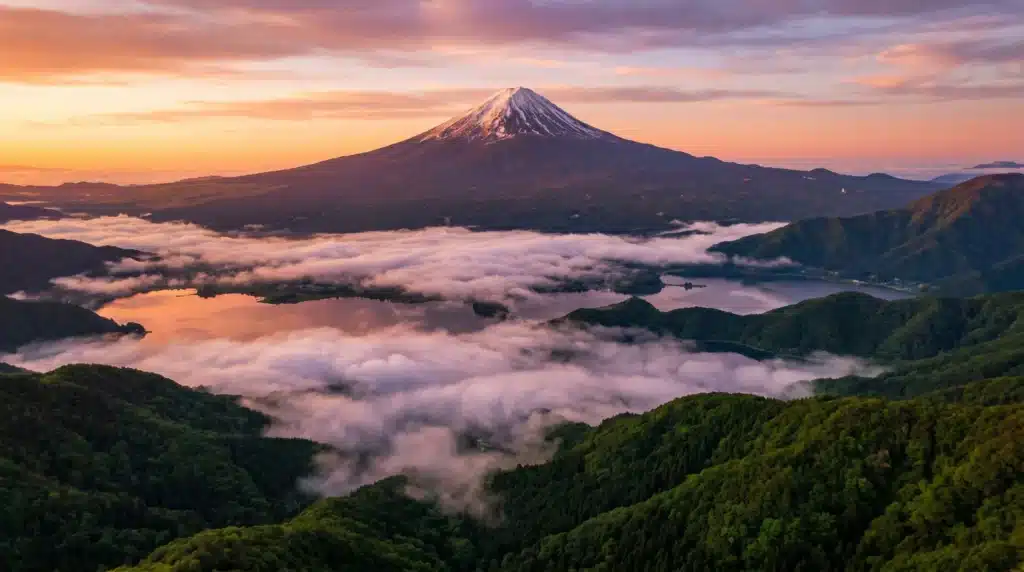
Mount Fuji sits about 100 km from Tokyo, yet most people know it only as a postcard image.
At 3,776 meters, it is Japan’s tallest mountain, a living volcano, a sacred Shinto site, and a UNESCO World Heritage Cultural Site all at once.
Every summer, roughly 300,000 people try to reach its summit in just eight short weeks. Some go for the sunrise. Some go for the challenge. Others simply want to say they did it.
This blog covers facts about Mount Fuji that go well beyond the basics, from how it formed to who actually owns its peak and why women were banned from climbing it for centuries.
Mount Fuji at a Glance: Key Stats and Numbers
Before getting into the full list of facts about Mount Fuji, here are the core numbers at a quick glance.
| Detail | Information |
|---|---|
| Height | 3,776 m (12,389 ft) |
| Location | Honshu Island, Japan |
| Distance from Tokyo | 100 km southwest |
| Volcano type | Active stratovolcano |
| Last eruption | December 16, 1707 to January 1, 1708 |
| Crater diameter | 500 m wide, ~250 m deep |
| Climbing season | Early July to early September |
| UNESCO status | Cultural World Heritage Site (2013) |
| Peaks around the crater rim | 8 |
These figures set the baseline. The facts below are where it gets far more interesting.
How Was Mount Fuji Formed?
Mount Fuji formed through four stages of volcanic activity over roughly 100,000 years, starting where the Eurasian, North American, and Philippine plates meet beneath Honshu Island.
The oldest layer, called Komitake, sits at the base. Above that came Ko-Fuji (Old Fuji), which was built up around 100,000 to 17,000 years ago.
The current cone, known as Shin-Fuji (New Fuji), formed on top of Old Fuji about 10,000 years ago through repeated lava and ash eruptions, giving the mountain its near-perfect symmetrical shape.
30 Facts About Mount Fuji
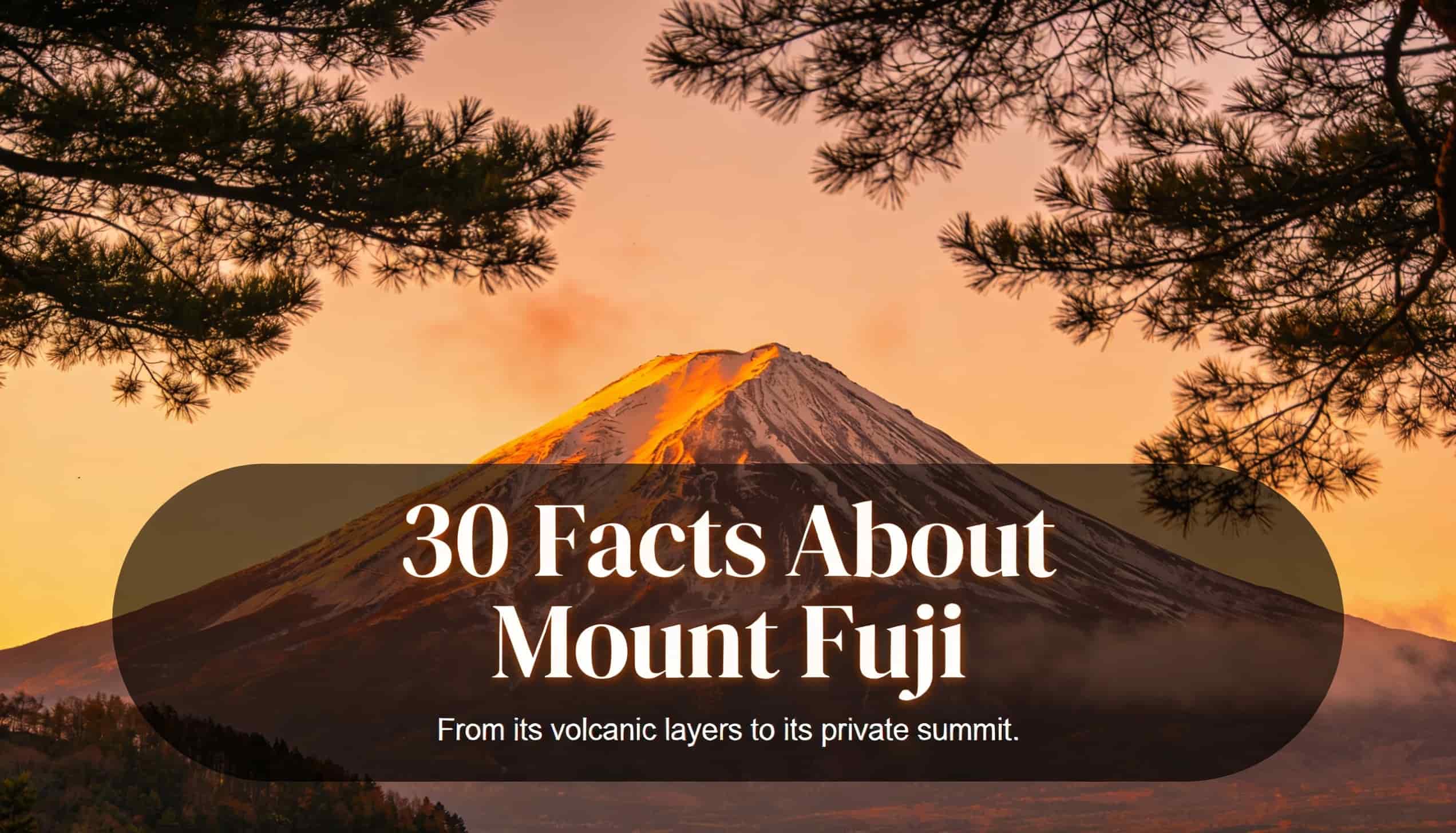
Alt Text: Mount Fuji with a snow-covered peak rising above a forest, illuminated by a warm sunrise glow with soft clouds resting at its base.
Here are Mount Fuji fun facts that cover geology, culture, wildlife, history, and a few surprises most visitors never hear about.
- Mount Fuji is the tallest mountain in Japan at 3,776 meters (12,389 feet) and is visible from Tokyo on clear days.
- It sits at the junction of three tectonic plates, making the area one of the most seismically active regions on Earth.
- The mountain is not one volcano. It is three separate volcanoes stacked on top of each other: Komitake at the base, Ko-Fuji in the middle, and Shin-Fuji at the top.
- Shin-Fuji, the cone visible today, is approximately 10,000 years old. The mountain’s geological base, however, began forming over 100,000 years ago.
- Mount Fuji is classified as an active stratovolcano, the same type as Mount Vesuvius in Italy and Mount Baker in Washington State.
- The crater at the summit is about 500 meters wide and 250 meters deep, with eight distinct peaks running along its rim.
- The mountain’s base is roughly 125 km in circumference and spans 40 to 50 km in diameter.
- Mount Fuji’s peak sits only 25 km from the sea and just 23 km from the nearest Shinkansen (bullet train) line.
- It straddles two prefectures, Yamanashi to the north and Shizuoka to the south, though its exact summit prefecture is legally unresolved.
- Mount Fuji has erupted more than 15 times since 781 CE, with the two most significant eruptions being the Jogan eruption in 864 CE and the Hoei eruption in 1707.
- The 864 CE Jogan eruption was effusive (lava-based), and its lava flow split a single lake into what are now Lake Shoji and Lake Sai, two of the five Fuji lakes. It also created the Aokigahara Forest.
- Aokigahara Forest, which grew directly on top of hardened Jogan lava, is sometimes called the “Sea of Trees.”
- Mount Fuji has over 70 lava tunnels beneath and around it, including the popular Narusawa Ice Cave and Fugaku Wind Cave.
- The five lakes at the mountain’s base, Kawaguchiko, Yamanakako, Saiko, Shojiko, and Motosuko, were all formed by lava flows that dammed natural water channels.
- Volcanic ash from past eruptions made the soil in the surrounding region unusually fertile. The area now produces well-known peaches, grapes, and green tea.
- The Fuji cherry tree (Prunus incisa), a species native to the Fuji region, produces pure white blossoms and is found nowhere else in the world.
- Over 30 species of mammals live on Mount Fuji, including black bears, foxes, Japanese serow (a goat-antelope), and wild boars.
- Several plant species are unique to Mount Fuji’s volcanic slopes, including Fuji thistle and fujihatazao, both adapted to grow in volcanic ash soil.
- Snow covers the summit roughly five months a year, from October through May. The mountain’s height also changes slightly with the seasons, as snow accumulation adds or subtracts from the measured elevation.
- Mount Fuji is one of Japan’s Three Holy Mountains, known in Japanese as Sanreizan, alongside Mount Tate and Mount Haku.
- The mountain’s main Shinto deity is Konohanasakuya-hime, the goddess of cherry blossoms and volcanoes, said to reside in the summit crater.
- For centuries, women were completely banned from climbing beyond the second station. The ban was officially lifted in 1872 during the Meiji period. Forty years before the lift, a woman named Tatsu Takayama climbed to the summit in 1832 by disguising herself in men’s clothing and joining a group of male climbers.
- The first officially recorded foreign ascent was made by British diplomat Sir Rutherford Alcock in 1868. He reached the summit in eight hours.
- Couples can get legally married at Okumiya Shrine on Mount Fuji’s summit. Wedding parties are capped at 10 people due to limited space at that elevation.
- Everything above the 8th station, from 3,360 meters to the top, is private land owned by Fujisan Hongū Sengen Taisha, a Shinto shrine with ties going back to a 1606 donation from shogun Tokugawa Ieyasu. The land was officially returned to the shrine in 2004 after a legal dispute that began in 1949.
- The shrine cannot formally register the summit as private property because the prefecture it belongs to is legally undetermined.
- Mount Fuji’s image appears on the back of Japan’s 1,000 yen note.
- In 2013, UNESCO designated Mount Fuji a Cultural World Heritage Site, not a Natural one. The designation recognized its influence on Japanese art, literature, and religion over centuries rather than just its physical geography.
- UNESCO recognized 25 cultural sites within the Mount Fuji locality, including the mountain itself, the Fujisan Hongū Sengen Taisha shrine, and surrounding lakes and forests.
- The name “Fuji” has no confirmed meaning. Competing theories trace it to an Ainu word for fire or the grandmother of fire, to an Old Japanese term meaning “fire master,” and to words meaning “without equal” or “immortal.” Linguists have debated this for decades without agreement.
Mount Fuji Eruption History
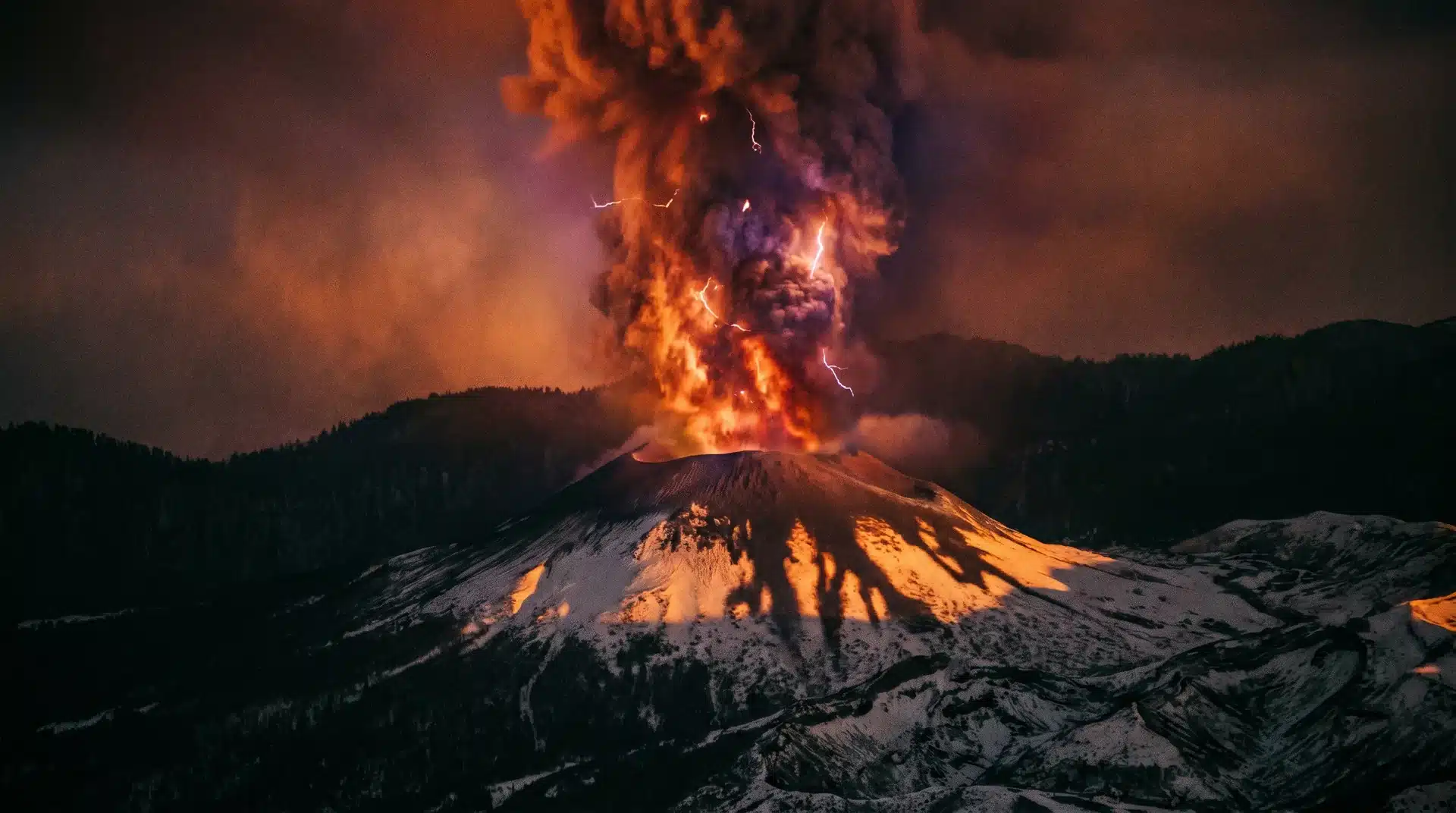
Alt Text: A dramatic night view of a volcanic eruption at Mount Fuji, showing glowing lava erupting from the peak against a dark, smoky sky.
The Hoei eruption began on December 16, 1707, just 49 days after a major earthquake struck the region, and lasted until January 1, 1708.
No lava flowed, but the eruption released an estimated 800 million cubic meters of ash and cinders, burying parts of the surrounding area up to three meters deep, destroying crops, triggering famines, and blanketing what is now central Tokyo, 100 km away, in several centimeters of ash.
The eruption also formed a new crater and secondary peak on the mountain’s southeastern side, now known as Hoeizan.
Mount Fuji has shown no eruption since, though its last recorded signs of volcanic activity occurred in the 1960s, and it is monitored around the clock by the Japan Meteorological Agency.
Climbing Mount Fuji: What You Need to Know Before You Go
Planning to climb Mount Fuji? Before you head out, check current trail conditions, safety regulations, and facility status on the official Mt. Fuji Climbing website. The four climbing trails are Yoshida, Subashiri, Gotemba, and Fujinomiya.
The four climbing trails are Yoshida, Subashiri, Gotemba, and Fujinomiya. Each starts at its own 5th Station, roughly halfway up the mountain, and follows a system of 10 stations to the summit.
- Yoshida Trail: The most popular route, with the most mountain huts and facilities. A round trip takes between 8 and 12 hours.
- Subashiri Trail: A quieter alternative with forest cover in the lower section. It merges with the Yoshida Trail near the 8th station.
- Gotemba Trail: The longest and least crowded route. It starts at the lowest of the four elevations, which means a longer climb, often 10 to 15 hours round-trip.
- Fujinomiya Trail: The shortest route in terms of distance and the closest to the summit from its 5th Station. It is also the steepest.
The official climbing season runs from early July to early September. Outside this window, the trails close due to extreme cold, limited visibility, and the lack of access to mountain huts that provide shelter and supplies during the open season.
Roughly 300,000 people climb Mount Fuji in this eight-week window each year. Many climbers start the ascent the night before and time their arrival at the summit for sunrise, a tradition called Goraiko, meaning “the arrival of light.”
Conclusion
Mount Fuji is one of those rare places that keeps giving the more you look into it. It is Japan’s tallest peak, a three-layer volcano, private religious property, and a mountain where women were once banned for fear of angering a goddess.
These facts about Mount Fuji show the mountain is far more layered than its famous silhouette suggests.
From the 864 CE lava flow that still shapes the landscape today to the legal mystery of its undefined prefecture, there is always something new to learn.
If you are planning a visit or just want to keep reading, check out our guide on things to do near Mount Fuji.
Frequently Asked Questions
How Old Is Mount Fuji?
The mountain’s geological base began forming over 100,000 years ago, though the current cone (Shin-Fuji) is around 10,000 years old.
Why Is Mount Fuji Very Famous?
Mount Fuji is famous for being Japan’s tallest mountain, an active volcano with a near-perfect cone, a UNESCO World Heritage Site, and a symbol of Japan seen in art, religion, and everyday life for centuries.
Is There a Second Mount Fuji?
No second Mount Fuji exists, but several mountains in Japan are nicknamed “local Fujis” for their similar cone shape, such as Yotei in Hokkaido, which is sometimes called Ezo-Fuji.
Who Owns Mount Fuji Now?
The land from the 8th station to the summit is privately owned by Fujisan Hongū Sengen Taisha, a Shinto shrine, and has been since 2004.
Is Mount Fuji Still a Volcano?
Yes, Mount Fuji is still classified as an active volcano by the Japan Meteorological Agency, even though it has not erupted since 1707.