
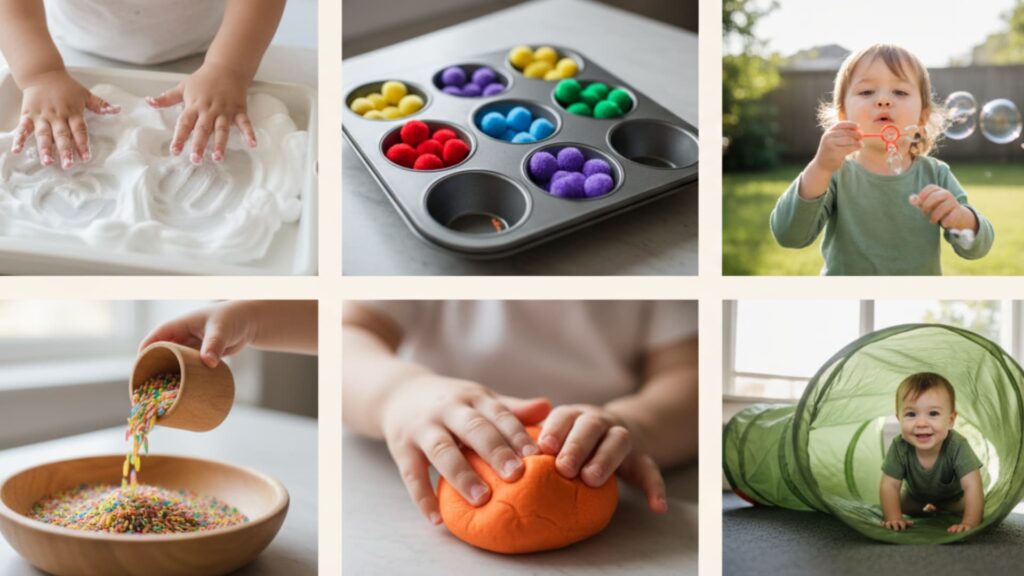
Kids learn best when they get their hands dirty. Literally.
Watch a preschooler drop beans into a bin, shake a jar of rice, or squish cold play-dough for the first time, and you will see it happen in real time.
Their face goes from curious to completely absorbed. That is sensory play doing exactly what it is supposed to do.
Sensory activities for preschoolers are not just a fun way to fill an afternoon.
They build the brain connections children need for focus, language, movement, and emotional control. And most of them take less than five minutes to set up.
Here are ideas, sorted by sense, that you can start using today.
What Are Sensory Activities for Preschoolers?
Sensory activities for preschoolers are hands-on experiences that engage one or more senses, such as touch, sight, sound, smell, taste, balance, and body awareness.
They give children a way to learn about the world not through instructions, but through direct, physical contact with materials, sounds, smells, and movement.
Unlike screen-based activities, sensory play asks the whole body to get involved, which is exactly how preschool-age brains are wired to absorb new information.
Even something as simple as pouring water between two cups counts, because the child is observing, adjusting, and problem-solving simultaneously.
The 7 Senses You Should Know About
Most people grow up learning about the five senses. But children actually use seven during play and daily life. Knowing all seven helps you choose the right activities for what your child needs most.
- Touch (Tactile): The skin detects textures, pressure, and temperature through direct contact with surfaces and materials.
- Sight (Visual): The eyes process color, contrast, movement, and light to help children make sense of their surroundings.
- Sound (Auditory): The ears pick up volume, pitch, and rhythm, which support listening, language, and early reading skills.
- Smell (Olfactory): The nose connects scents to memory and emotion, one of the most powerful sensory pathways in the brain.
- Taste (Gustatory): The tongue detects sweet, sour, salty, bitter, and savory, and plays a big role in how children relate to food.
- Balance (Vestibular): Located in the inner ear, this system helps children stay upright, move with coordination, and feel calm in their bodies.
- Body Awareness (Proprioception): Sensors in the muscles and joints tell the body where it is in space, so children can move, grip, and coordinate without having to watch every action.
Touch Sensory Activities for Preschoolers
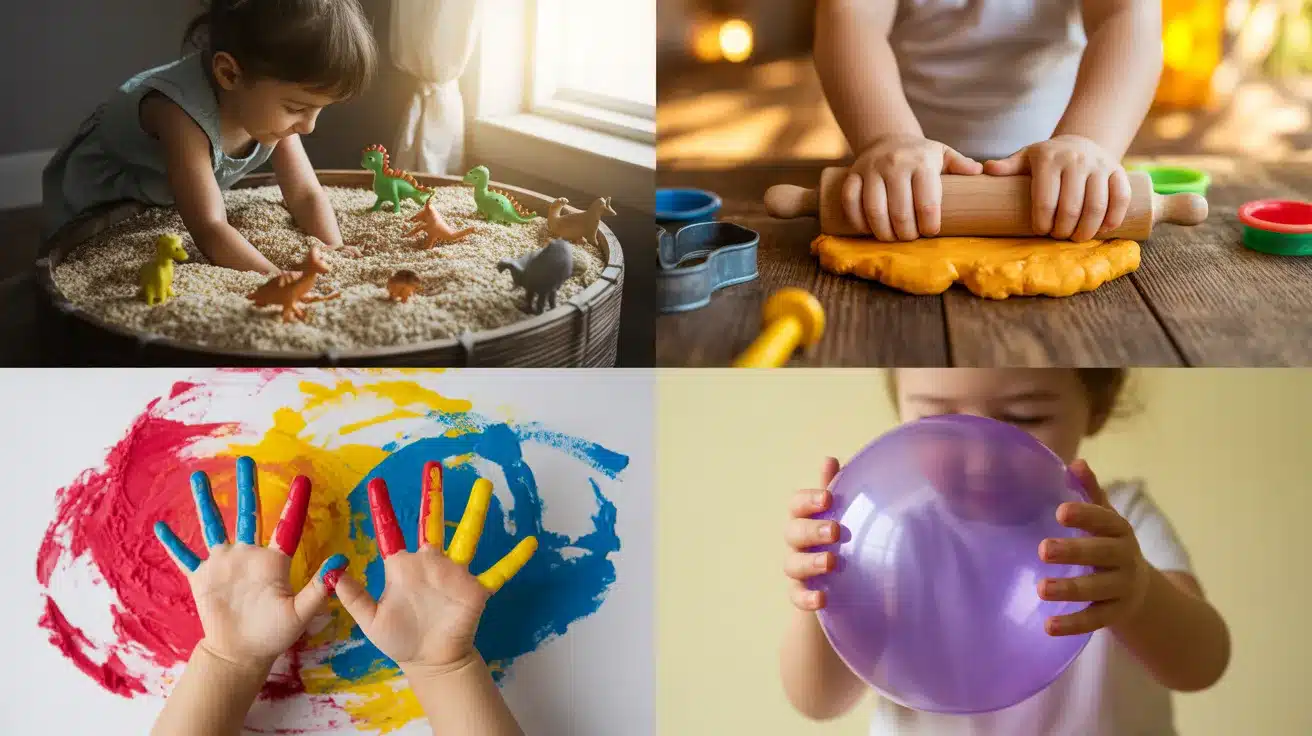
Alt Text: Sensory activities collage with rice play, playdough rolling, finger painting, and a toddler holding a balloon
Touch is usually the first sense children use to explore something new. For preschoolers, tactile play builds hand strength, coordination, and the ability to stay calm and focused. These activities give little hands exactly the kind of input they are looking for.
1. Sensory Bin with Rice or Beans
| What You Need | Details |
|---|---|
| Container | Large plastic bin or storage tub |
| Filler | Dry rice, dried beans, lentils, or cereal |
| Tools | Scoops, small cups, spoons, toy animals |
Fill a plastic bin with dry rice or dried beans and add a few small toys underneath. Let your child scoop, pour, and dig freely. The repetitive motion of scooping is naturally calming and helps with hand control.
2. Play-Doh Sculpting
| What You Need | Details |
|---|---|
| Dough | Store-bought or homemade (flour, salt, water) |
| Tools | Cookie cutters, plastic knives, rolling pin |
| Add-on | A few drops of food coloring or extract |
Give your child a lump of Play-Doh and a few simple tools. Let them roll, flatten, cut, and press without a set goal. The squeezing and pressing motion builds the small hand muscles children need for writing later on.
3. Finger Painting
| What You Need | Details |
|---|---|
| Paint | Washable, non-toxic finger paint |
| Surface | Large paper, a tray, or butcher paper |
| Protection | Old shirt or paint smock |
Lay a large sheet of paper on the floor and pour washable paint into small trays. Children use their fingers, palms, and even feet to spread color across the page. This is one of the most direct forms of tactile exploration available to preschoolers.
4. Shaving Cream Tray
| What You Need | Details |
|---|---|
| Main material | Unscented shaving cream |
| Surface | Baking tray or flat plastic lid |
| Optional | Food coloring mixed in for a color effect |
Spray shaving cream onto a flat tray, then have your child spread it around, draw in it, and press their hands flat into it. Kids can practice letters or shapes, wipe them clean, and start again. It is low prep and genuinely satisfying to touch.
5. Kinetic Sand
| What You Need | Details |
|---|---|
| Sand | Kinetic sand (store-bought or DIY with craft sand and cornstarch) |
| Tools | Small molds, scoops, plastic animals |
| Surface | A tray to contain it |
Kinetic sand sticks to itself but not to hands, making it easy to mold and clean up. Children can build, flatten, and rebuild without frustration. It gives strong tactile feedback without the mess of regular sand.
6. Oobleck (Cornstarch and Water)
| What You Need | Details |
|---|---|
| Cornstarch | 2 cups |
| Water | 1 cup |
| Optional | Food coloring for visual effect |
Mix two parts cornstarch with one part water and watch the confusion begin. Oobleck acts like a solid when you press it and a liquid when you relax your grip. Children are fascinated by this, and the science behind it is real.
7. Texture Boards
| What You Need | Details |
|---|---|
| Base | Thick cardboard or wooden board |
| Textures | Sandpaper, velvet, aluminum foil, bubble wrap, cotton |
| Glue | Strong craft glue |
Cut small squares of different materials and glue them onto a piece of cardboard. Children run their fingers across each one and describe how it feels. This builds vocabulary alongside tactile awareness.
8. Ice Cube Play
| What You Need | Details |
|---|---|
| Ice | Colored with food dye and frozen in trays |
| Container | Shallow bin or baking dish |
| Add-on | Small toys to “rescue” from the ice |
Drop colored ice cubes into a shallow bin and let your child touch, slide, and watch them melt. Add small plastic animals for a rescue game. The cold temperature adds a new layer of sensation that most indoor activities do not offer.
9. Mud Kitchen Play
| What You Need | Details |
|---|---|
| Space | Small outdoor area or large bin |
| Materials | Soil, water, old kitchen tools |
| Optional | Leaves, sticks, small rocks for props |
Give your child an outdoor space with soil, water, old pots, spoons, and containers. Let them mix, pour, and pretend. Mud play is one of the richest tactile experiences available and supports imaginative thinking at the same time.
10. Textured Balloon Squeeze
| What You Need | Details |
|---|---|
| Balloons | Standard latex balloons |
| Fillers | Rice, flour, water, playdough, cornstarch |
| Note | Always supervise to prevent choking if a balloon breaks |
Fill balloons with different materials before tying them off. Each one feels completely different when squeezed. Children love comparing them and will squeeze the same balloon over and over again.
Sight Sensory Activities for Preschoolers
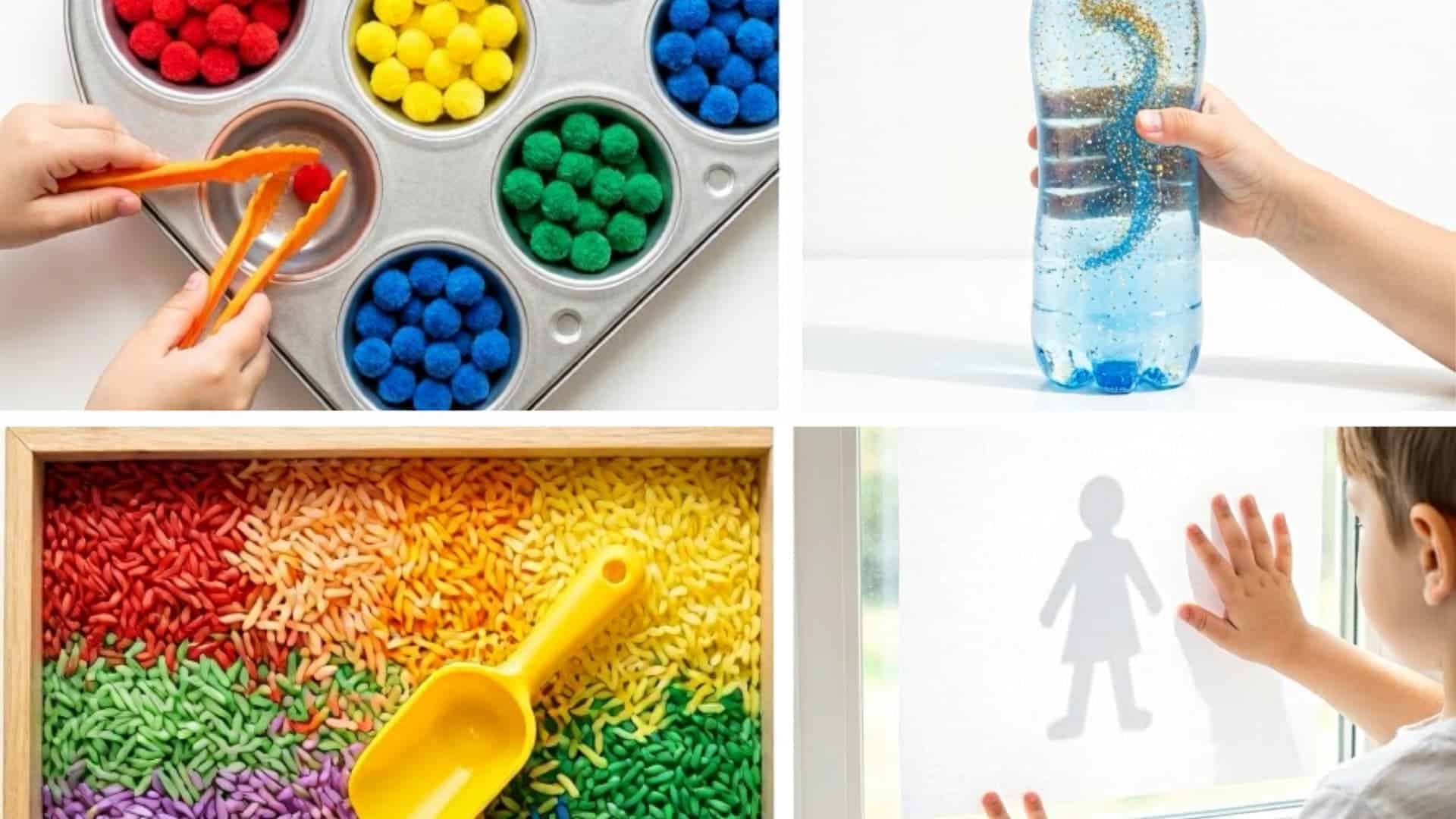
Alt Text: Sight sensory activities with pom-pom sorting, glitter bottle, colored rice bin, and shadow play on a window
Visual-sensory play goes well beyond just looking at things. It teaches children to spot differences, sort by color, track movement, and notice patterns. These skills connect directly to early math and reading readiness.
11. Color Sorting with Pom-Poms
| What You Need | Details |
|---|---|
| Pom-poms | Assorted colors, multiple sizes |
| Sorter | Muffin tin, ice cube tray, or labeled cups |
| Tool | Child-safe tongs or tweezers |
Place a muffin tin in front of your child and a pile of mixed-color pom-poms. Ask them to sort by color. Add tongs for an extra challenge that also builds the hand strength needed for a pencil grip.
12. Sensory Calm Bottle
| What You Need | Details |
|---|---|
| Bottle | Clear plastic bottle with a secure lid |
| Filling | Warm water, glitter glue, fine glitter |
| Seal | Strong adhesive or hot glue around the cap |
Fill a clear plastic bottle with warm water, glitter glue, and a few drops of dish soap. Seal it tightly. When shaken, the glitter swirls and slowly settles. Children often use these to calm down after a big feeling.
13. Light Table Exploration
| What You Need | Details |
|---|---|
| Light source | Commercial light table or DIY bin with fairy lights |
| Objects | Colored transparent tiles, tissue paper, plastic gems |
| Surface | Frosted or white plastic lid to diffuse light |
Place a light table on a low surface. Set out translucent objects like colored beads, tissue paper, or plastic shapes. Children arrange and rearrange while the light changes everything they see. A DIY version works just as well with a storage bin and fairy lights beneath a white plastic lid.
14. Rainbow Rice Bin
| What You Need | Details |
|---|---|
| Rice | Uncooked white rice |
| Dye | Food coloring mixed with rubbing alcohol |
| Tools | Small cups, spoons, funnels |
Dye uncooked rice with food coloring and rubbing alcohol, then spread it out to dry. Once dry, layer different colors in a clear bin. Children run fingers through it, sort by color, or fill and pour with small cups.
15. Shadow Tracing
| What You Need | Details |
|---|---|
| Objects | Small toys, blocks, household items |
| Paper | White paper or cardstock |
| Light | Natural sunlight near a window |
Place a toy or household object near a sunny window. Trace its shadow on white paper. Come back an hour later and trace again. Children are surprised to find the shadow has moved, and this opens up a real conversation about light and time.
16. Colored Ice Painting
| What You Need | Details |
|---|---|
| Ice | Watercolor paint frozen in trays |
| Paper | Thick white paper or watercolor paper |
| Surface | A tray to catch drips |
Freeze watercolor paint mixed with water in an ice cube tray. Give children white paper and let them drag the melting cubes across it. The color bleeds and blends as the ice melts, creating results they cannot fully predict.
17. Mirror Play
| What You Need | Details |
|---|---|
| Mirror | Acrylic safety mirror (unbreakable) |
| Add-ons | Colorful scarves, plastic toys, and wooden blocks |
| Setup | Floor level for best reflection angle |
Lay a small mirror flat on the floor and place toys around and on top of it. Children look at the reflections, try to pick up what they see, and notice that things look different from above. Adding colorful scarves or translucent objects makes this even more visually interesting.
18. Bubble Play
| What You Need | Details |
|---|---|
| Bubble mix | Commercial or homemade (dish soap and water) |
| Wands | Various shapes and sizes |
| Space | Outdoor area or large indoor space |
Blow bubbles outdoors and let children chase and pop them. Use different bubble wands to see how the shapes change. Ask them to describe what they see inside each bubble before it pops. This builds observation skills without any formal instruction.
Sound Sensory Activities for Preschoolers
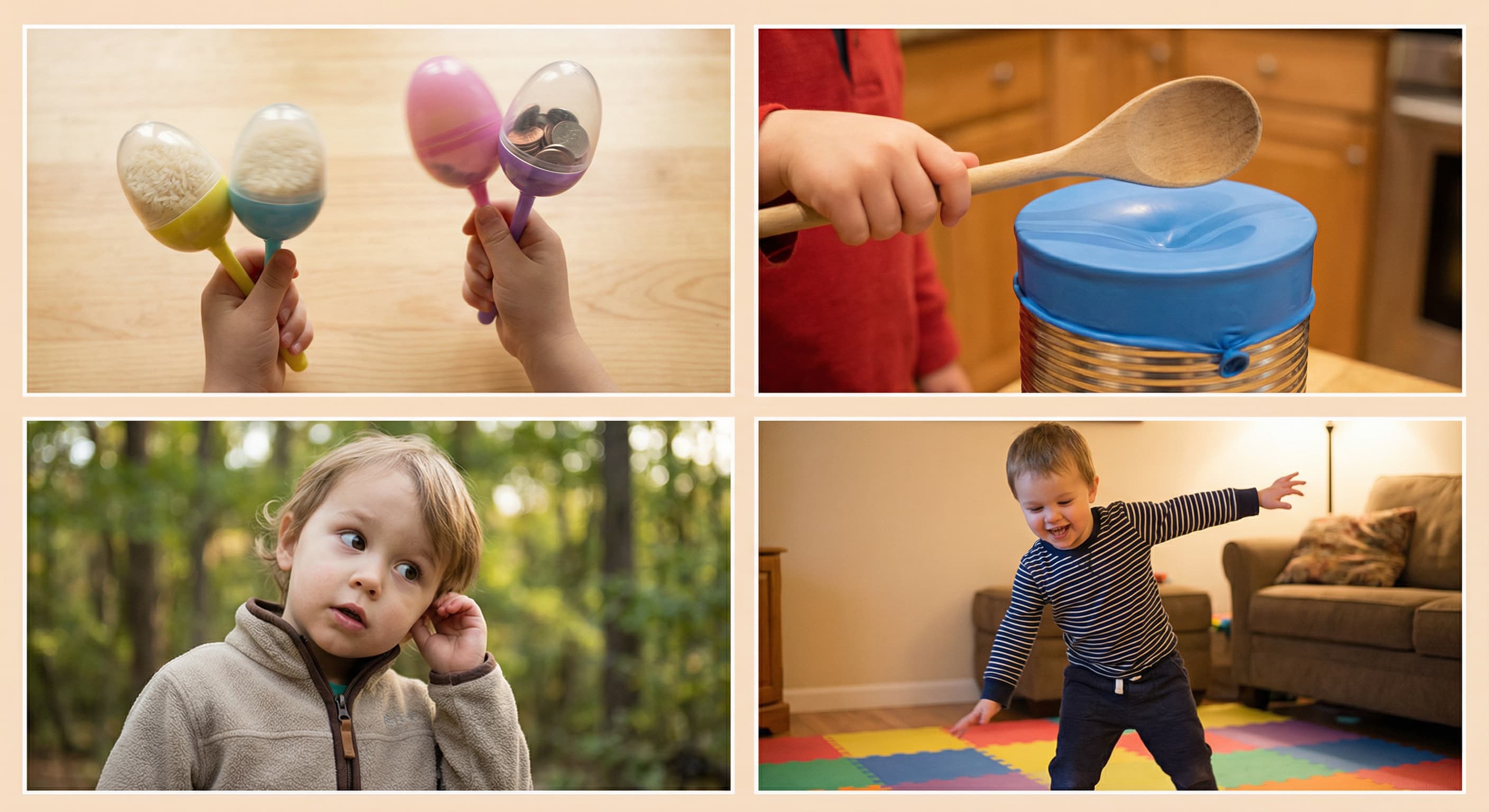
Alt Text: Sound sensory activities for kids using homemade shakers, tapping drums, listening outdoors, and playful movement at home
Listening is a learned skill, and preschoolers are at the perfect age to start building it. Auditory sensory play trains children to notice, compare, and respond to different sounds, which directly supports language development and later reading readiness.
19. Homemade Shakers
| What You Need | Details |
|---|---|
| Containers | Empty spice jars, plastic eggs, film canisters |
| Fillers | Rice, coins, dried beans, pebbles, beads |
| Seal | Tape or glue to keep lids secure |
Fill small containers with different materials and seal them. Give a few to your child and let them shake away. Ask which one is loudest, which is softest. This simple comparison teaches children to listen with attention.
20. Sound Matching Game
| What You Need | Details |
|---|---|
| Containers | Same containers in pairs (e.g., 6 plastic eggs = 3 pairs) |
| Fillers | Same material in each pair (rice in pair 1, coins in pair 2) |
| Cover | Wrap or paint so children cannot see the contents |
Make two of each shaker with identical fillings. Mix them all up and ask your child to shake and find the matching pair by sound alone. This builds auditory memory and focus at the same time.
21. DIY Drum Set from Tin Cans
| What You Need | Details |
|---|---|
| Cans | Empty tin cans with smooth edges |
| Drumhead | Balloons stretched and secured with rubber bands |
| Sticks | Wooden spoons or dowels |
Cover the open tops of empty tin cans with balloon sheets stretched tight and secured with rubber bands. Give your child a wooden spoon and let them compare the sounds each can make. Place different amounts of rice inside some cans for an extra sound variation.
22. Nature Sound Walk
| What You Need | Details |
|---|---|
| Location | Any outdoor space: backyard, park, or sidewalk |
| Tools | None required; a notebook to record sounds is optional |
| Time | 10 to 20 minutes |
Go outside. Stop every minute or two and listen. How many sounds can your child name? Birds, cars, wind, leaves, their own footsteps. This is a zero-prep activity with real sensory value, and children love feeling like sound detectives.
23. Freeze Dance
| What You Need | Details |
|---|---|
| Music | Any playlist your child enjoys |
| Space | Clear floor area for movement |
| Device | Phone, tablet, or speaker |
Play music and let your child dance freely. Stop the music without warning. Children freeze in place until it starts again. This activity trains auditory attention and body control at the same time.
24. Story Sound Effects
| What You Need | Details |
|---|---|
| Book | Any picture book with varied scenes |
| Sounds | Fully child-generated, no props needed |
| Optional | Simple instruments for added effect |
Read a picture book aloud. At key moments, such as a rainstorm, an animal, or a door closing, pause and ask your child to add the sound. Let them choose what it sounds like. This keeps listening active and adds a creative layer to storytime.
25. Whisper Tube Game
| What You Need | Details |
|---|---|
| Tube | Paper towel roll, wrapping paper roll, or PVC pipe |
| Words | Short, clear words to start |
| Variation | Try two tubes connected with tape for a longer path |
Whisper a simple word into one end of a cardboard tube. Your child listens at the other end. Try different lengths of tube or speak louder and softer. Children are fascinated by how sound changes as it travels.
26. Bell Obstacle Course
| What You Need | Details |
|---|---|
| Bells | Small jingle bells on a string or ribbon |
| Path | Chairs, doorways, or a hallway |
| Challenge | Narrow the path or add more bells as skill improves |
Hang small bells along a simple indoor path at child height. Ask your child to walk through without making them ring. This requires slow, deliberate movement and careful listening, which builds body control alongside auditory focus.
Smell Sensory Activities for Preschoolers
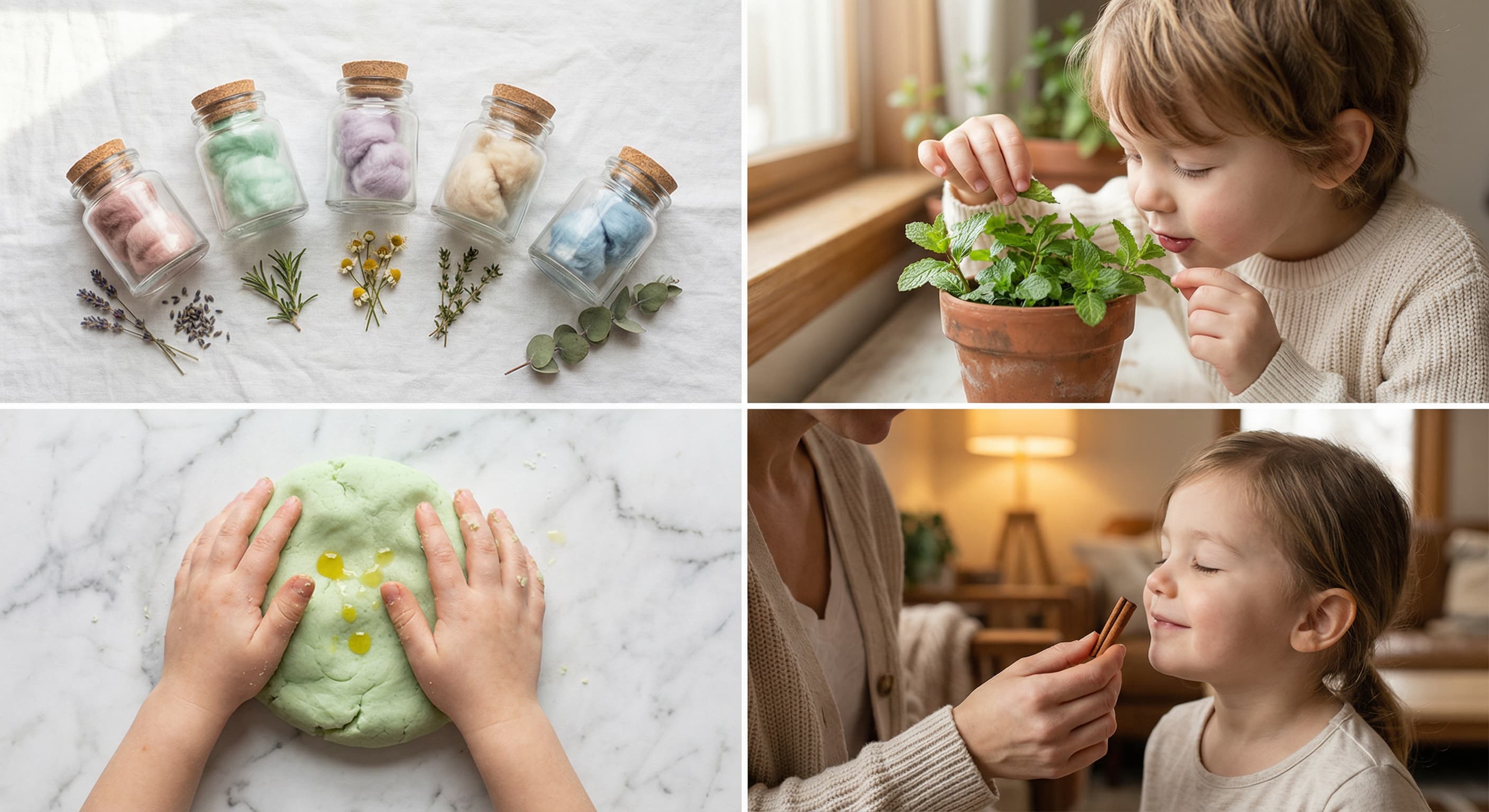
Alt Text: Smell sensory activities with scent jars, a child smelling herbs, scented playdough, and a child enjoying cinnamon sticks
Smell is one of the most overlooked senses in preschool play. But it is also one of the most closely associated with memory and emotion. Smell-based activities build vocabulary, teach children about nature and food, and create surprisingly strong recall.
27. Scent Jars
| What You Need | Details |
|---|---|
| Jars | Small glass or plastic jars with lids |
| Scents | Vanilla, lemon, peppermint, lavender extracts or oils |
| Cotton | Cotton balls to absorb the scent |
Soak cotton balls in different extracts or essential oils, then place each in a small jar. Let children open, sniff, and name each scent. Simple and low-cost, this activity works well for building descriptive language.
28. Scent Matching Pairs
| What You Need | Details |
|---|---|
| Jars | An even number of identical small containers |
| Scents | Two cotton balls with identical scents per pair |
| Cover | Keep jars visually identical so only smell guides the match |
Make two jars for each scent. Mix them all up and ask your child to sniff and find the matching pairs. This adds a memory and focus challenge on top of the olfactory experience.
29. Herb Garden Touch and Smell
| What You Need | Details |
|---|---|
| Herbs | Mint, basil, rosemary, lavender (easy to grow in small pots) |
| Setup | Windowsill or small table outdoors |
| Optional | Let children water the herbs themselves |
Set out small pots of mint, basil, and rosemary. Show your child how to gently rub a leaf between two fingers and then smell. Talk about what each one reminds them of. This teaches children that plants have their own smell for a reason.
30. Scented Play Dough
| What You Need | Details |
|---|---|
| Dough | Basic homemade dough: flour, salt, water, cream of tartar |
| Scent | Food-safe extracts like vanilla, lemon, and peppermint |
| Color | Matching food coloring to reinforce the scent association |
Make a batch of plain play-dough and add a few drops of a food-safe extract before kneading. Each batch can have a different scent. Mint, vanilla, and citrus work well. Children get tactile and smell input at once.
31. Blindfold Smell Guessing
| What You Need | Details |
|---|---|
| Items | Common fruits, spices, and vegetables from the kitchen |
| Blindfold | Soft cloth or sleep mask |
| Optional | Keep a record of correct guesses and try again a week later |
Gently blindfold your child, or ask them to close their eyes. Hold common food items close, such as an apple, an onion, a banana, and cinnamon, and see if they can name each one by smell alone. Even if they guess wrong, the conversation that follows is rich with learning.
32. Scented Watercolor Art
| What You Need | Details |
|---|---|
| Paint | Watercolors mixed with a few drops of extract |
| Paper | Thick watercolor paper or cardstock |
| Scents | Vanilla, peppermint, lemon extract |
Mix a few drops of food-safe extract into cups of watercolor paint. Children paint on paper and get a faint scent as they work. It adds an unexpected layer to a familiar activity and keeps children engaged longer.
33. Popcorn Five Senses Activity
| What You Need | Details |
|---|---|
| Corn | Popcorn kernels |
| Equipment | Pot with a lid or air popper |
| Extras | Light butter or salt for tasting at the end |
Pop popcorn together on the stovetop or in a pot. Ask your child to describe each step. What do they hear? What do they smell? What does it look like as it changes? What does it feel like? What does it taste like? This covers all five basic senses in one kitchen activity.
Taste Sensory Activities for Preschoolers
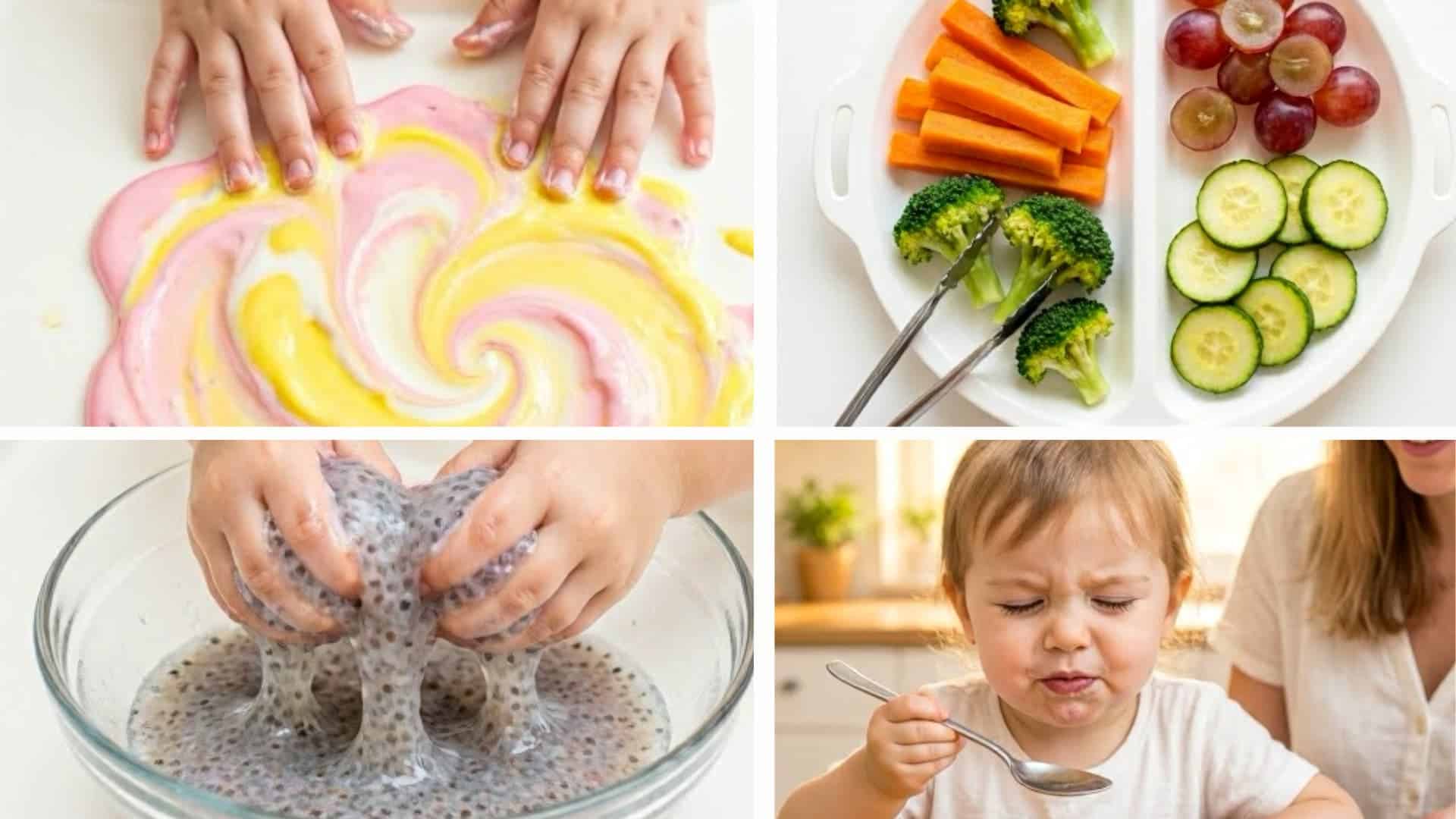
Alt Text: Taste sensory activities for kids with messy play, healthy snacks, chia slime, and a child reacting to flavors
Taste-based play is one of the most natural ways preschoolers connect with food. Research shows that children who play with food first are more likely to try it later. These activities keep things safe and fun while giving children a real sensory experience with what they eat.
34. Edible Finger Paint with Yogurt
| What You Need | Details |
|---|---|
| Paint base | Plain whole-milk yogurt |
| Color | Food coloring in separate small bowls |
| Surface | Baking tray, large plate, or high chair tray |
Mix plain yogurt with food coloring and give your child a tray to paint on. They can use their fingers freely and lick them without worry. This is a good starting point for children who are hesitant about messy activities.
35. Fruit and Vegetable Sorting Tray
| What You Need | Details |
|---|---|
| Produce | 4 to 6 different fruits and vegetables, cut into small pieces |
| Tray | Flat plate, baking sheet, or sectioned container |
| Extras | Small tongs or spoons for sorting |
Set out small pieces of broccoli, baby carrots, grapes, and a cucumber on a tray. Ask your child to sort by color, by shape, or simply by which ones they like. Tasting is optional but often happens naturally during this kind of open exploration.
36. Edible Rainbow Slime
| What You Need | Details |
|---|---|
| Chia seeds | 2 to 3 tablespoons |
| Liquid | Fruit juice or coconut water (multiple colors) |
| Time | Allow 15 to 20 minutes for the chia seeds to swell |
Mix chia seeds into flavored juice or coconut water. The chia seeds swell, creating a gel-like texture that children love to squeeze and stir. Add different colored juices for a rainbow effect.
37. Taste Test Game
| What You Need | Details |
|---|---|
| Sweet | A small piece of a banana or a raisin |
| Sour | A small taste of lemon juice or plain yogurt |
| Salty | A single cracker or a pinch of pretzel |
| Savory | A small piece of mild cheese |
Prepare small tastes of sweet, sour, salty, and savory foods. Blindfold your child lightly and give them one at a time. Can they identify each taste? This teaches children to notice flavor the same way they notice texture and color.
38. Cookie Dough Sculpting
| What You Need | Details |
|---|---|
| Dough | Egg-free edible dough: heat-treated flour, butter, sugar, milk |
| Tools | Cookie cutters, rolling pin, small molds |
| Note | Heat-treat the flour at 350°F for 5 minutes before using |
Make a simple, egg-free edible cookie dough using flour, butter, sugar, and a splash of milk. Let your child press, roll, and shape it freely. Then bake what they create and eat it together.
39. Flavor Water Exploration
| What You Need | Details |
|---|---|
| Water | Plain filtered or tap water |
| Additions | Lemon, cucumber, mint, berries, and orange slices |
| Cups | Clear cups so children can see the infusion |
Fill clear cups with plain water. Add a slice of lemon to one, a few mint leaves to another, and a small piece of cucumber to a third. Let children observe, smell, and taste each over time. Talk about how the flavor changes as it sits.
Balance and Movement Activities
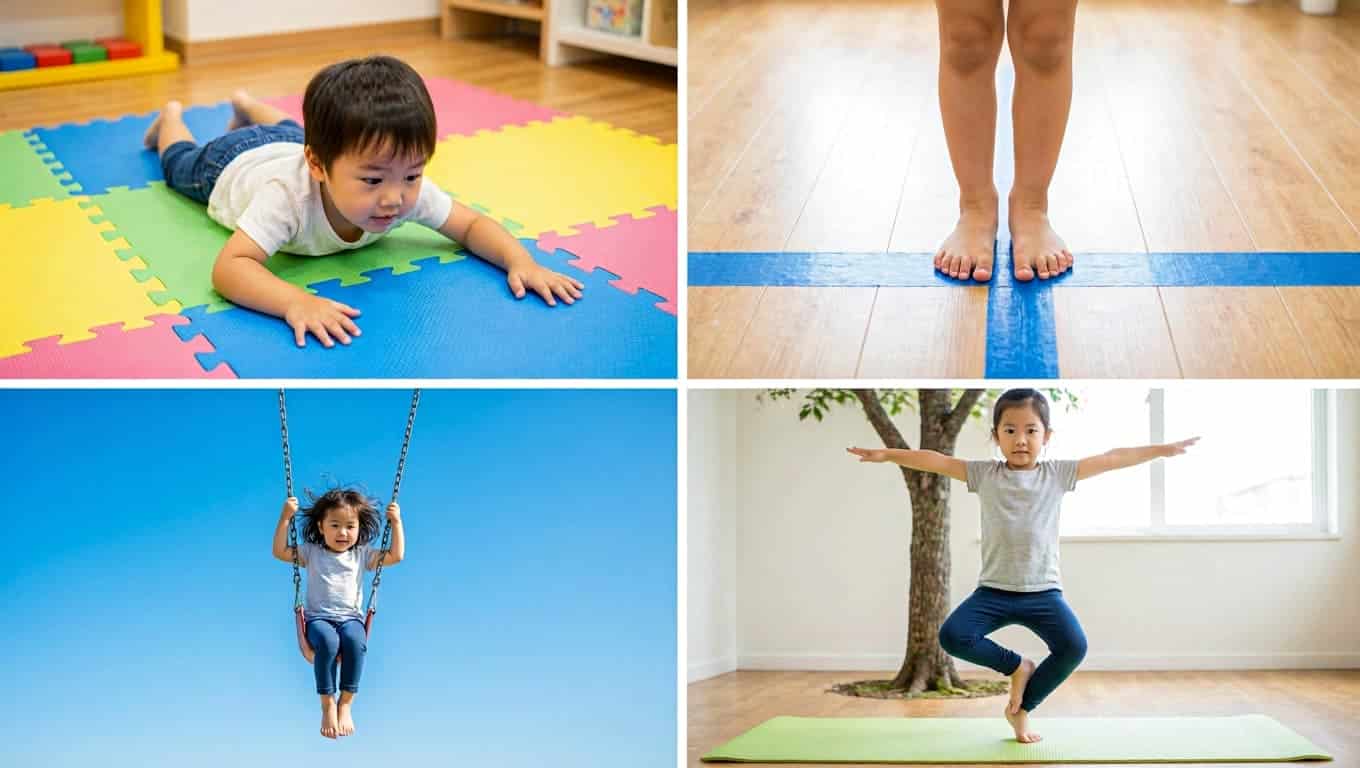
Alt Text: Kids doing balance and movement activities like crawling, line walking, swinging, and yoga for coordination and body control
The vestibular system, located in the inner ear, controls how children sense movement, gravity, and balance. When this system gets regular input through swinging, spinning, and climbing, children are calmer, more focused, and better at controlling their bodies during seated tasks.
40. Animal Walks
| What You Need | Details |
|---|---|
| Space | Clear floor area indoors or outdoors |
| Animals | Bear (hands and feet), crab (belly up), frog (squat and jump) |
| Variation | Time the child or set a start and finish line |
Call out an animal and let your child move like it across the room. Bear crawl for a bear, hop for a frog, waddle for a penguin. Each movement pattern works a different set of muscles and gives the body new coordination challenges.
41. Balance Beam Walk
| What You Need | Details |
|---|---|
| Tape | Masking tape or painter’s tape |
| Floor | Any flat indoor surface |
| Progression | Start straight, then add curves and corners |
Put a strip of tape on the floor in a straight line. Ask your child to walk heel-to-toe without stepping off. Make it harder with curves or zigzags. No equipment needed, and it can go up in difficulty as confidence builds.
42. Outdoor Swing Time
| What You Need | Details |
|---|---|
| Swing | Standard outdoor swing, indoor doorway swing, or sensory swing |
| Time | 10 to 20 minutes |
| Note | Watch for signs of dizziness and stop if the child asks |
Regular time on a swing is one of the most effective vestibular activities available. The back-and-forth motion helps organize the nervous system and makes children feel more settled afterward. Even 10 minutes makes a noticeable difference for many kids.
43. Controlled Spinning
| What You Need | Details |
|---|---|
| Equipment | Sit-and-spin toy or office chair |
| Safety | Slow, steady spins only; stop immediately if child feels unwell |
| Follow-up | A few minutes of walking helps the system resettle |
Let your child sit in a sit-and-spin toy or gently spin on an office chair. Slow and controlled spinning gives the vestibular system input without overwhelming it. Always watch for signs of overstimulation and stop before the child feels dizzy.
44. Bubble Wrap Stomp
| What You Need | Details |
|---|---|
| Bubble wrap | Large sheet, any size bubbles work |
| Tape | Secure the corners so it does not slide |
| Space | Hallway or open floor area |
Tape a large sheet of bubble wrap to the floor. Let your child stomp, jump, and roll across it. The sound of the pops adds an auditory layer to the movement, making it doubly stimulating.
45. Indoor Obstacle Course
| What You Need | Details |
|---|---|
| Items | Couch cushions, pillows, rolled towels, low stools |
| Setup | 5 to 8 steps in sequence |
| Variation | Add a timer or theme such as “you are a spy” |
Use couch cushions, pillows, low chairs, and rolled blankets to create a path for your child to crawl through, step over, and balance on. Change the layout each time to keep the challenge fresh.
46. Ribbon Dancing
| What You Need | Details |
|---|---|
| Ribbon | Long strip of fabric, crepe paper, or a store-bought ribbon wand |
| Music | Any child-friendly playlist |
| Space | Open area to move freely |
Give your child a ribbon tied to a short stick or just held in the hand. Play music and let them move the ribbon freely. The goal is to watch what the ribbon does and follow it with their body. This builds coordination and rhythm.
47. Simple Yoga Poses
| What You Need | Details |
|---|---|
| Space | A yoga mat or soft carpet |
| Poses | Tree, cat-cow, child’s pose, downward dog |
| Guidance | A short kid-friendly yoga video or cards with pictures |
Start with three or four poses: tree pose, cat and cow, and child’s pose. Hold each for a count of five. This builds balance, breathing, and an awareness of where the body is in space.
Body Awareness Activities
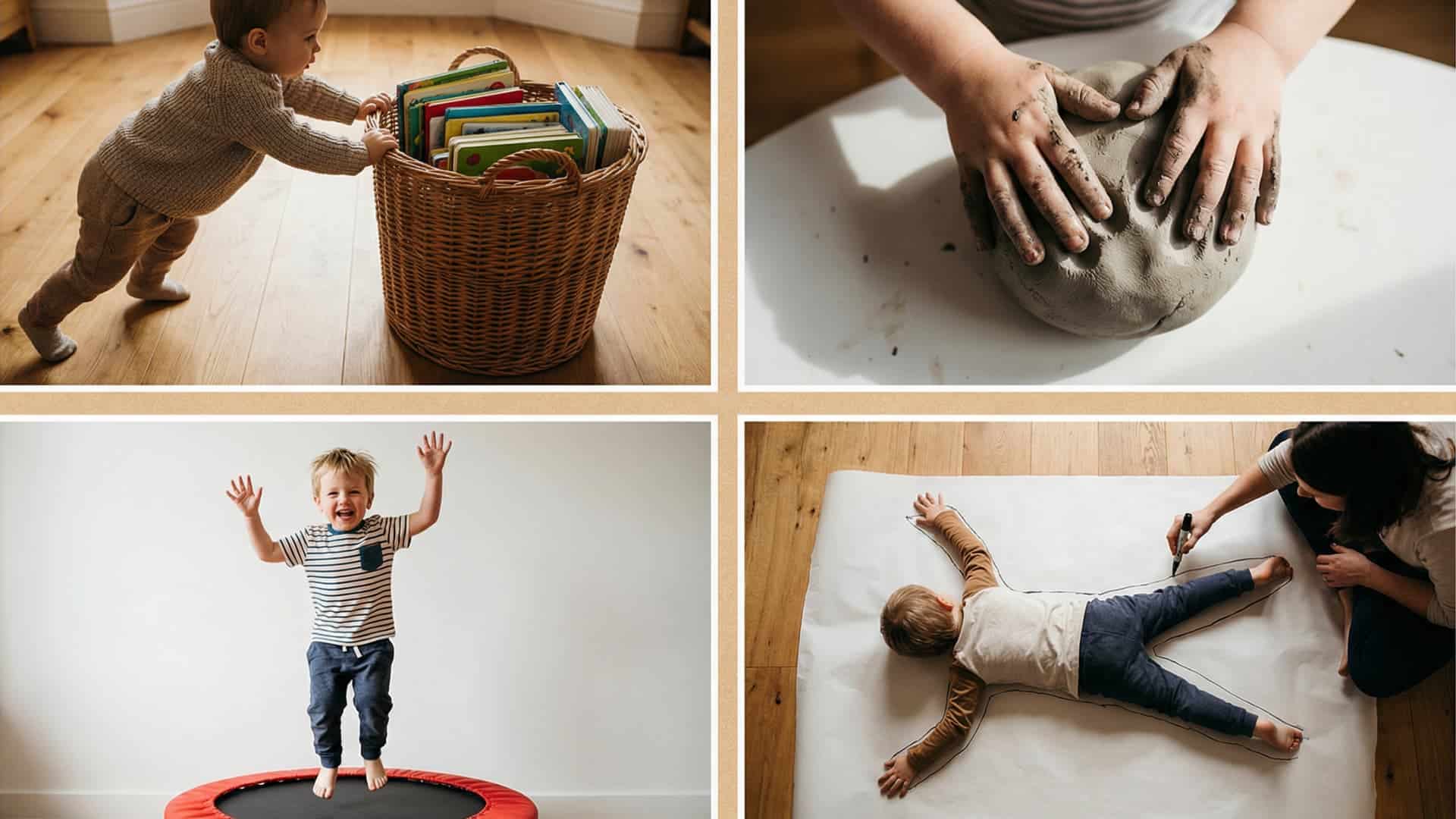
Alt Text: Kids doing body awareness activities like pushing a basket, playing with clay, jumping, and tracing body outlines for coordination and spatial awareness.
Proprioception is the sense that tells the body where it is in space without needing to look. When this system gets enough input, children can button a shirt, hold a pencil with the right amount of force, and move without bumping into everything around them. These activities give the joints and muscles the feedback they need.
48. Push the Laundry Basket
| What You Need | Details |
|---|---|
| Basket | Plastic laundry basket with handles |
| Weight | Books, folded blankets, or soft toys |
| Surface | Smooth floor for easier pushing |
Fill a laundry basket with books, blankets, or stuffed animals. Ask your child to push it from one side of the room to the other. The resistance travels through the arms and shoulders straight into the joints, which is exactly what the proprioceptive system is looking for.
49. Pillow Squish
| What You Need | Details |
|---|---|
| Pillow | Large, firm sofa cushion or floor pillow |
| Pressure | Gentle and steady; always ask the child if it feels okay |
| Note | Stop immediately if the child shows any discomfort |
Ask your child to lie down. Place a large, soft pillow on top and press down gently with your hands. Hold for a few seconds, then release. Many children find this deeply calming. It provides the kind of firm, whole-body pressure that settles the nervous system quickly.
50. Tug of War with a Towel
| What You Need | Details |
|---|---|
| Towel | Bath towel or thick rope |
| Players | One adult and one child, or two children of similar size |
| Safety | Play on a soft surface in case anyone loses their grip |
Grip opposite ends of a rolled-up towel and pull. Keep it playful and let your child win sometimes. The resistance through the arms, shoulders, and core gives the joints strong proprioceptive input and also builds grip strength.
51. Stiff Clay or Playdough Pressing
| What You Need | Details |
|---|---|
| Material | Air-dry clay, cold play dough, or stiff homemade dough |
| Tools | Hands only to start; add tools for more complex work |
| Note | Warm up the cold dough slightly if it is too hard for small hands |
Give your child a stiffer clay or a cold, firm dough. The extra resistance during pressing, rolling, and flattening means the hands and fingers have to work harder, which sends stronger signals to the proprioceptive system than soft dough does.
52. Mini Trampoline Jumping
| What You Need | Details |
|---|---|
| Trampoline | Small indoor toddler trampoline with handlebars |
| Time | 5 to 10 minutes before a quiet activity |
| Safety | Always supervise; use a handlebar model for stability |
Repetitive jumping on a small trampoline is one of the most effective ways to organize the nervous system before a focused task. Many occupational therapists recommend a few minutes of jumping before reading, drawing, or other fine motor work.
53. Carry the Grocery Bag
| What You Need | Details |
|---|---|
| Bag | Reusable grocery bag or small backpack |
| Weight | Light items only: a loaf of bread, a small box |
| Goal | 10 to 20 steps of carrying is plenty |
Let your child carry a small, lightly loaded grocery bag from the car or into the kitchen. The weight in the hands and arms provides proprioceptive input to the joints. Plus, children feel genuinely useful, which matters to them at this age.
54. Body Tracing
| What You Need | Details |
|---|---|
| Paper | Large butcher paper or taped-together sheets |
| Marker | Non-toxic, washable marker for tracing |
| Supplies | Crayons or colored pencils for decorating |
Have your child lie flat on a large sheet of paper. Trace the full outline of their body with a marker. Then let them color it in, label body parts, and decorate it however they like. This connects the name of each body part to its actual location.
55. Crawl Through a Fabric Tunnel
| What You Need | Details |
|---|---|
| Tunnel | Fabric pop-up play tunnel (widely available online) |
| Setup | Flat on the floor with both ends open |
| Variation | Place a toy inside for the child to crawl toward |
A fabric play tunnel gives the whole body a firm squeeze as a child crawls through, which is strong proprioceptive input from head to toe. Children who crave this kind of physical feedback will go through the tunnel again and again without being asked.
How to Set Up a Safe Sensory Play Space at Home?
You do not need a dedicated room or expensive equipment. A plastic storage bin on the kitchen floor, with a mess mat underneath, is genuinely all the setup most families need.
Before you begin, put clean-up supplies within reach: a dustpan, a roll of paper towels, or a small handheld vacuum.
For messier activities like shaving cream or oobleck, a vinyl tablecloth on the floor works better than a fabric mat. Keep the space consistent so your child knows where play happens, and rotate the materials every few days the keep interest fresh.
If you are short on space, a high chair tray works perfectly for smaller tactile activities, and the bathtub is an easy option for anything wet or particularly messy.
Wrapping It Up
Sensory activities for preschoolers do not have to be complicated or perfectly planned.
A bin of rice, a handful of beans, or a homemade shaker can give a 4-year-old everything their brain is asking for in that moment.
The ideas in this list cover all seven senses, so you always have something ready, no matter what kind of day it is.
Start with whatever feels easiest. Try one thing this week. See how your child responds.
Which activity are you going to try first? Drop it in the comments below. We would love to know what works in your home.